
The City Where Time Breathes
While the world often rushes toward the chaotic charm of Marrakech or the industrial pulse of Casablanca, Rabat stands as a sophisticated secret, a city that does not shout but sings. In 2026, the « Capital of Light » has emerged as the ultimate destination for the conscious traveler—a place where avant-garde architecture like the Grand Théâtre meets the salt-crusted stones of the 12th century.
To walk through Rabat is to navigate a living museum. It is a city of « Baraka, » where the Atlantic breeze carries the scent of orange blossoms and the echoes of dynasties past. This guide is not a mere list of monuments; it is an invitation to uncover the hidden pulse of a capital that remains, above all, the guardian of Morocco’s elegance.
The Soul of Rabat – Between Atlantic Whispers and Almohad Echoes
Rabat is not a city you simply visit; it is a city you tame at the pace of the tides and the sun dipping over the Bouregreg estuary. If Marrakech is the beating heart of Morocco, Rabat is its serene spirit—a stone sentinel watching over the Kingdom’s history for millennia.
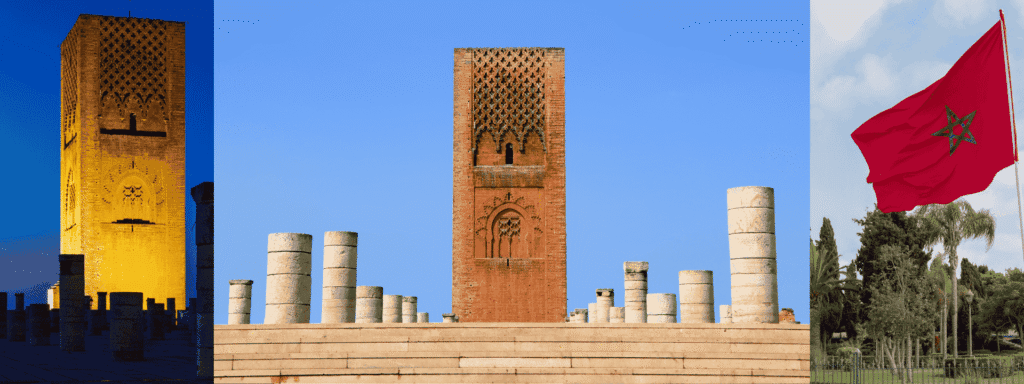
The Enigma of the Hassan Tower: What the Stones Don’t Tell You
Every traveler recognizes the massive silhouette of the Hassan Tower. But few know that this unfinished minaret was destined to be the largest religious structure in both Christendom and Islam in the 12th century.
- The Historical Secret : Sultan Yaqub al-Mansur didn’t just want a mosque; he envisioned a « City of Peace » capable of housing his entire army for prayer. The internal ramps were designed with a specific purpose: they were built wide and gradual so the Sultan could ascend to the summit on horseback. He never wanted to set foot on the ground in front of his subjects, symbolizing a direct, elevated link between the divine and temporal power.
The Necropolis of Chellah: Where Worlds Converge
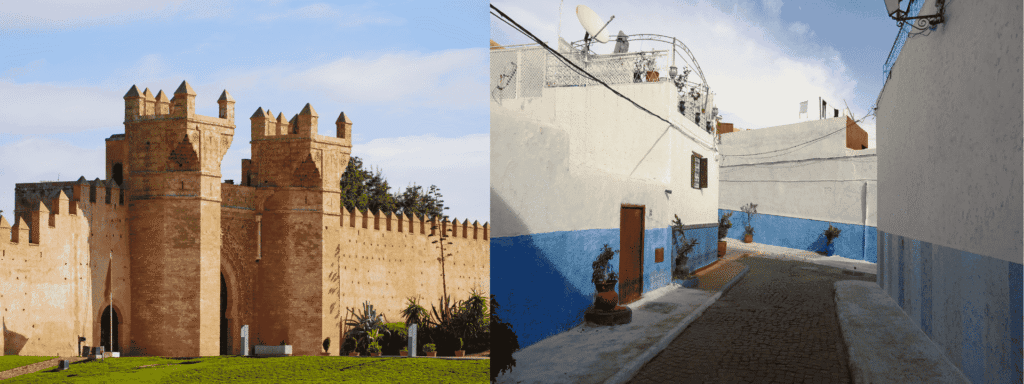
When you step through the monumental gates of Chellah, you aren’t just entering medieval ruins. You are entering a zone of deep spiritual energy where storks have replaced Roman legionnaires.
- The Hidden Fact : Beneath the Roman remains of Sala Colonia, recent excavations suggest the existence of an even older Phoenician trading post. This makes Rabat one of the oldest points of contact between the Orient and the Mediterranean West.
- The Secret Spot : The Sacred Eel Basin. According to local lore, feeding the eels hidden in these dark waters brings fertility and grants your deepest wishes. It is here that ancient animism meets Moroccan spirituality, far from the typical tourist trails.
The Kasbah of the Udayas: The Cobalt Labyrinth
Perched on its rocky cliff, the Kasbah is a village within the city. Its lime-washed blue walls aren’t just for aesthetics; they historically repelled heat and insects, while symbolizing the protection of the heavens.
- The Hidden Detail : Look closely at the door knockers (the khamsa) in the Rue Jamaa. While many feature the « Hand of Fatima, » others display secret geometric patterns that once indicated the owner’s profession—be it a weaver, a sailor, or a scholar.
- The Ultimate Viewpoint : The Platform of the Semaphore. As the sun sinks into the Atlantic, this is where you can truly feel the ghost of the « Republic of Bouregreg »—the small, independent pirate state that defied European fleets in the 17th century.
The Architecture of the Wind and the Secret Arboreal Sanctuaries
Rabat possesses an urban signature unlike any other global capital. It is a city that has masterfully balanced the « Green City » vision with 21st-century audacity. To understand Rabat is to understand how a stone fortress can breathe through its gardens and dream through its steel.
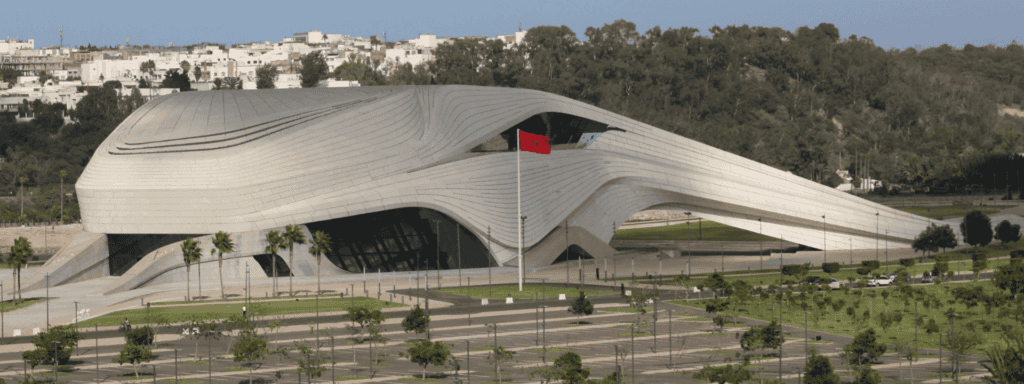
The Grand Theatre: Zaha Hadid’s Frozen Wave on the Bouregreg
Emerging from the left bank of the Bouregreg River like a prehistoric creature rising from the tide, the Grand Theatre of Rabat is the architectural crown jewel of modern Morocco. Designed by the late, legendary Zaha Hadid, this structure is more than a performance space; it is a testament to the « fluidity of movement. »
- The Design Secret : The building’s curves were meticulously modeled to mimic the meandering flow of the river itself. However, the true genius lies in its passive acoustic engineering. The external « skin » of the building was crafted from innovative materials intended to resonate with the Atlantic winds, creating a natural sonorous harmony before a single instrument is even tuned.
- The Untold Ecological Legacy : In 2026, light pollution is a global concern. The Grand Theatre features a « Dark Sky » lighting system. At night, the luminescence is calibrated to a specific frequency that does not disorient the thousands of migratory birds that nest in the Bouregreg Valley, proving that avant-garde design can coexist with delicate ecosystems.
The Botanical Test Garden: Morocco’s Living Laboratory
Nestled in the heart of the administrative district, this 17-hectare sanctuary is the silent lung of the capital. Established in 1914, it is not merely a park but a botanical archive containing over 650 rare species from across the globe.
- The « Secret » Cactus Quadrant : Tucked away in the western corner lies a world of succulents and rare cacti. This was the « Beta-Test » site for 20th-century botanists. Every palm tree you see lining the boulevards of Casablanca or Marrakech likely had its « ancestor » tested right here for climate resilience. It is the genetic blueprint of Morocco’s modern landscape.
- The Whisper of Ancient Science : The central neo-Moorish pavilion once housed a clandestine research center. Local legend says scholars here translated ancient Andalusian pharmacopeia manuscripts, merging medieval herbal wisdom with modern biological science to create the unique flora found in Rabat today.
The Andalusian Garden of the Udayas: A Poem in Sacred Geometry
Entering the garden of the Kasbah is like stepping into a mathematical prayer. Built upon the ruins of ancient palaces, it follows the strict aesthetic codes of the Alhambra in Granada.
- The Invisible Engineering : Look beneath the vibrant orange trees and roses. You will notice a network of small brick channels known as « Seguias. » This gravity-fed irrigation system is a masterclass in hydraulic history. It dates back to the Almohad engineers who understood how to move water through sheer geometry, ensuring that even in the heat of August, the garden remains a humid, cool oasis.
- The Alchemist’s Detail : The placement of the jasmine and datura is intentional. They are positioned near the garden’s « wind tunnels »—small openings in the Kasbah walls—so that as the evening breeze blows in from the sea, it carries the scent through the entire neighborhood, a natural, city-wide aromatherapy.
In the narrow, salt-aired alleys of the Rabat Medina, the most exquisite flavors aren’t found on menus. They are found in the scent of burning oak from the communal ovens and the amber pour of a tea glass in a shaded courtyard. To eat in Rabat is to partake in a centuries-old dialogue between Al-Andalus and the Maghreb.
The Communal Hearth: The Secret Language of Bread
If you want to find the true pulse of a Rabat neighborhood, follow a child carrying a wooden tray covered with a flour-dusted cloth. They are heading to the « Ferran »—the communal wood-fired oven.
- The Hidden Social Code: These ovens are the original social networks of the city. Every family has a unique « signature » or « stamp » cut into their dough—a specific pattern of slashes or a thumbprint—so the baker knows whose loaf is whose.
- The « Secret » Snack : If you find a Ferran, ask for « Khobz be l’msemmen » or simply wait for the baker to pull out a scorched, aromatic loaf. In Rabat, the best bread isn’t sold in shops; it is the one still warm from the Arâr (juniper) wood fire, which gives the crust a smoky, resinous depth you cannot replicate in a modern kitchen.
The Great Tea Accident: A 19th-Century Diplomacy
Moroccans call it « Berred, » but the world knows it as Moroccan Mint Tea. However, the history of how Rabat became obsessed with tea is a fascinating historical fluke.
- The 1854 Secret : Tea wasn’t always the national drink. During the Crimean War in 1854, British merchants were left with massive surpluses of gunpowder green tea. They docked in Tangier and Rabat, desperate to sell. The local elite in Rabat, known for their refined tastes, took this bitter « Northern » leaf and « Moroccanized » it by adding fresh Nâanâa (mint) and heavy cones of sugar.
- The Ritual of the Three Glasses : In the traditional homes of Rabat, you never drink just one glass. There is a proverb for the three servings:
- The first is gentle, like life.
- The second is strong, like love.
- The third is bitter, like death.
To refuse the third glass is to refuse the host’s soul.
Kaab el Ghazal: The Pastry of the Aristocracy
You may have seen « Gazelle Horns » across Morocco, but the ones in Rabat are different. They follow the « Fassi » (Fez) style—thin, translucent, and incredibly delicate.
- The Secret Ingredient : The true Kaab el Ghazal of Rabat uses Meskka (Natural Mastic) and orange blossom water distilled directly from the trees in the Udayas. The dough is rolled so thin it becomes a « skin » for the almond paste, which must be hand-ground with a mortar and pestle to preserve the oil.
- Where to find the « Real » thing : Avoid the tourist stalls. Look for the small, unmarked windows in the Medina near the Rue des Consuls. If you see a line of local women waiting, you’ve found the master baker. These pastries are often made to order for weddings and are rarely displayed for passersby.
The « Amlou » of the North
While Amlou (the Moroccan « Nutella ») is traditionally from the South (Souss), Rabat has a coastal variation. Here, the honey used is often Eucalyptus honey from the Maâmora forest nearby. This gives the almond-and-argan spread a medicinal, cooling finish that is unique to the capital’s breakfast tables.
The Avant-Garde Horizon – Street Art, Sky-High Ambition, and the Atlantic Riviera
For decades, Rabat was whispered about as a « quiet administrative city. » That Rabat no longer exists. Today, the capital is a playground for visionaries, where the tallest spire in Africa pierces the clouds and the city walls serve as canvases for the world’s most daring street artists.
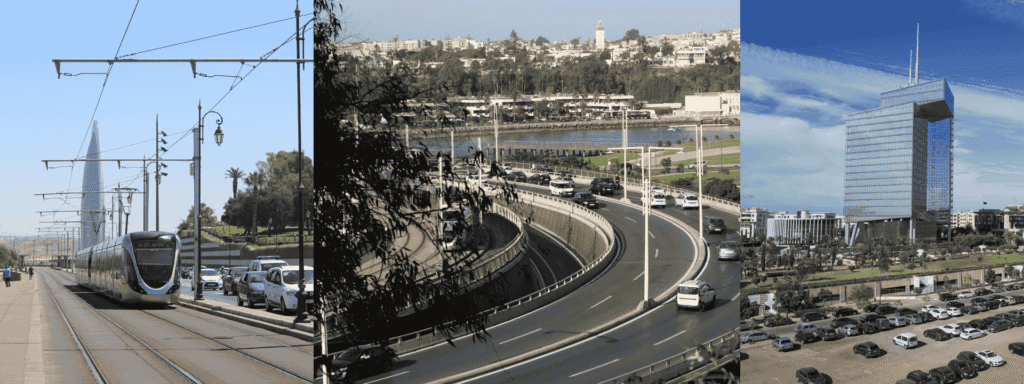
The Mohammed VI Tower: The Lighthouse of the 22nd Century
Dominating the valley of the Bouregreg, the Mohammed VI Tower is not just a skyscraper; it is a 250-meter-tall statement of intent. As the tallest building on the continent, it serves as a futuristic bookend to the ancient Hassan Tower.
- The Engineering Secret : The tower is designed to withstand not just Atlantic gales but seismic activity, using a high-tech « tuned mass damper »—a giant internal weight that counteracts movement.
- The « Green » Truth : It is one of the most sustainable high-rises in the world, covered in 3,350 square meters of solar panels. But here is the detail most visitors miss: the tower’s « skin » is designed to change color based on the angle of the sun, shifting from a pearlescent white to a deep gold, mimicking the changing hues of the Sahara sands.
Jidar: The Walls That Speak
While the Medina walls represent the past, the « New City » walls represent the voice of the youth. Through the Jidar Street Art Festival, Rabat has been transformed into a massive, open-air gallery.
- The Underground Narrative : These aren’t just « murals. » If you look closely at the giant artworks in neighborhoods like Agdal or Massa, you’ll find hidden social commentaries. Moroccan artists like Moha use traditional Berber (Amazigh) symbols disguised within futuristic, psychedelic characters.
- The Secret Walk : The best way to experience this isn’t by car. Start at the Musée Mohammed VI (MMVI)—the first museum in Africa to be powered entirely by solar energy—and walk toward the railway station. You are walking through a curated timeline of Morocco’s contemporary soul.
The Atlantic Riviera: Luxury on the Edge of the World
The coastline of Rabat is moving away from simple beaches toward a high-end « Riviera » lifestyle. From the new Rabat Marina to the cliffs of Harhoura, the Atlantic is being reclaimed.
- The Surfer’s Secret : While everyone heads to Taghazout, the « insider » surf spot is Plage des Nations, just north of the city. In 2026, it has become the weekend retreat for the Rabat elite. The waves here are « cleaner » due to the unique underwater canyon at the mouth of the Bouregreg.
- The Luxury Transformation : The « Corniche » has been redesigned with ecological corridors. You can now walk or cycle from the Kasbah all the way to the lighthouse on paths lined with indigenous coastal flora, designed to protect the shoreline from erosion while providing a « wellness » track for the city’s residents.
The « Underground » Jazz Scene
Rabat’s nightlife is discreet. You won’t find the loud clubs of Marrakech here. Instead, the modern renaissance has birthed a series of « Speakeasy » Jazz bars tucked away in the basements of 1930s Art Deco buildings in the Ville Nouvelle.
- The Insider Tip: Look for the cafes around the Cinema Renaissance. In the evenings, the backrooms often host jam sessions where traditional Gnawa musicians collaborate with modern jazz saxophonists—a fusion sound known as « Rabat-Blue » that is currently the talk of the North African music scene.
The Silent Elegance of Morocco’s Infinite Capital
As the sun sets behind the Atlantic horizon, painting the limestone walls of the Udayas in shades of honey and gold, one truth becomes clear: Rabat does not belong to the past, nor does it wait for the future. It lives in the perfect, sophisticated present.
While other cities in the Kingdom may offer louder spectacles or more frenetic energy, Rabat offers something far rarer in 2026: Balance. It is a city where you can walk through a 12th-century gateway in the morning and attend a world-class opera in a Zaha Hadid masterpiece by evening. It is a place where the scent of ancient wood-fired bread mingles with the salt of the ocean and the ambition of a continent.
To visit Rabat is to realize that the « Capital of Light » is not just a title—it is a feeling. It is the clarity of the Atlantic breeze, the precision of the Almohad stones, and the quiet warmth of a tea ritual shared in a hidden garden.
Morocco Walker’s Final Word: Do not make the mistake of treating Rabat as a mere administrative stopover. Give it your time, and it will give you its secrets. Whether you are lost in the cobalt labyrinth of the Kasbah or gazing up at the solar-powered spires of the new skyline, you are witnessing the soul of a New Morocco—one that respects its ancestors while building a throne for the generations to come.
Morocco walker