

Morocco is a land of two faces. There is the one you see on postcards—the bustling squares of Marrakech and the blue-washed walls of Chefchaouen. But then, there is the Invisible Morocco. This is the country that reveals itself only when the engine stops, the GPS fails, and the pace slows down to the rhythm of a walking heartbeat.
In 2026, as the world moves faster than ever, the true luxury of travel isn’t found in five-star resorts; it is found in the silence of a High Atlas valley, the steam of a remote village hammam, and the shared glass of tea with a shepherd who measures time by the sun.
This guide is not for the tourist in a hurry. It is for the Morocco Walker—the traveler who seeks depth over distance and connection over consumption. Over the next ten chapters, we will journey beyond the asphalt, crossing the threshold of the known to explore the hidden granaries of the Anti-Atlas, the mystical rituals of the Gnaoua, and the secret, windswept reaches of the Atlantic coast.
Leave your expectations at the border. Pack light, walk slow, and prepare to see a Morocco that doesn’t just welcome you, but changes you.
The journey begins now.
- The Call of the Unknown – The Philosophy of Travel in Morocco
- Hidden Treasures of the Atlas – Secret Mountains and Berber Villages
- The Anti-Atlas and the Intimate Sahara – Forgotten Oases and the Deep Desert
- The Savage Coast – Secret Beaches and White Atlantic Towns
- The Spiritual and Mystical Heritage – Sufis, Saints, and Pilgrimages
- Authentic Gastronomy – Beyond Tagine and Couscous
- The Imperial Cities and Their Secrets – Fès, Meknès, and Rabat Differently
- The Art of Local Transport – Mastering the Organized Chaos
- Languages, Traditions, and Savoir-Vivre – Navigating the Moroccan Soul
- The Backpacker’s Toolkit – Budget, Gear, and Safety for 2026
- The Journey Begins
The Call of the Unknown – The Philosophy of Travel in Morocco
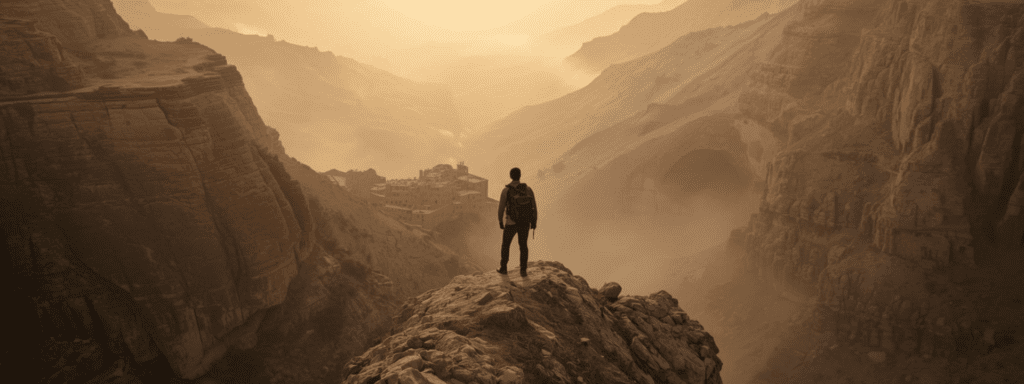
Morocco is a land of profound contrasts, but for many, it remains a collection of carefully curated clichés: the chromatic chaos of Jemaa el-Fna, the leather tanneries of Fès, or the luxury resorts of Agadir. But for the « Morocco Walker, » the true journey begins where the asphalt ends and where the guidebooks stop printing maps.
1. Why Choose the « Invisible » Morocco?
The invisible Morocco is that of the douars (hamlets) perched in the High Atlas, the oases that appear on no GPS itinerary, and the fishing ports where only Darija (Moroccan Arabic) or Tachelhit is spoken. Choosing this path means trading predictable comfort for enriching uncertainty.
- Raw Authenticity : Far from the classic circuits, hospitality is not a commercial transaction but a sacred duty. Moroccan hospitality, Diyafa, takes on its full meaning here.
- Silence and Space : In a world saturated with noise, the desert plateaus of the Anti-Atlas or the cedar forests of the Middle Atlas offer a rare luxury: immensity without a single other tourist on the horizon.
2. Beyond the Clichés: Marrakech, Fès… and then what?
Marrakech and Fès are jewels, but they have become the « staged » windows of Morocco. For the adventurer, these cities are merely gateways.
- « Selfie-Tourism » Fatigue : You don’t come here for the perfect photo, but for the imperfect conversation with a shepherd over a glass of scorching tea.
- The Search for the Deep Morocco : After the effervescence of the medinas, the call of rural Morocco is a need to return to the source. This is where the historical and spiritual heart of the country beats—in lands that watched trans-Saharan caravans and founding dynasties pass by.
3. The « Morocco Walker » Philosophy: Slowness, Immersion, Respect
Traveling as a « Walker » doesn’t necessarily mean walking all the time; it means adopting a state of mind.
» Time is a gift, not a resource to be optimized. «
- Slowness (Slow Travel) : In Morocco, there is no point in rushing. The bus will be late, the tea will take thirty minutes to steep, and the roadside discussion will last an hour. Accepting this rhythm means integrating into the local flow rather than fighting against it.
- Immersion : This means sleeping in gîtes d’étape (trail guesthouses), taking the « Grand Taxi » squeezed between locals and their groceries, and eating where the truck drivers stop.
- Respect : You don’t walk through a Berber village like you walk through a museum. Respecting the dress code, staying quiet near holy sites, and honoring local modesty is the key that opens all doors.
4. Demystifying Fears: Safety and Etiquette
Many travelers hesitate to step off the beaten path out of fear of the unknown. Yet, rural Morocco is often much safer than the major tourist hubs.
- Hospitality as Protection : In the deep Morocco, you are not a « walking wallet »; you are a Dîf (guest). Locals often feel a personal responsibility for your safety.
- Social Graces : Fear often stems from a lack of codes. A simple « Salam Alaykoum » accompanied by a smile and a hand over the heart de-escalates 99% of tense situations.
5. Preparing Your Mind: Opening Up to the Interior
The journey begins in the mind. To live this adventure, you must be ready to:
- Let Go of the Schedule : The most beautiful discoveries in Morocco happen when you get lost or miss your bus.
- Accept Discomfort : Cold showers and nights on thin rugs are part of the folklore. They are the price to pay for memories that money cannot buy.
- Listen More Than You Speak : Morocco has an immense oral tradition. Every old man sitting on a stone wall has an epic story to tell if you take the time to listen.
This guide is not a list of hotels; it is an invitation to drift. We are now going to dive into the rugged ridges of the Atlas for our second stage.
The Atlas Mountains are the spine of Morocco, but most travelers only see the vertebrae nearest to Marrakech. While Mount Toubkal attracts the crowds, the true « Morocco Walker » turns their gaze toward the Central High Atlas and the Middle Atlas, where the peaks are silent and the ancient Berber (Amazigh) way of life remains untainted by the souvenir shops of the plains.
1. The Central High Atlas: Into the Valley of Happiness
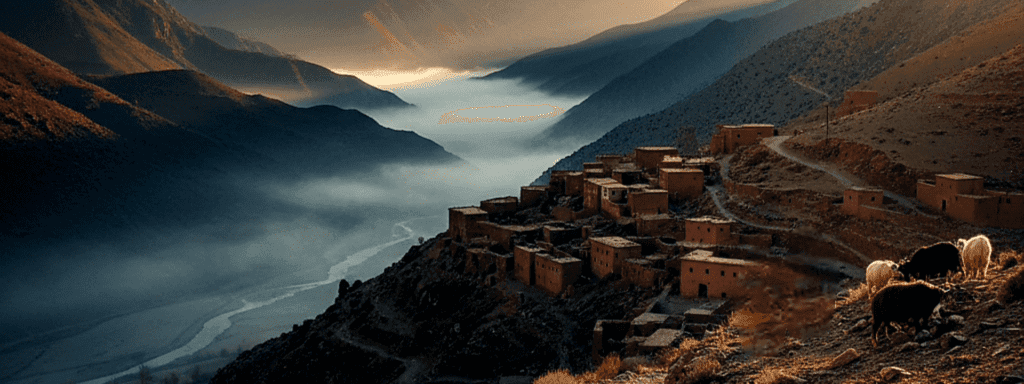
Hidden deep within the folds of the mountains lies the Ait Bouguemez Valley, often called « The Happy Valley. » Accessible only by a winding, vertigo-inducing road, this is a place where time has frozen in the most beautiful way possible.
- The Landscape : Imagine a patchwork of vibrant green terraces—barley, wheat, and apple orchards—framed by the towering, jagged red limestone of the M’goun massif.
- The Architecture : Here, the villages are built of pisé (rammed earth), blending perfectly into the mountainside. The most iconic structure is the Sidi Moussa Marabout, a circular fortified granary perched on a conical hill. It serves as both a storehouse for grain and a shrine for fertility.
- The Experience : There are no « sights » to check off here. The experience is the rhythm: watching women wash clothes in the stream, hearing the call to prayer echo off the canyon walls, and walking through fields where the only sound is the wind.
2. The Middle Atlas: Cedars and Secret Lakes
While the High Atlas is dramatic and rocky, the Middle Atlas is soft, forested, and mysterious. Moving toward Azrou and the area around Ifrane, the landscape shifts.
- The Giant Cedars : This region is home to the largest cedar forests in North Africa. Beyond the famous « Gouraud Cedar » (where most tourists stop to feed monkeys), lies a vast wilderness of ancient trees that have stood for a thousand years.
- The Lake Circuit (Dayets) : Follow the « Route des Lacs » to find Dayet Aoua or Dayet Ifrah. These are volcanic lakes where wild horses graze on the banks and nomadic shepherds set up their black wool tents. In winter, the landscape turns into a snowy wonderland that feels more like Switzerland than Africa.
3. The Agadir: Ancient Fortified Granaries
One of the most profound cultural treasures of the Atlas is the Agadir—the collective granary. These are some of the oldest banking systems in the world.
- The Purpose: For centuries, Berber tribes used these cliffside fortresses to store their most precious belongings: grain, oil, and legal documents (written on wooden tablets). Each family had a locked « cell » within the fort.
- Where to find them : While many are in ruins, some in the Amtoudi or Ait Baha regions are still standing. Climbing the steep paths to reach a granary perched on a 300-meter cliff is a lesson in the resilience and ingenuity of the mountain people.
4. Ethical Trekking: The Code of the Mountains
In these remote regions, your presence as a traveler has an impact. To be a « Walker » is to be a guest, not a consumer.
- Hire Locally : Don’t book your guide in Marrakech. Wait until you reach the village. Hiring a local guide from the valley ensures the money stays in the community and gives you access to stories and paths no agency knows.
- The Tea Ritual : If a family invites you for tea, accept. It is the cornerstone of mountain social life. Remove your shoes, sit where you are directed, and remember that three glasses are the standard: The first is as bitter as life, the second as strong as love, the third as gentle as death.
- Support the Co-ops : Look for women’s cooperatives selling walnut oil or hand-woven carpets. Buying directly from the source is the most powerful way to support the preservation of Berber culture.
5. The Survivalist Spirit: Adapting to the Altitude
Life in the Atlas is hard. The winters are brutal, and the sun is unforgiving.
- The Berber Poncho (Akhnif) : You will see men wearing heavy wool djellabas. These aren’t just clothes; they are survival gear. Take a cue from them: dress in layers and always carry a windbreaker, even in summer.
- Food of the Heights : Forget the fancy salads of the coast. Here, food is fuel. Try Berber Tagine—usually just vegetables and goat meat, slow-cooked over a charcoal fire—and Amlou, a rich paste made of toasted almonds, argan oil, and honey. It is the « Berber Nutella » and the ultimate hiking fuel.
The Atlas is not just a mountain range; it is a fortress of culture that has resisted invasion for millennia. When you walk these paths, you are walking through the living history of North Africa.
The Anti-Atlas and the Intimate Sahara – Forgotten Oases and the Deep Desert
South of the High Atlas lies a landscape that feels like another planet. The Anti-Atlas is Morocco’s « Old West »—a rugged, prehistoric range of purple granite and deep ochre canyons. Beyond it, the Sahara begins, but not the Sahara of the postcards. This is the intimate desert, where the silence is so heavy you can hear your own heartbeat.
1. Tafraout: The Pink Heart of the Granite
Tafraout is the crown jewel of the Anti-Atlas. Tucked into the Ameln Valley, the town is surrounded by massive, rounded granite boulders that glow neon orange at sunset.
- The Painted Rocks : In the 1980s, Belgian artist Jean Verame painted several of these boulders in shades of blue and pink. While controversial to some, they have become a surreal landmark in the middle of the desert scrub.
- The Ameln Villages : Don’t stay in the town center. Walk to the surrounding villages like Oumesnat. Here, traditional houses are built directly into the rock. Visit a « traditional house » museum to see how the ingenious cooling systems and grain storage worked in this harsh climate.
- The Lion’s Face : Look up at the summit of Jebel el Kest; the natural rock formation resembles a lion’s head guarding the valley. It’s a reminder of the animist spirits that many locals believe still inhabit these peaks.
2. The Oasis of Fint: A Cinematic Mirage
Near Ouarzazate, most tourists flock to the movie studios or Ait Ben Haddou. But if you take a rocky track 10 kilometers into the mountains, you find Oasis Fint.
- The Hidden Valley : Fint means « hidden » in Berber, and it earns its name. It is a lush green ribbon of date palms squeezed between black volcanic cliffs.
- The Water System : Watch the Seguias (irrigation channels) in action. This ancient communal water-sharing system is a masterclass in sustainability. Each family gets a specific « time » for water, managed by a village elder.
- The Vibe : This is the place to stop. No WiFi, no shops. Just the sound of the frogs in the river and the smell of mint growing in the shade of the palms.
3. Erg Chigaga: The Silent Sahara
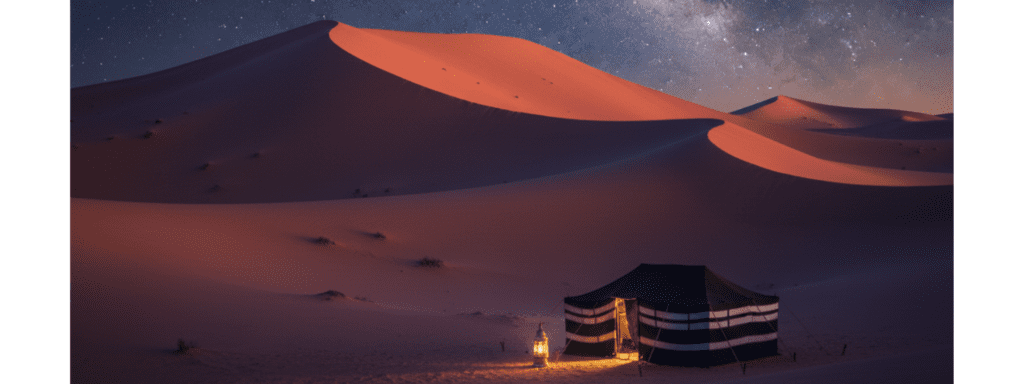
Most travelers go to Merzouga (Erg Chebbi) to see the desert. While beautiful, Merzouga is crowded with quad bikes and luxury camps. For the « Morocco Walker, » the destination is Erg Chigaga.
- The Journey : To reach Chigaga, you must travel 60 kilometers off-road from the village of M’hamid El Ghizlane. This is the « End of the Road. »
- The Dunes : The dunes here are taller and more wild than in Merzouga. Because it is harder to reach, you might be the only person for miles. This is the Sahara of the nomads—the Blue Men of the desert.
- The Nomadic Way : Spend a night with the nomadic families who still graze goats on the fringes of the desert. They don’t live in camps for tourists; they live in khaimas (camel-hair tents). Sitting with them reveals a philosophy of survival where « having nothing is having everything. »
4. The Culture of the Blue Men (Sahrawis)
As you move south, the culture shifts from the mountain Berbers to the Sahrawi people.
- The Dara’a : You’ll see men wearing the Dara’a—a wide, flowing blue robe. It is designed to create a micro-climate around the body, keeping the wearer cool in 45°C heat.
- The Tea Ceremony (Desert Style) : In the desert, tea is even more ritualized. They use more sugar and pour it from a great height to create a thick foam. The foam is said to protect the tea from the blowing sand.
- Sahrawi Music : Listen for the Hassani dialect and the sound of the Tbal (drum) and the Ardin (harp). It’s a haunting, soulful music that speaks of longing and the vastness of the dunes.
5. Survival in the Arid South
The south is beautiful but unforgiving.
- The Chèche (Turban) : The long cotton scarf (Indigo blue or white) is not a fashion statement. It’s a tool. It protects your face from sandstorms, acts as a towel, a pillow, and a water filter in emergencies. Learn to tie it from a local—it’s the first step to being accepted in the south.
- The Argan Tree : You are now in the only place on Earth where Argan trees grow wild. Watch for the famous « climbing goats » in the branches, but focus on the oil. Real south-Moroccan Argan oil, pressed by hand by village cooperatives, is liquid gold for both food and skin.
The Anti-Atlas and the Sahara teach you the value of a single drop of water and the insignificance of human ego. In the shadow of these ancient rocks, you don’t just see the landscape—you feel the weight of time.
The Savage Coast – Secret Beaches and White Atlantic Towns
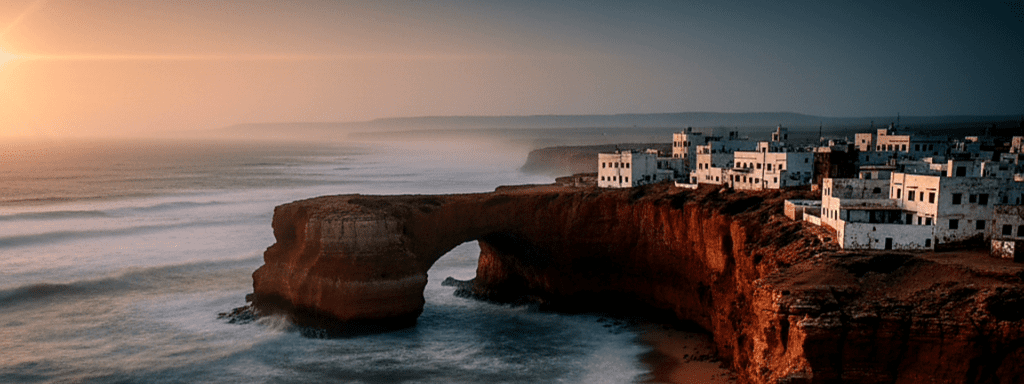
While the Mediterranean coast of Morocco is beautiful, it is the Atlantic Coast that holds the raw, untamed spirit of the « Morocco Walker. » South of the tourist-heavy Agadir and the bohemian Essaouira lies a stretch of coastline where the Sahara meets the sea, creating a misty, salt-crusted landscape of red arches, Art Deco ruins, and fishing villages that time forgot.
1. Sidi Ifni: The Ghost of the Spanish Sahara
Sidi Ifni is one of the most unique towns in Morocco. A Spanish enclave until 1969, it feels like a dream sequence where Andalusia meets the edge of Africa.
- The Architecture : Walk through the town center to see crumbling Art Deco buildings painted in pastel blues and whites. The old Spanish consulate, the cinema, and the lighthouse stand as silent witnesses to a colonial past that has faded into a sleepy, Moroccan pace.
- The Atmosphere : It is often shrouded in La Brume (the sea mist), which gives the town a melancholic, poetic vibe. It’s a place for writers and wanderers who prefer a quiet café and a view of the crashing waves over a bustling souk.
2. Mirleft: The Surfer’s Sanctuary
Just north of Sidi Ifni lies Mirleft, a hilltop village overlooking five distinct beaches hidden between jagged cliffs.
- Legzira Beach : Though its most famous natural stone arch collapsed a few years ago, the remaining arch and the red sandstone cliffs are still a sight to behold. At low tide, you can walk for miles under the towering crimson walls.
- The Trek : Follow the cliffside paths that connect the beaches. You’ll find secret coves where local fishermen live in caves carved directly into the rock. If you bring a few dirhams and a smile, they might just grill some sardines for you on the spot.
3. The Desert Beaches of Guelmim
As you push further south toward the « Gateway to the Sahara » (Guelmim), the road leaves the cliffs and opens up into vast, sandy plains that crash into the ocean.
- Plage Blanche (The White Beach) : This is a 40-kilometer stretch of untouched sand dunes that meet the Atlantic. There are no hotels, no kiosks, and often no people. It is the ultimate destination for those seeking total isolation.
- Fishermen’s Huts : Along this coast, you will see tiny shacks built from driftwood and recycled metal. These are the seasonal homes of Sahrawi fishermen. Their resilience against the salt and wind is a testament to the Moroccan spirit of Sabr (patience).
4. Oualidia: The Azure Lagoon
Heading back north toward Casablanca, you’ll find Oualidia, a serene break from the Atlantic’s fury.
- The Lagoon : Protected by a barrier of rocks, the lagoon of Oualidia is a calm, turquoise haven. It is famous for its oysters, which are considered the best in North Africa.
- The Royal Ruins : On the edge of the lagoon sits the abandoned summer palace of King Mohammed V. While you can’t enter, the sight of the crumbling royal architecture against the backdrop of traditional wooden fishing boats is a perfect « Morocco Walker » moment.
5. Life by the Tide: The Atlantic Way
The Atlantic coast isn’t just a place to swim; it’s a way of life governed by the moon and the tides.
- The Catch : In towns like Safi (famous for its pottery and sardines), the arrival of the fishing fleet is a daily theater. Watch as the blue boats unload silver mounds of fish, and the « auctioneers » scream out prices in a language only the locals understand.
- The Mist : The Chergui (hot inland wind) sometimes battles with the cool Atlantic breeze, creating a thick fog. Locals believe this mist carries healing properties for the lungs.
- The Surf Culture : Unlike the commercialized surf camps of Taghazout, the southern coast offers « soul surfing. » It’s about being alone in the water with nothing but the horizon.
Traveling the savage coast requires a tolerance for salt in your hair and sand in your shoes. It is a place where the grandeur of the ocean humbles the traveler, reminding us that nature—not man—is the true architect of Morocco.
The Spiritual and Mystical Heritage – Sufis, Saints, and Pilgrimages
To understand Morocco, you must look beyond the visible. Beneath the surface of trade and tourism lies a deep, mystical current. Morocco is known as the « Land of a Thousand Saints, » where spirituality isn’t just practiced in mosques, but lived in the streets, through music, and at the tombs of holy men. For this part of the journey is about the soul.
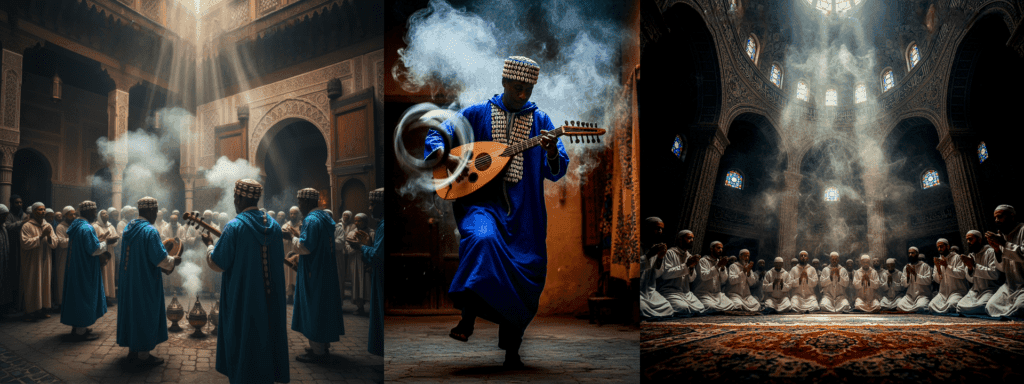
1. Moulay Idriss Zerhoun: The Holy City on the Hill
Perched across two volcanic spurs near the Roman ruins of Volubilis, Moulay Idriss Zerhoun is the most sacred town in Morocco. Until 1912, non-Muslims were forbidden from staying overnight. Today, it remains a place of intense pilgrimage.
- The Founder : The town holds the tomb of Moulay Idriss I, the great-grandson of the Prophet Muhammad and the founder of the first Moroccan dynasty.
- The Experience : The town is a labyrinth of white-washed houses and narrow staircases. Because large tour buses cannot enter the steep streets, it remains remarkably authentic. At the top, you’ll find the only cylindrical minaret in Morocco, adorned with green tiles displaying verses from the Quran.
- The Vibe : There is a heavy, peaceful energy here. Sitting in a café on the main square, watching pilgrims arrive in white robes, you feel the weight of 1,200 years of history.
2. Sufism: The Path of the Heart
While Islam is the religion, Sufism is the mystical heart of Morocco. It emphasizes a direct, personal connection with the Divine through love, poetry, and music.
- The Zaouias : Scattered throughout the country (especially in Fès and Marrakech) are Zaouias—spiritual retreats or lodges associated with different Sufi brotherhoods. While some areas are closed to non-Muslims, the chanting (dhikr) heard from the streets is hauntingly beautiful.
- The Message : Sufism in Morocco is about tolerance and inner peace. It is the reason why Moroccan Islam has historically been a bridge between the East and the West.
3. Gnaoua: Music, Trance, and Healing
Originally brought to Morocco by enslaved people from West Africa (Mali, Guinea, Sudan), Gnaoua music has evolved into a powerful spiritual tool used for healing and protection.
- The Lila : A Lila is an all-night ceremony of music and incense. Led by a Maâlem (Master) playing the Guembri (a three-stringed bass lute), the music uses repetitive, hypnotic rhythms to induce a state of trance (Jadhba).
- The Symbolism : Each rhythm and color corresponds to a different spirit or « entity. » Even if you don’t attend a ritual, seeing Gnaoua performers in their cowrie-shell-encrusted hats in the streets of Essaouira is a connection to a deep, African heritage that predates modern borders.
4. Marabouts and Moussems: The Cult of Saints
Moroccans have a unique relationship with their « Saints » (Marabouts). These were historical figures—teachers, warriors, or hermits—believed to possess Baraka (divine blessing).
- The White Domes : As you travel, you will see small, square white buildings with domes in the middle of nowhere. These are the tombs of saints. Locals visit them to ask for healing, fertility, or protection.
- The Moussems : These are annual festivals held in honor of a saint. A Moussem is part pilgrimage, part carnival, and part trade fair. The most spectacular is the Moussem of Tan-Tan, where desert tribes gather for camel races and « Fantasia » (traditional cavalry displays).
5. Spiritual Etiquette for the Traveler
Navigating Morocco’s spiritual landscape requires deep sensitivity.
- Respecting the « Haram »: Most mosques and active shrines in Morocco are closed to non-Muslims. Never try to enter unless explicitly invited. Respect the boundary—it’s not about exclusion, but about preserving the sanctity of the space.
- The Power of « Insh’Allah »: You will hear « Insh’Allah » (God willing) dozens of times a day. It isn’t just a phrase; it’s a surrender to the idea that humans don’t control the future. Adopting this mindset helps you handle travel delays with a Moroccan smile.
- Photography : Be extremely cautious. Taking photos of people praying or at a saint’s tomb is often seen as disrespectful or a violation of their privacy. Always ask, or better yet, put the camera away and just be there.
Morocco’s spirituality isn’t found in books; it’s found in the smoke of the incense, the vibration of the drum, and the silent prayer of an old woman at a white dome. It is a reminder that the most important part of any journey is the one that happens within.
Authentic Gastronomy – Beyond Tagine and Couscous
In the West, Moroccan food is often reduced to a few iconic dishes. But for the « Morocco Walker, » food is a map of the country’s history—a blend of Berber heartiness, Arab refinement, Andalusian delicacy, and Jewish influence. To eat like a local, you must leave the white tablecloths behind and follow the smoke of the charcoal grills into the heart of the souks.
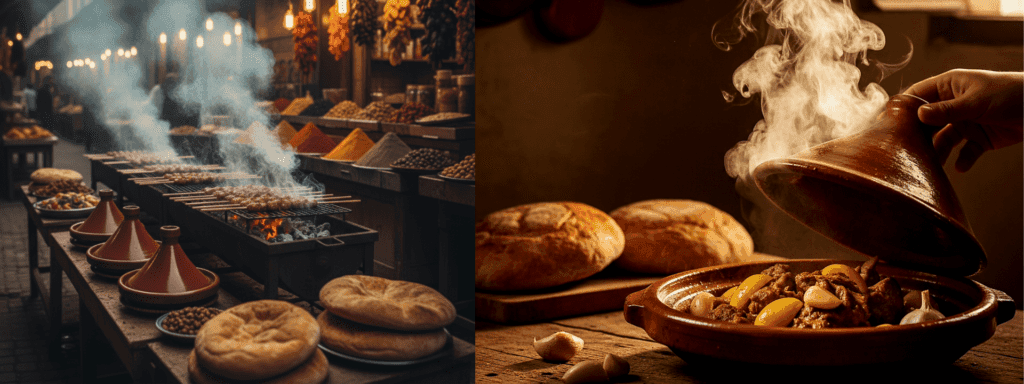
The best food in Morocco is often sold from a cart or a hole-in-the-wall stall.
- Bissara : The breakfast of champions. A thick, creamy fava bean soup topped with a generous swirl of olive oil, cumin, and chili. It’s cheap, filling, and keeps the mountain chill away.
- Maakouda : A spiced potato fritter, often tucked into a piece of crusty bread with harissa (hot pepper paste). It is the ultimate Moroccan « burger. »
- Sfenj : Moroccan donuts, fried on the spot and served hot. They are crunchy on the outside and airy on the inside. Try them dipped in sugar or plain with your morning tea.
- The « Snails » (Babbouche) : You’ll see carts with giant steaming pots. The broth is a medicinal blend of 15 different herbs and spices. It’s an acquired taste, but locals swear by its health benefits.
2. Tanjia Marrakchie: The Bachelor’s Stew
While everyone knows Tagine, few know the Tanjia.
- The Ritual : This is a dish traditionally prepared by men. Meat (usually lamb or beef), preserved lemons, garlic, saffron, and smen (fermented butter) are packed into an earthen clay jug.
- The Oven : The jug isn’t cooked on a stove. It’s taken to the local Fernatchi—the man who heats the water for the public hammam. He buries the Tanjia in the hot ashes for 6 to 12 hours. The result is meat so tender it falls apart at the touch of a piece of bread.
3. Regional Secrets: From Medfouna to Pastilla
Every province has its « signature » that you won’t find elsewhere.
- Medfouna (Berber Pizza) : Found in the desert regions of Rissani and Erfoud. It’s a round bread stuffed with meat, herbs, eggs, and sometimes almonds, then baked in a traditional clay oven.
- Fessi Pastilla : A masterpiece of sweet and savory. Layers of paper-thin ouarka pastry filled with pigeon (or chicken), almonds, cinnamon, and sugar. It takes days to master and is the pride of Fès.
- Saffron of Taliouine : If you pass through the Anti-Atlas, look for the purple crocus fields. This is the highest quality saffron in the world. A tiny pinch transforms a simple dish into a royal feast.
4. The Sacred Tea Ritual (Atay)
In Morocco, tea is more than a drink; it’s a sign of welcome.
- The Blend : It’s a mix of green gunpowder tea, fresh mint (there are dozens of varieties), and a lot of sugar. In winter, they add Cheiba (wormwood) to warm the body.
- The Pour : The tea is poured from a height to create a « crown » of foam in the glass. This oxygenates the tea and shows the host’s skill.
- The Etiquette : Never refuse a first glass of tea. It is considered a rejection of the host’s hospitality. Drink it slowly, enjoy the heat, and let the conversation flow.
5. The « Walker’s » Guide to the Souk
- Follow the Locals : If a stall is crowded with locals and has no English menu, that’s where you want to be.
- The Bread (Khobz) is Holy : You will rarely see forks. Bread is your utensil. It’s used to scoop up sauces and meats. Never throw bread in the trash; if a piece falls, Moroccans often pick it up and kiss it as a sign of respect for God’s bounty.
- Seasonality : Don’t ask for strawberries in December. Eat what is on the carts: prickly pears in summer, pomegranates in autumn, and citrus in winter.
Eating in Morocco is a communal act. It is about sharing a single large plate, sitting low to the ground, and appreciating the Baraka (blessing) of the meal. It is the fuel that will carry you through the labyrinth of the Imperial Cities in our next chapter.
The Imperial Cities and Their Secrets – Fès, Meknès, and Rabat Differently
Most tourists experience the Imperial Cities as a frantic blur of carpet shops and photo ops. But for the « Morocco Walker, » these cities are living libraries. Beyond the famous gates lie hidden gardens, underground prisons, and intellectual sanctuaries that hold the keys to the Moroccan identity.
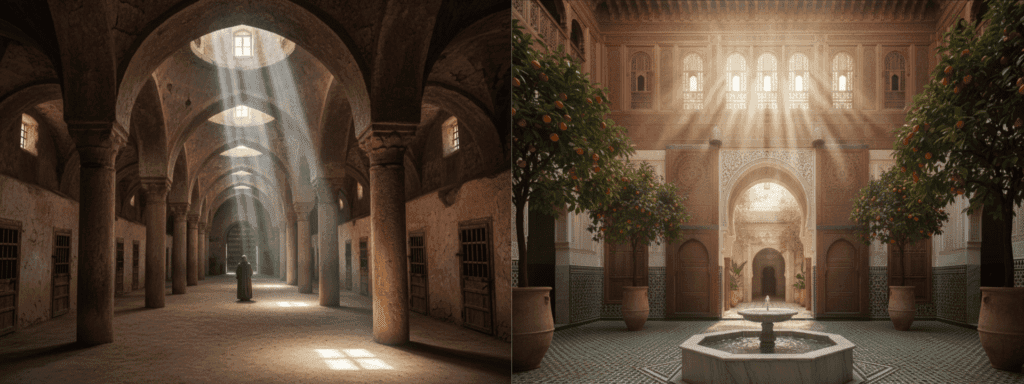
1. Fès El Bali: The World’s Largest Urban Labyrinth
Fès is the intellectual and spiritual capital of the kingdom. It is home to the Al-Qarawiyyin, founded in 859 AD and recognized as the oldest degree-granting university in the world.
- The « Secret » Gardens : When the noise of the 9,400 alleys becomes too much, look for Jnan Sbil. This 18th-century garden was once reserved for the Sultan but is now a lush sanctuary of waterwheels and exotic plants.
- The Medersas (Theology Schools) : While the crowds line up for the Bou Inania, seek out the Medersa Sahrij. It’s quieter, often empty, and features a stunning turquoise pool that reflects the intricate woodwork and zellige (tilework).
- Craftsmanship as Meditation : Find the Place Seffarine, where the rhythm of hammers hitting copper creates a metallic symphony that hasn’t changed in centuries. Watching the artisans isn’t just « shopping »—it’s witnessing a lineage of knowledge being passed down.
2. Meknès: The Forgotten Giant
Often overshadowed by its neighbor Fès, Meknès was the vision of the fierce Sultan Moulay Ismail. It is a city of « Gargantuan » proportions.
- The Underground Prison (Habs Qara) : Deep beneath the city lies a vast subterranean labyrinth. Legend says it could hold 40,000 prisoners. It is cold, eerie, and a stark contrast to the sunny plazas above.
- The Royal Granaries (Heri es-Souani) : These aren’t just barns; they are architectural marvels. With walls 4 meters thick and a sophisticated underground cooling system, they could store enough grain to feed the Sultan’s army for 20 years. The sheer scale of the arches makes it a favorite for photographers seeking « Game of Thrones » vibes.
- The Wine of the Atlas : Meknès is the heart of Morocco’s wine country. Visit the vineyards in the foothills of the Atlas for a tasting—a surprising side of Morocco that many travelers miss.
3. Rabat: The Elegant Capital
Rabat is often dismissed as a « modern administrative city, » but it possesses a refined, Andalusian soul that is much more relaxed than Marrakech.
- Chellah Necropolis : This is where the Roman city of Sala Colonia meets a 14th-century Merenid necropolis. It is now a romantic ruin overgrown with wildflowers and home to dozens of nesting storks. It is perhaps the most peaceful spot in all of Morocco.
- The Kasbah of the Oudayas : While everyone takes photos of the blue streets, walk all the way to the Plateforme du Sémaphore. You’ll have a panoramic view of the Bouregreg River meeting the Atlantic Ocean—a perfect spot to watch the sunset away from the city’s bustle.
- The Museum of Jewelry : Located in the Oudaya gardens, this small museum holds incredible Berber and Sahrawi silver collections that tell the story of tribal identity through adornment.
In the Imperial Cities, you will be approached by « guides. »
- The « Morocco Walker » Way : Learn the « No, thank you » (La, Shokran) with a firm smile and keep walking. In Fès, getting lost is the goal. Each district has five essential elements: a mosque, a hammam, a fountain, a bakery, and a school. Use these landmarks to orient yourself.
- The Art of the Hammam: To truly « see » the city, you must wash in it. Skip the luxury « spa » hammams and go to the local neighborhood one. It is where social barriers disappear, and you’ll experience the authentic ritual of purification.
5. Architectural Language: Zellige and Plaster
As you walk through these cities, pay attention to the details.
- Zellige : The geometric tilework isn’t just decoration; it represents the infinite nature of God. Because Islamic art avoids human figures, mathematics becomes the language of beauty.
- The Riad : The architecture is « introverted. » From the street, you see only plain walls. The beauty is hidden inside, centered around a courtyard. This reflects the Moroccan value of privacy and the idea that true wealth is internal.
The Imperial Cities are not museums; they are functioning organisms. They require patience and a willingness to step off the main thoroughfare into the shadows where the real history is whispered.
The Art of Local Transport – Mastering the Organized Chaos
To be a « Morocco Walker » is to embrace the journey as much as the destination. In Morocco, transport isn’t just about getting from point A to point B; it’s a social theater, a test of patience, and the best way to witness the country’s changing soul. Forget private transfers and domestic flights—the real Morocco is found in the back of a shared taxi or on the rattling tracks of the ONCF.
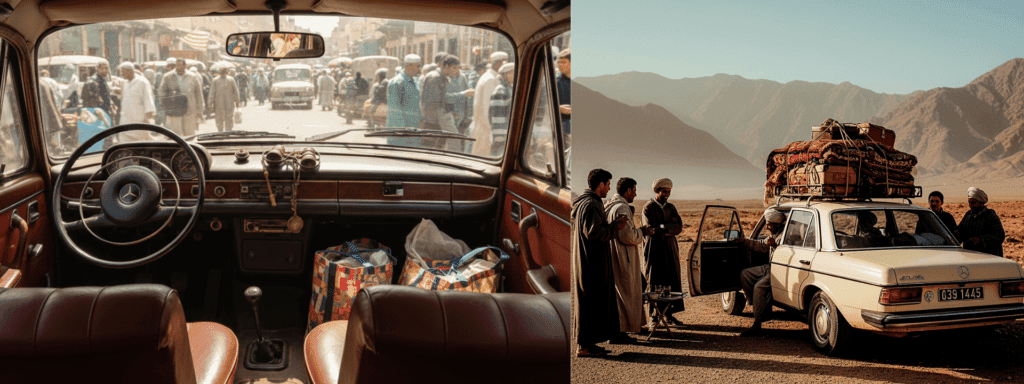
1. The Grand Taxi: The Backbone of the Kingdom
If there is one icon of Moroccan travel, it is the Grand Taxi. Traditionally vintage Mercedes-Benz sedans (and now increasingly modern minivans), these are the arteries of the nation.
- How it works : They don’t follow a schedule; they leave when they are full (usually six passengers). You buy a « seat. »
- The « Walker » Pro-Tip : If you want more space or are in a hurry, you can « buy » two seats or even the whole car. But the true experience is being squeezed between a grandmother with a basket of chickens and a student going home for the weekend. This is where the best travel tips are exchanged.
- Where to find them : Every town has a « Station des Grands Taxis, » usually a dusty lot on the outskirts. Just shout your destination, and a « caller » will point you to the right car.
2. The Train (ONCF): Elegance and Iron
Morocco boasts the best rail network in Africa, including the Al Boraq—the high-speed train that connects Tangier to Casablanca in just over two hours.
- The Experience : Taking the train is the most « civilized » way to travel. The route between Fès and Marrakech is a cinematic masterpiece of rolling hills, olive groves, and distant Atlas peaks.
- Class Culture : First class is affordable and offers air conditioning and reserved seats. Second class is a social hub—expect to share snacks, stories, and perhaps a few photos of your family with your neighbors.
- The Ritual : There is a specific rhythm to Moroccan train travel—the tea vendor walking through the aisles, the sudden naps, and the collective excitement as the train pulls into the red station of Marrakech.
3. The Local Bus: CTM vs. The « Wild » Buses
- CTM and Supratours : These are the « gold standard. » They are reliable, have air conditioning, and you can book tickets online. Supratours is particularly useful because it connects to the train network in places where the tracks end (like Essaouira or the South).
- The « Wild » Buses (Souk Buses) : These are the colorful, often battered buses that serve the rural villages. They are slow, stop every five minutes, and carry everything from tires to livestock on the roof. They are also incredibly cheap and will take you to places no tourist bus would ever go. If you have a day to spare and a strong stomach, take one.
4. Hitchhiking (Auto-Stop): The Law of Hospitality
In rural areas—especially the Atlas and the Deep South—transport can be scarce. Here, hitchhiking is not seen as a « rebellious » act but as a practical extension of Moroccan hospitality.
- The Code : It is common for locals to flag down trucks or private cars. As a foreigner, you will likely be picked up quickly.
- Etiquette : While many drivers won’t ask for money, it is polite to offer the equivalent of a bus fare (Baraka). Often, the driver will refuse, preferring the reward of a good conversation with a traveler.
- Safety : Use your intuition. In rural Berber areas, the code of honor is extremely strong, making it generally very safe.
- The Price : For taxis, the price is fixed per seat on popular routes. For a private « Petit Taxi » within a city, always ask for the meter (le compteur). If they refuse, agree on a price before you put your bag in the trunk.
- Patience as a Virtue : A « ten-minute » delay in Morocco can mean an hour. Don’t fight it. Use the time to observe the street life or have another tea.
- The Language of Transport : Learning a few words like Fin? (Where?), Waqaf hna (Stop here), and Chhal? (How much?) will earn you immediate respect from drivers who are used to tourists who only speak French or English.
Mastering Moroccan transport is like learning a dance. It looks chaotic from the outside, but it has a deep, rhythmic logic. Once you stop trying to control the clock, the road will start revealing its secrets.
You can have the best boots and the most expensive tent, but the most important tool for a « Morocco Walker » is a cultural compass. Morocco is a high-context society where what is unsaid is often as important as what is said. Mastering the « Savoir-Vivre » (the art of living) is the difference between being a spectator and being a guest.
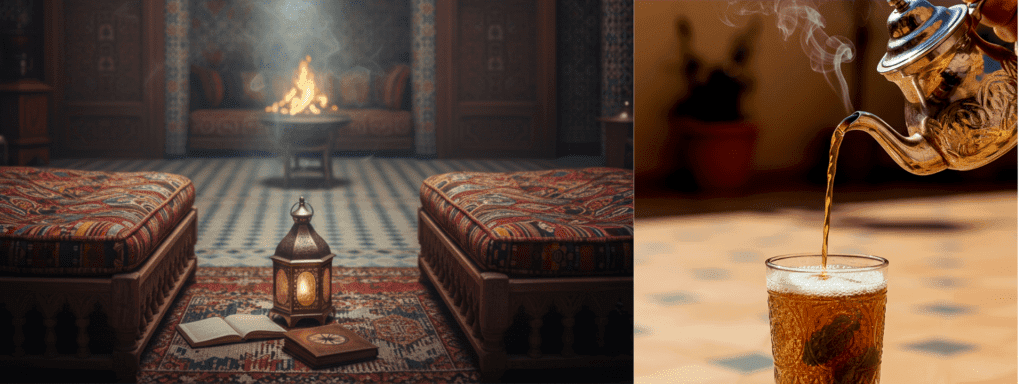
1. The Linguistic Kaleidoscope
Morocco is a polyglot’s dream—and a traveler’s puzzle.
- Darija (Moroccan Arabic) : This is the heart’s language. It’s a spicy mix of Arabic, French, Spanish, and Berber. Even five words of Darija will transform your experience.
- Shokran (Thank you), Labas? (How are you?), and Bsh’hal? (How much?) are your basics.
- The most powerful word? Bismillah (In the name of God). Say it before eating or starting a journey—it’s like a cultural « open sesame. »
- Tamazight (Berber) : In the mountains and the south, this is the ancestral tongue. Using a Berber greeting like Azul (Hello) in a remote village is like a magic key; it signals that you respect their specific identity.
2. The Art of the « Haggle » (The Bargain with Soul)
In the West, we see bargaining as a confrontation. In Morocco, it’s a social contract.
- The Philosophy : To accept the first price is to deny the seller the pleasure of the conversation.
- The Rules : Never start bargaining if you have no intention of buying. Smile, be firm, and use humor. If the price isn’t moving, walk away politely. Often, that’s when the real price is revealed.
- The « Baraka » Price : Remember that for you, 10 dirhams is a coffee; for a rural artisan, it’s a kilo of flour. Bargain for the sport, but pay with a generous heart.
3. « Diyafa »: The Sacred Guest
Moroccans believe that a guest is sent by God. This leads to an hospitality that can feel overwhelming to a Westerner.
- Accepting the Tea : If you are invited for tea three times, you must accept at least once. It is a social ritual of « scanning » the stranger.
- The Right Hand Rule : In traditional settings, always eat with your right hand. The left is reserved for personal hygiene. Even if you are a « Morocco Walker » with a fork in your bag, try to scoop the tagine with bread using your thumb and first two fingers. It shows you’ve done your homework.
4. Modesty and « Saving Face »
Morocco is a conservative society where « shame » (Hshouma) and « honor » are pillars of the community.
- Dress Codes : Outside the beach clubs of Marrakech, modesty is your best friend. For men and women, covering shoulders and knees is a sign of respect. It also protects you from the sun and the dust!
- Public Displays of Affection : Kissing or heavy physical affection in public is generally frowned upon, especially in rural areas.
- The « White Lie » : Moroccans hate to say « no » or « I don’t know » because they don’t want to disappoint you. If you ask for directions and someone looks hesitant, ask a second person. It’s not about honesty; it’s about the desire to be helpful.
5. Navigating « Faux Guides » and Scams
Because the « Morocco Walker » often looks like an easy target, you will face « hustlers. »
- The « Closed Road » Scam : « The road is closed for a festival, follow me. » (Spoiler: The road is not closed).
- The Secret : A firm, polite « La, Shokran » (No, thank you) with a smile and continued walking is 100% effective. If they persist, don’t get angry—anger makes you lose « face. » Use a joke or ask them about their family; it breaks the « predator/prey » dynamic.
6. The Rhythm of « Sabr » (Patience)
In Morocco, things happen Insh’Allah (God willing).
- The bus is late? Insh’Allah. * The shop is closed for prayer? Insh’Allah. * The Lesson: Stop fighting the clock. The beauty of Morocco is that it forces you to exist in the present moment. Once you stop checking your watch, the country starts opening up to you.
Understanding the culture is about realizing that you are a student, not a teacher. Every interaction is a chance to learn about the resilience, humor, and depth of the Moroccan people.
The Backpacker’s Toolkit – Budget, Gear, and Safety for 2026
You have the philosophy, the route, and the cultural keys. Now, it’s time to pack the bag. Traveling the « Walker » way in 2026 requires a blend of old-school ruggedness and modern tech-savviness. Whether you are trekking the lunar landscapes of the Anti-Atlas or navigating the digital nomad hubs of the coast, this is your ultimate survival kit.
1. The 2026 Budget: Traveling Smart
Morocco remains one of the best value-for-money destinations, but inflation and the rise of « boutique » tourism mean you need to plan.
- The « Walker » Daily (300-500 MAD / $30-$50) : This covers dorms or basic gîtes, street food, grand taxis, and plenty of tea.
- The « Comfort » Daily (700-1000 MAD / $70-$100) : This allows for private rooms in Riads, one sit-down restaurant meal, and occasional car rentals.
- Cash is King : While cities are increasingly digital, the « invisible » Morocco runs on paper. Always carry enough Dirhams for three days of travel when heading into the mountains or the desert. ATMs in small towns often run out of cash on Fridays.
2. The Essential Gear List
- The « Two-Bag » System : A 40-50L main backpack (carry-on size is best for Grand Taxis) and a small 10L daypack for water, camera, and valuables.
- The Wardrobe : * Linen and Cotton: Breathable fabrics for the heat.
- The « Emergency » Layer : Even in summer, the desert and the Atlas drop to near-freezing at night. A lightweight down jacket is essential.
- A Sturdy Sarong : It’s a towel, a headscarf, a privacy curtain for hostel beds, and a beach mat.
- Footwear : One pair of trail-running shoes (better than heavy boots for most Moroccan terrain) and one pair of sturdy sandals (like Tevas) for city walking and communal showers.
3. Tech and Connectivity
- The eSIM Revolution : In 2026, physical SIM cards are fading. Download an eSIM (like Airalo or a local Maroc Telecom/Inwi digital plan) before you land. 5G is now standard in major hubs, but expect « Edge » speeds in the deep valleys.
- Power Bank : Essential for long bus rides and nights in mountain gîtes where electricity might be limited to a few hours of solar power.
- Offline Maps : Download the entire Morocco map on Maps.me or Google Maps. The winding alleys of Fès will scramble your GPS, but offline maps are a lifesaver on mountain trails.
4. Health and Wellbeing
- Water : Avoid tap water in the south and rural areas. However, to reduce plastic waste, bring a LifeStraw or a Grayl filter bottle. It allows you to drink safely from any source.
- The « Moroccan Pharmacy » : * Cumin: The local cure for upset stomachs (swallow a spoonful with water).
- Sunblock & Hydration Salts : The Moroccan sun is a silent predator.
- Argan Oil : Buy it locally for skin burns or dryness.
- Hammam Etiquette : Bring your own Kessa (scrubbing glove) and Sabon Beldi (black soap) for the most authentic and hygienic experience.
5. Safety in the Wild
- Solo Travel : Morocco is very safe for solo travelers, including women, but it requires « active » management. Be confident, set boundaries, and arrive in new towns before dark.
- Insurance : Never skip it. Ensure your policy covers « high-altitude trekking » if you plan to go above 2,500m in the Atlas.
- Registration : If heading into the deep Sahara or remote border regions, let your embassy or a local gîte owner know your planned route.
6. The « Walker’s » Final Advice: Leave No Trace
As more people seek the « authentic, » these fragile environments are under pressure.
- Waste : Pack out what you pack in. Many mountain villages have no waste disposal system.
- Respect the Water : In oases, water is life. Never wash with soap directly in a stream or seguia.
- People, not Props : Always ask before taking a photo. A « no » is a no.
The Journey Begins
You are now ready to cross the threshold. Morocco isn’t just a country; it’s a mirror. It will reflect back your patience, your fears, and your openness. If you walk with respect and a slow heart, the « invisible » Morocco will reveal itself to you in ways that no article could ever fully capture.
Safe travels, Morocco Walker. Tariq Salama (Peaceful journey).
– MOROCCO WALKER
[…] forests of ancient firs that drink the Mediterranean mist. To travel here is not to « visit » Morocco; it is to enter an enclave with its own laws of hospitality, its own dialect of Arabic and […]