

The traveler seeking Morocco in the glossy, over-saturated brochures of mainstream travel agencies often ends up swallowed by the electric chaos of Marrakech. But the one they call the « Little Marrakech » is only small in name. Taroudant is a giant of the soul. Nestled in the heart of the fertile Souss Valley, shielded by the formidable ramparts of the High Atlas and the Anti-Atlas mountains, she is the guardian of a secret that only the slow, the curious, and the dreamers ever truly unearth.
- The Arrival: A Collision of Ochre and Indigo
- The Ramparts: A Belt of Clay and Chronicles
- The Architecture of Silence
- The Souk: A Labyrinth for the Senses
- Place Assarag: The Beating Heart
- The Hands of the Souss – A Symphony of Craft and Calloused Palms
- The Gastronomy of the Sun – A Feast of Argan and Fire
- The Secret History – Shadows of the Saadians
- The Beyond – The Oasis of Tiout and the Atlas Giant
- Why You Must Go
The Arrival: A Collision of Ochre and Indigo
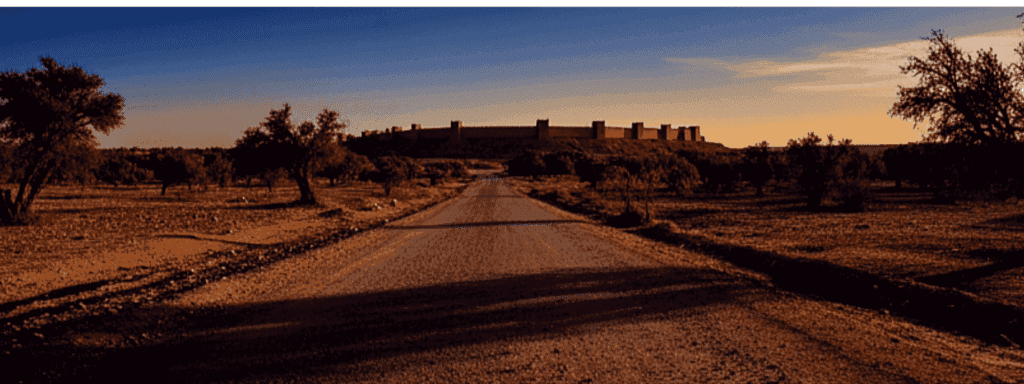
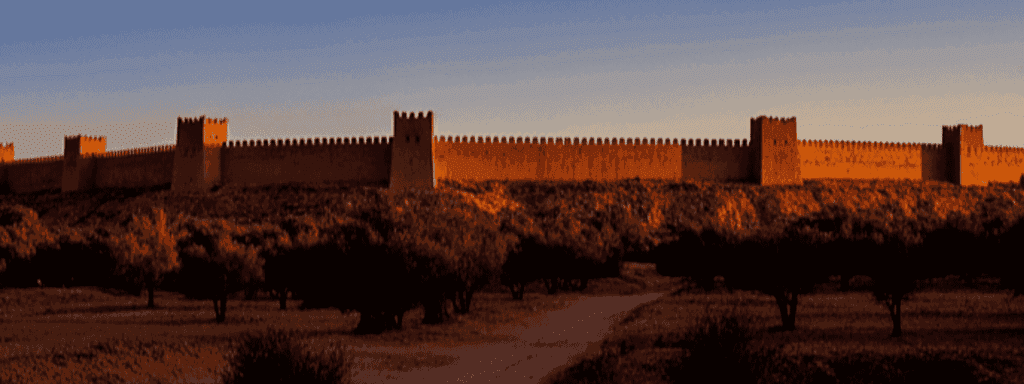
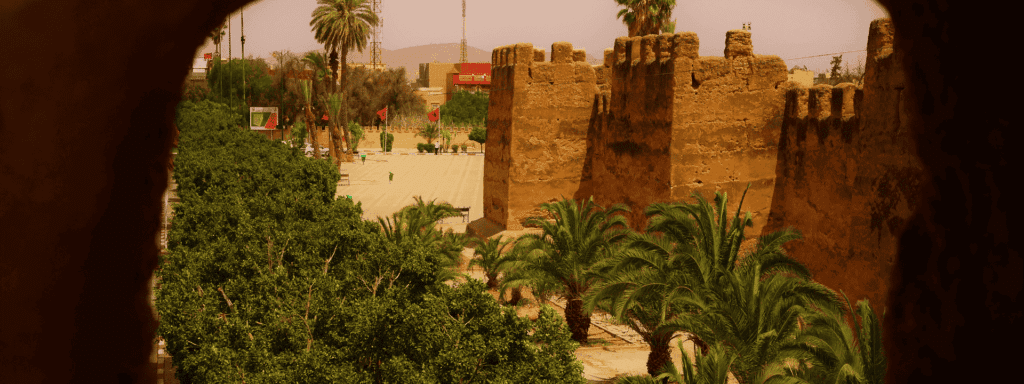
One does not stumble upon Taroudant by accident. You come here because you have consciously decided to veer off the coastal highways of Agadir, turning your back on the Atlantic to plunge into the land of the Argan tree. As the ramparts rise on the horizon, a strange vibration climbs your spine. Six kilometers of crenellated walls, a deep ochre that bruises into purple as the sun begins its slow descent.
This is not a dead city. It is not a museum curated for the Western gaze. It is a living, breathing organism. The walls of Taroudant are not there to impress tourists; they are there to protect a Berber intimacy that refuses to be put on display. Here, there are no aggressive touts, no menus plastered in five languages on every street corner. You enter through Bab Kasbah or Bab Taghzout as you would enter a private home: with a quiet breath and a sense of reverence.
The Ramparts: A Belt of Clay and Chronicles
Picture yourself on a creaking bicycle—the undisputed king of transport here. Circling the ramparts is your first initiation. The earth from which they are built feels as though it still carries the warmth of the Saadian labor of the 16th century, when they made this city their ephemeral capital before the conquest of Marrakech.
Every tower, every bastion whispers of resistance. Resistance against invaders, yes, but more importantly, resistance against oblivion. Beneath the shadows of these towers, children play football, elders debate on stone benches, and the horse-drawn carriages (the famous koutchis) trot to the rhythm of a clock that no longer bothers with minutes.
The Architecture of Silence
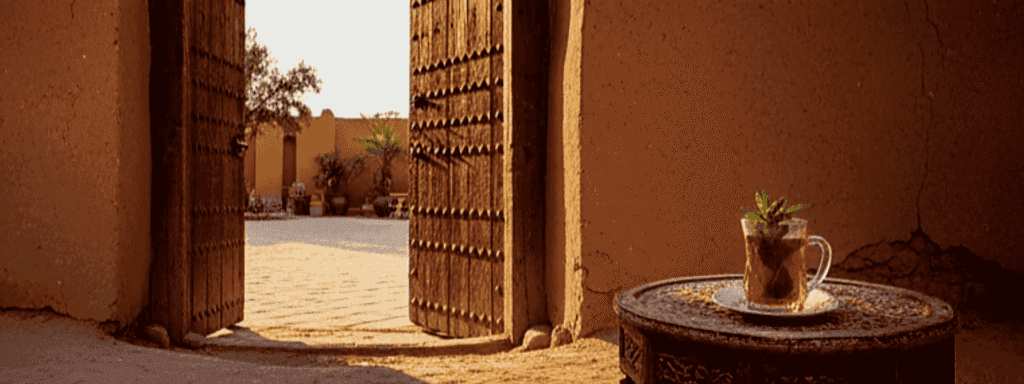
What strikes you in Taroudant is the sheer intelligence of the habitat. The houses do not open their hearts to the street. They fold inward, collapsing into secret patios where the trickle of a fountain dialogues with the glossy leaves of an orange tree. This is the architecture of modesty. To understand the city, one must learn to read between the sun-dried mud bricks, realizing that wealth here is an internal affair, measured in shade and hospitality rather than outward display.
The Souk: A Labyrinth for the Senses
If Marrakech is a theater, the souk of Taroudant is a conversation. It breathes through two lungs: the Arab souk and the Berber souk.
In the former, you witness the alchemy of leather. The babouches here are not plastic-lined souvenirs; they smell of genuine tannin, worked by ancestral methods that defy the rush of the modern world. The sandals of Taroudant are legendary throughout the Kingdom for their durability. You see the artisans bent over their work, their gestures precise, their eyes sharp, superbly ignoring the smartphones attempting to capture their timeless craft.
In the Berber souk, the atmosphere shifts. You come here for spices, for grandmotherly remedies, and above all, for the Saffron of Taliouine. The « Red Gold » is at home here. It is offered in tiny glass jars, and the scent… the scent is haunting. It is the perfume of scorched earth mingled with a medicinal sweetness. It is here you realize that Taroudant is the true crossroads where the mountains meet the desert.
Place Assarag: The Beating Heart
At nightfall, all paths lead to Place Assarag. This is the Roman forum, the Greek agora, the Moroccan living room under the stars. The café terraces fill with men in grey or brown djellabas, sipping mint tea so heavily sugared it becomes a syrup of life.
This is where the magic takes hold. Storytellers, the occasional snake charmer, and most importantly, Gnaoua musicians begin to vibrate the air. The deep thrum of the guembri (traditional bass) and the rhythmic clash of the qraqeb (metal castanets) create a gentle trance. You aren’t watching a show; you are part of a ritual. In Taroudant, no one asks where you are from; they offer you a chair and let you observe the waltz of bicycles and passersby beneath the soft neon glow of the stalls.
The Hands of the Souss – A Symphony of Craft and Calloused Palms
To enter the workshops of Taroudant is to step into a rhythmic, tactile world where the industrial revolution is but a distant rumor. Here, the « Made in Morocco » label isn’t a marketing gimmick; it is a bloodline. The artisans of this city do not merely produce objects; they exhume them from raw materials—hides, silver, and clay—using tools that have remained unchanged since the Saadian sultans walked these very alleys.
The Alchemists of Leather
We begin in the tanneries, located just outside the walls to allow the desert wind to carry away the pungent, organic scent of the trade. Unlike the sprawling, tourist-clogged vats of Fez, the tanneries of Taroudant are intimate, almost monastic. Here, the process is a slow dialogue between water, salt, lime, and pigeon droppings.
I watched an old man, his forearms stained the color of mahogany, dunking goat skins into vats of natural dyes: indigo for the deep blues of the Tuareg, poppy for the vibrant reds, and saffron for the royal yellows. There is no timer here, only the artisan’s intuition. He touches the hide, feels its suppleness, and knows exactly when the earth has surrendered its pigment to the skin. When you hold a pair of Taroudant sandals, you are holding months of patience. They don’t just fit your feet; they tell the story of the Souss valley’s resilience.
The Silver Silence of the Jewelers
Moving back into the labyrinthine heart of the « Souk des Bijoutiers, » the air grows quieter. The sound of hammers on anvils is delicate, like the pecking of a bird. Taroudant is the gateway to the Anti-Atlas, the stronghold of Berber (Amazigh) jewelry.
In a tiny stall no larger than a confession box, I met Brahim. He was working on a tiznit—a traditional fibula used to fasten robes. He doesn’t use modern CAD software; he draws patterns in the dust on his workbench. He works with « coin silver, » melting down old currency to create heavy, geometric pieces inlaid with amber, coral, and turquoise. These jewels are protective talismans. Every etched line is a prayer for fertility, a shield against the « evil eye, » or a map of a tribe’s lineage. To wear a piece from Taroudant is to carry a piece of the mountain’s soul around your neck.
The Gastronomy of the Sun – A Feast of Argan and Fire
In Taroudant, food is not a commodity; it is a sacred act of hospitality. The cuisine of the Souss is distinct from the North—it is earthier, influenced by the ruggedness of the Berber hinterland and the luxury of the oasis.
The Liquid Gold: Argan and Amlou
You cannot speak of Taroudant without speaking of the Argan tree (Argania spinosa), a prehistoric survivor that grows nowhere else on earth but this specific corner of Morocco.
I spent a morning with a cooperative of women in a village just past the walls. The sound of the reha—the traditional stone mill—is the heartbeat of the countryside. They crack the nuts with stones, a task requiring terrifying precision, then roast the kernels until the air smells like toasted hazelnuts and popcorn. This oil is the « liquid gold » of the Souss.
Then comes the Amlou. Imagine the most decadent nut butter in existence: toasted almonds, argan oil, and pure mountain honey, ground together into a dark, rich paste. Dipping a piece of warm, wood-fired tafarnout bread into a bowl of fresh Amlou while sitting under the shade of a lemon tree is a sensory epiphany. It is the taste of the sun itself.
The Tajine of the Souss
While Marrakech favors the sweet-and-savory tanjia, Taroudant excels in the Tajine Gadiri. It is a slow-cooked masterpiece, usually featuring lamb or goat, simmered with caramelized onions, prunes, and a generous dusting of Taliouine saffron. The secret is the « Slaoui » (long Moroccan zucchini) or the local carrots that soak up the spiced fat until they melt on the tongue.
The heat is always indirect, provided by charcoal embers (kanoun). In the local fondouks (travellers’ inns), you can see rows of clay pots steaming quietly. There is no « fast food » here. If you want to eat well, you must wait for the fire to do its work. It is a lesson in slow living that our modern world has desperately forgotten.
The Secret History – Shadows of the Saadians
Taroudant is often called the « Mother of Marrakech, » and for good reason. In the 16th century, the Saadian Dynasty used this city as their base of power to launch their quest to unify Morocco.
The Ghost of the Palace
Walking through the Kasbah district, the air feels heavy with history. This was the aristocratic heart of the city. While much of the original palace is in ruins or hidden behind the walls of private riads, the layout of the streets still follows the military precision of a royal citadel.
The history here isn’t found in museums with velvet ropes; it’s in the thickness of the walls. These ramparts, built of pisé (rammed earth mixed with lime and straw), have survived centuries of sieges and the brutal Moroccan sun. They are self-healing structures; when it rains, the clay softens and fills the cracks, a metaphor for the city’s own ability to absorb shocks and remain standing.
The Marabout and the Mystic
Taroudant has always been a center of Sufism. Scattered throughout the Medina are the Zaouias—spiritual schools and sanctuaries. You’ll see humble doorways painted in deep green, where the scent of incense wafts out. These are the anchors of the community. Even in the height of summer, these thick-walled sanctuaries remain cool, offering a refuge for both the body and the spirit. The history of Taroudant is a blend of the sword (the ramparts) and the spirit (the zaouias).
The Beyond – The Oasis of Tiout and the Atlas Giant
To truly understand Taroudant, you must eventually leave it. The city exists because of its surroundings.
Tiout: The Emerald Mirage
A thirty-minute drive brings you to the Oasis of Tiout. From the top of the ancient Kasbah that overlooks the palm grove, the view is staggering. Below you lies a sea of 20,000 palm trees, a lush green ribbon cutting through the scorched landscape.
Descending into the oasis is like entering a different dimension. The temperature drops by ten degrees. You walk along the seguias—the ancient irrigation channels—listening to the sound of running water and the chatter of bulbuls. Here, the local farmers still practice « three-story agriculture »: vegetables and alfalfa at the ground level, fruit trees (pomegranate, fig, orange) in the middle, and the towering date palms above, providing the necessary shade for it all to survive.
The Guardian Mountains
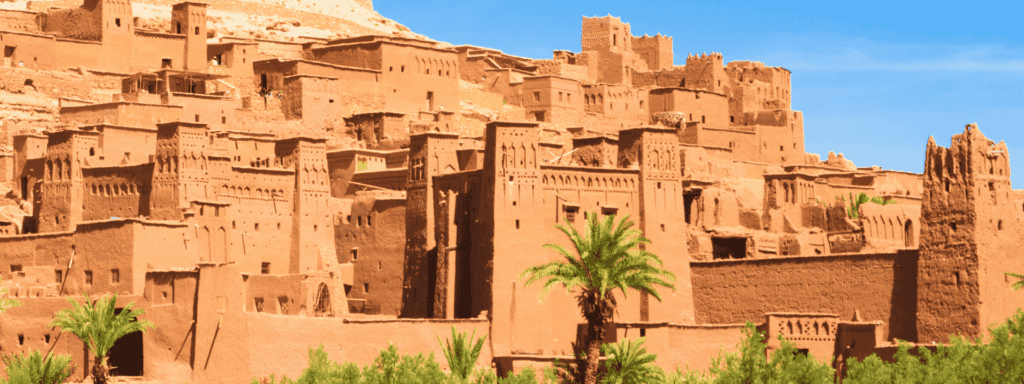
To the North, the High Atlas looms like a wall of granite. To the South, the Anti-Atlas offers a more lunar, jagged beauty. Taroudant sits in the cradle between them. Exploring the foothills, you find « Agadirs »—fortified granaries perched on impossible cliffs where tribes once stored their grain and silver during times of war.
As I sat on a ridge overlooking the valley, watching a shepherd lead his flock through the dust, I realized that Taroudant isn’t just a destination. It is a portal. It is a place that strips away the unnecessary noise of the 21st century and returns you to the essentials: the warmth of the earth, the taste of the bread, and the value of a long, unhurried conversation.
Why You Must Go
Taroudant will not entertain you with flashy attractions. It will not bow to your schedule. Instead, it will invite you to sit, to breathe, and to observe. By the time you leave, your clothes will smell of woodsmoke and saffron, and your heart will be tuned to a slower, more human frequency.
The first flight is waiting. The ramparts are glowing purple. Will you answer the call of the Souss?