

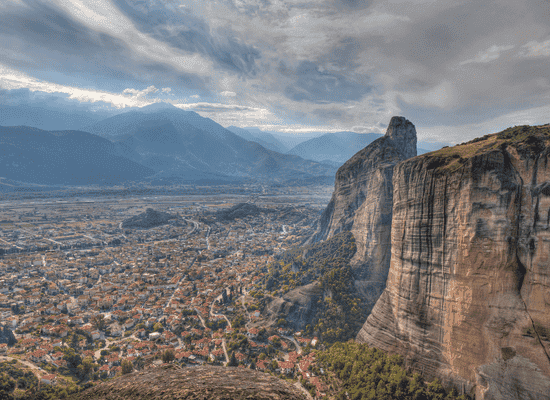
The road from Kalabaka does not merely lead you to a destination; it leads you to a confrontation with the impossible. As the mist clears, the Thessalian plain gives way to a forest of stone—monolithic pillars of dark sandstone that pierce the heavens like the fingers of a buried giant.
This is Meteora. The name itself, Metéoros, means « suspended in the air. » But to the bohemian soul, it is more than a geological anomaly. It is the physical manifestation of the human urge to rise above the noise of the world. It is where the gravity of the earth meets the levity of the spirit.
- The Overture: The Geology of Faith
- The Hidden Hermitages – The Architecture of Solitude
- The Six Sentinels – Beyond the Frescoes
- The Secret Trails of the Adhrakhti
- The Hidden Libraries of the Sky – Parchment, Peril, and Persistence
- The Alchemy of the Stone – Flora, Fauna, and the Living Rock
- The Monastic Table – Bread, Wine, and the Fast
- The Logistics of the Infinite – A Guide for the Earthbound
- QA – Whispers from the Heights
- The Weight of the Air
The Overture: The Geology of Faith
Before the first monk ever carved a handhold into these rocks, the wind and the water were the primary architects. Sixty million years ago, this was a delta. As the waters receded and the earth buckled, these pillars were left behind—obsidian-colored sentinels of conglomerate and sandstone.
But the history we seek is the one written in sweat and prayer. In the 11th century, the first hermits arrived. They didn’t build cathedrals; they found hollows. They lived in the « caves of the sky, » suspended hundreds of feet in the air, accessible only by retractable wooden ladders and hemp ropes. They sought the hesychia—the divine silence. Today, as we navigate the winding asphalt, we must look past the tour buses to find the shadow of those original seekers.
Most travelers visit the « Big Six »—the active monasteries. But the true soul of Meteora is hidden in the rocks that have no souvenir shops.
1. The Prisons of the Monks (Phylakae Monachon)
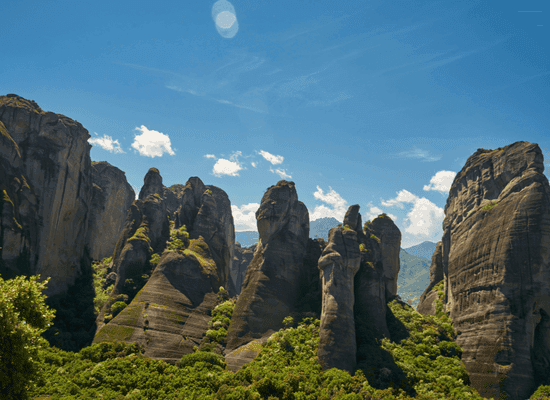
On the western face of the rock of Dupiani, there are cavernous openings that look like dark eyes staring out over the valley. These are the « Prisons. » In centuries past, monks who broke their vows or sought extreme penance were sent here. There are no stairs. There are no railings.
To stand at the base of this rock is to feel the weight of a solitude so profound it borders on the terrifying. This is a point of view unknown to the casual tourist: the realization that Meteora was a place of iron discipline as much as it was of golden light.
2. The Cave of Saint Gregory
Tucked away in a fold of the rock near the village of Kastraki lies the hermitage of Saint Gregory. To reach it, you must follow a path that the locals call « The Shepherd’s Whisper. » Here, you can see the remains of the wooden beams that once supported the precarious wooden platforms. This is where the « Sky-Walkers » lived. The walls are still stained with the soot of candles lit five hundred years ago. There is a specific scent here—cold stone, wild sage, and the lingering presence of centuries of isolation.
3. The Monastery of Saint Nicholas Badovas
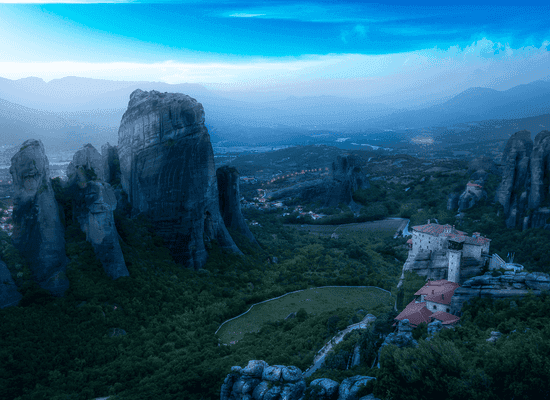
Often overlooked because it is built into the rock rather than on top of it, Badovas is a masterpiece of vertical integration. It looks like a wasp’s nest made of stone and timber. While the Great Meteoro is grand, Badovas is intimate. It represents the « Bohemian » survivalism of the early monks—using every crack and crevice to create a sanctuary.
The Six Sentinels – Beyond the Frescoes
We now turn to the active monasteries, but we shall view them through a lens of craftsmanship and human endurance rather than mere religious tourism.
1. The Great Meteoron: The Citadel of the Clouds
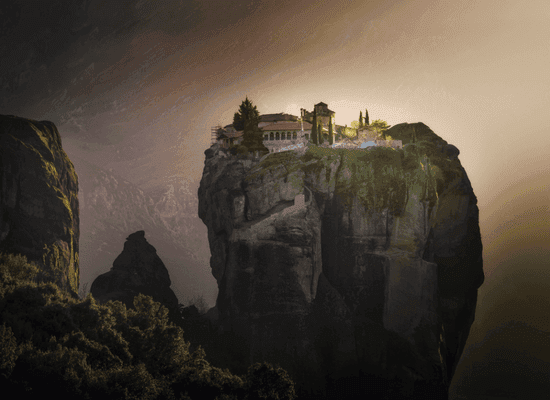
The Holy Monastery of the Metamorphosis is the oldest and largest. But look past the museum. Look at the Vrizoni—the ancient windlass and net system. Until the 1920s, this was the only way up. You were placed in a net, and monks hauled you up by hand. When asked how often the ropes were replaced, the legendary answer was: « When the Lord lets them break. »
This captures the fatalistic beauty of the place. The Great Meteoron is a fortress of memory. In the ossuary, the skulls of former monks are stacked neatly on shelves. It is not macabre; it is a bohemian reminder of the transience of life. Standing in that room, you realize that for these men, the rock was the only thing that lasted.
2. Varlaam: The Labor of Five Decades
The story of Varlaam is a human epic. It took twenty-two years of hauling materials to the top of the rock before a single stone was laid for the actual construction. Imagine the calloused hands, the strained muscles, and the absolute certainty of purpose required to spend two decades just preparing to build. The frescoes here, by the great Frangos Katelanos, are vibrant, but the true art is the 16th-century water tank that holds the lifeblood of the community.
3. Roussanou: The Feminine Ascendance
Perched on a narrower, sharper spire, Roussanou (now a nunnery) has a different energy. It feels more delicate, more integrated into the verticality of the rock. The gardens here, maintained by the sisters, are a miracle of small-scale agriculture. To see a rose blooming 300 meters above a precipice is to understand the « Bohemian » victory over a harsh landscape.
The Secret Trails of the Adhrakhti
The « Adhrakhti » (The Spindle) is a solitary, needle-like rock that stands in the center of the stone forest. Most visitors see it from the road. We will walk to its base.
1. The Path of the Ancients
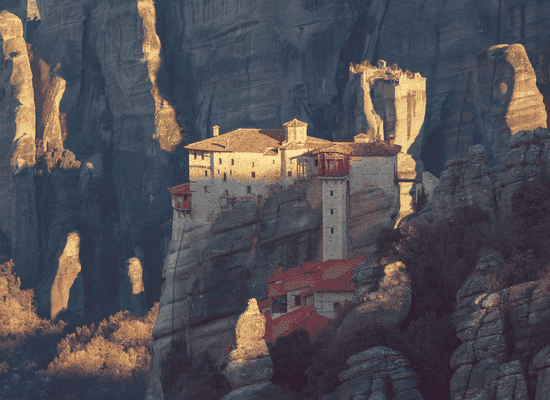
There is a trail that starts behind the old church in Kastraki. It is not marked on most tourist maps. It winds through oak forests where the ground is carpeted in cyclamen and wild orchids. As you climb, the pillars of Meteora begin to close in around you. You lose the horizon. You are in a canyon of giants.
2. The Vertical Perspective
At the base of the Adhrakhti, you can look straight up. This is the « Secret Point of View. » From here, the rocks don’t look like mountains; they look like frozen waves of a dark sea. The scale is soul-crushing and soul-expanding all at once. You hear the wind whistling through the « needles, » a sound the monks called the « Choir of the Stones. »
To understand the weight of the air in Meteora, one must look toward the shadows of the scriptoria. While the world below was being reshaped by the sword—from the fall of Byzantium to the Ottoman expansion—the monks were busy preserving the world’s memory in ink.
1. The Secrets of the Codex
In the hidden vaults of the Great Meteoron and Agios Stephanos, there exist manuscripts that have survived fire, earthquake, and war. These are not mere books; they are the DNA of Western thought. During the 14th and 15th centuries, when the valley below was a corridor for invading armies, the monks hauled crates of vellum up the cliffside.
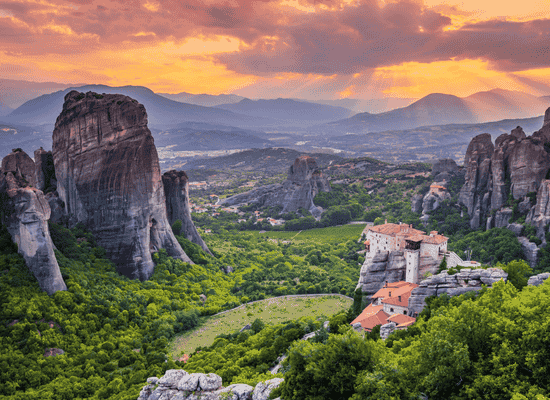
I spoke with a scholar who had touched the « Meteora Codices. » He described the sensation of the cold, heavy parchment—skins of goats that grazed these very hills six centuries ago. The ink, made from oak galls and soot, remains a deep, defiant black. These libraries were the original « cloud storage. » They kept the Greek language, the liturgical chants, and the philosophical treatises of the ancients safe by placing them where the average soldier could not reach.
Few visitors realize that the rocks of Meteora are hollowed out by more than just prayer. During the centuries of Ottoman rule, and much later during the dark days of World War II, the verticality of Meteora served a tactical purpose.
Behind the altar of a small, now-abandoned hermitage near Agia Moni, there is a narrow fissure that leads into a natural chimney within the rock. This was a « Krifo Scholio »—a secret school. Under the cover of night, children from the village of Kastraki would climb the hidden paths to learn their language and faith by candlelight. The « Bohemian » spirit here is one of intellectual defiance. The rock wasn’t just a place to hide; it was a fortress for the mind.
The Alchemy of the Stone – Flora, Fauna, and the Living Rock
Meteora is often treated as a gallery of buildings, but the rock itself is a living organism. To spend a week here is to realize that the stone has a pulse, influenced by the migration of birds and the blooming of rare mountain flowers.
1. The Guardians of the Air: The Egyptian Vulture
Look up, away from the domes. You might see the white and yellow silhouette of the Neophron percnopterus, the Egyptian Vulture. These rocks are one of the last strongholds for this endangered sovereign of the skies. The monks view them as sacred companions. They build their nests in the same inaccessible hollows where the first hermits once knelt. There is a beautiful symmetry in this: the seeker of God and the seeker of the thermals, both sharing the same vertical sanctuary.
2. The Flora of the Precipice
The « Meteora Bellflower » (Campanula columnaris) is a flower that exists nowhere else on this planet. It clings to the vertical sandstone faces, blooming in a defiant burst of lilac against the dark conglomerate. It requires almost no soil, living off the morning mist and the minerals of the stone. This is the « Bohemian » plant par excellence—a life form that thrives on the edge of the abyss, finding beauty in the most precarious of circumstances.
The Monastic Table – Bread, Wine, and the Fast
Gastronomy in Meteora is an exercise in « Holy Simplicity. » In the monasteries, the diet is governed by the liturgical calendar, but it is deeply rooted in the volcanic and alluvial soil of the Thessalian plain.
1. The Wine of the Pillars
The monks have been viticulturists for nearly a millennium. The vineyards at the foot of the rocks benefit from a unique microclimate—the massive stones absorb the heat of the day and radiate it back onto the vines during the cool mountain nights. The result is a wine that is mineral-heavy, almost tasting of the sandstone itself. Tasting a glass of Meteora red is like drinking the filtered history of the earth.
2. The Art of the Lenten Feast
To eat with the monks (on the rare occasions it is permitted) is to understand that « limitation » is the mother of « flavor. » A simple dish of giant beans (Gigantes), slow-baked in a wood-fired oven with wild mountain oregano and sun-dried tomatoes, possesses a depth that outshines any Michelin-starred meal. The « Secret Ingredient » here is time—the slow, unhurried pace of the monastery kitchen where nothing is rushed and everything is a form of service.
The Logistics of the Infinite – A Guide for the Earthbound
Scaling the heights of Meteora requires more than a pair of hiking boots; it requires a strategy of the soul.
1. The Rhythm of the Rocks: Transport & Timing
- The Iron Way : The train from Athens to Kalabaka is the most poetic approach. As you cross the flat plains, the rocks appear on the horizon like a sudden, jarring chord in a symphony.
- The E-Bike Revolution : For the « Bohemian Human » traveler, skip the air-conditioned tour buses. Rent an electric bike in Kastraki. It allows you to feel the change in air pressure as you climb, to smell the wild thyme, and to stop at the small, unmarked pull-offs where the true silence resides.
- The Best Light : Everyone goes for sunset at the « Main Observation Point. » Instead, go to the Psaropetra lookout at 4 AM. Watch the mist rise from the valley floor, slowly revealing the monasteries one by one, like ships appearing through a fog.
2. Digital Solitude
- Applications : Use Wikiloc for the secret hiking trails. Many of the old « monk paths » are not on Google Maps.
- Connectivity : Be warned—the thick sandstone walls of the monasteries are natural Faraday cages. Embrace the « Digital Detox. » Your phone is best used here as a camera, not a tether to the world you are trying to leave behind.
QA – Whispers from the Heights
The Weight of the Air
As you descend back toward the lights of Kalabaka, the air begins to feel heavier. The « Vertical Silence » of Meteora stays with you, a quiet ringing in your ears that makes the chatter of the modern world seem trivial. You don’t just « visit » Meteora; you are measured by it. It stands as a testament to the fact that when humans find a place between the earth and the sky, they don’t just build walls—they build bridges to the infinite.
You leave with a bit of sandstone grit in your pockets and a vast, blue emptiness in your heart. The pillars remain, indifferent to the centuries, watching the clouds pass and waiting for the next seeker to look up and wonder.
« If you enjoy spiritual and peaceful destinations like Meteora, you might also love the hidden mountains of Nan in Thailand. »
- Morocco Walker
[…] If you enjoy peaceful destinations like Ucluelet, you might also love the spirit of Meteora in Greece, the hidden mountains of Nan in […]