

Marrakech does not offer itself; it must be earned. In the spring of 2026, while the world outside spins in a dizzying blur of speed and pixels, the « Ocher City » has undergone a silent metamorphosis. It has become the ultimate sanctuary for those who no longer seek to be seen, but to disappear with elegance.
The arrival in Marrakech during the « blue hour » is an act of pure sensory alchemy. As your plane descends toward Menara Airport—its concrete lace filtering the twilight like a modern cathedral—you feel the shift. The air, heavy with a dry warmth and the distant scent of orange blossoms, wraps around you like a bespoke cashmere burnous.
Crossing the ramparts of the Medina is a vow to break your contract with the straight line. Here, luxury is not found in the ostentation of facades, which remain austere and impenetrable, but in the promise of the interior. The true luxury of Marrakech in 2026 is the « invisible threshold »: that suspended moment when, after navigating the orchestrated chaos of the souks, a heavy, brass-studded cedar door opens onto a silence so dense it feels tactile.
It is the luxury of tadelakt beneath your palm—that lime plaster polished with river stones until it possesses the softness of human skin. It is the rhythmic murmur of a zellige fountain that instantly cancels the clamor of the outside world. In this odyssey, we will not merely map a city; we will decode an art of living where invisibility is the supreme privilege.
- The Genesis – From Nomadic Dust to Al-Andalus Elegance
- The Dwellings of Shadow – The Architecture of Invisibility
- The Maalem and the Matter – The High-Precision of the Hand
- The Confident Tables – The Sensory Alchemy of Moroccan Gastronomy
- The Gardens of the Invisible – Ancient Orchards and Private Paradises
- The Sabbatical of the Soul – The Architecture of Water and Silence
- The Logistics of Elegance – Navigating the Ocher Labyrinth
- The Mega-FAQ – Secrets of the Inner Ocher City
- The Crimson Horizon
The Genesis – From Nomadic Dust to Al-Andalus Elegance
To understand the Marrakech of 2026, one must travel back to the year 1070, when the Saharan sands froze into a city. Marrakech was not born from a king’s whim, but from the tactical vision of ascetic warriors: the Almoravids.
I. The Al-Murabitun: Sentinels of the Void
The term « Almoravid » derives from Al-Murabitun— »those who live in the Ribat » (the fortress-monastery). Picture these Sanhadja Berber tribes, draped in indigo veils, emerging from the depths of present-day Mauritania to forge an empire stretching from Castile to the Senegal River.
They chose this arid plateau at the foot of the Atlas Mountains not for its beauty, but for its strategic dominance. Marrakech was, originally, a military encampment, an anchor between the mountains and the plains. What historians call « Almoravid austerity » still pulses through the city’s structure today: a raw, monastic simplicity that conceals treasures of extreme refinement.
II. The Khettaras: The Engineering of a Miracle
The greatest luxury of Marrakech is not its gold, but its water. Without the hydraulic genius of the Almoravids, the Palmeraie would be nothing but a shroud of dust. They perfected the Khettaras: an ingenious network of underground galleries that drained water from the Atlas aquifers over dozens of miles, utilizing nothing but the steady pull of gravity.
In 2026, as global water management becomes the definitive challenge of the century, the Khettaras have become a point of obsessive rediscovery. Exploring the remains of these ancient veins near the Northern Palmeraie is a lesson in humility. It was this « invisible water » that transformed Marrakech into a garden-city, an artificial oasis of sensory pleasure.
III. The Almoravid Koubba: The Seed of Ocher
If you were to visit only one historical vestige to understand the city’s architectural DNA, it would be the Almoravid Koubba. It is the sole structure from this dynasty to have survived the iconoclastic fury of the Almohads in 1147.
Located near the Ben Youssef Mosque, this small dome is a masterpiece of mathematical perfection. Its intersecting arches and floral motifs are the direct ancestors of everything we admire in the Alhambra of Granada or the most exclusive Riads today. The Koubba is proof that Moroccan luxury was born from the collision of desert rigour and Andalusian sophistication.
IV. The Passing of the Torch: Almohad Grandeur and Saadian Gold
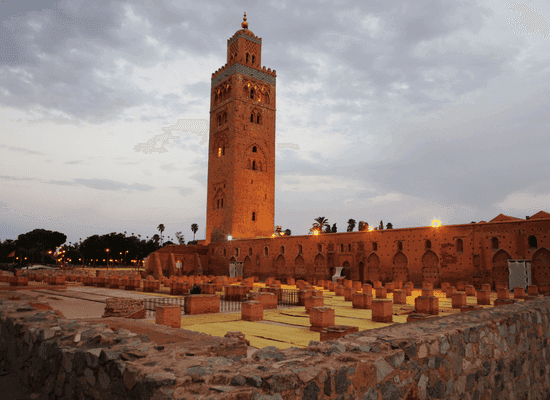
The history of Marrakech is a sequence of conquests, each adding a layer of velvet to the stone. The Almohads brought verticality with the Koutoubia, its minaret serving as a lighthouse for caravans. Centuries later, the Saadians introduced gold and Carrara marble into their tombs, creating an aesthetic of death so beautiful it became a celebration of life.
To understand this genesis is to realize that every Riad you step into in 2026 is the direct heir of a nomadic fortress and an Andalusian palace. Luxury in Marrakech is never « new »; it is simply reactivated.
The Dwellings of Shadow – The Architecture of Invisibility
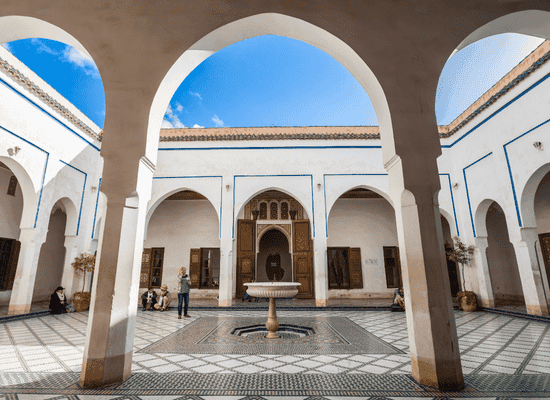
In the vocabulary of Marrakech, the word Riad translates literally to « garden. » However, in the context of 2026 luxury, a Riad is a philosophical statement. It is the architectural manifestation of the « interior life »—a deliberate rejection of the exterior world. While Western luxury often screams for attention through glass walls and soaring heights, the Moroccan palace whispers its secrets behind windowless, mud-brick ramparts.
I. The Anatomy of Seclusion
To enter one of the city’s most exclusive dwellings—such as those hidden in the labyrinthine corridors of the Mouassine or Bab Doukkala quarters—is to experience a masterclass in the transition of light. You move from the blinding, white-hot glare of the Moroccan sun into a dim, cool corridor (skifa). This « elbowed » entrance is designed specifically to prevent passersby from catching even a glimpse of the private courtyard.
In these sanctuaries, the architecture is a conversation between the four elements:
- Earth : The thick walls of rammed earth or baked brick provide a thermal mass that keeps the interior at a constant, temple-like coolness, even when the thermometer outside touches 45°C.
- Water : The central fountain is not merely a decorative centerpiece; it is a cooling mechanism and a sonic barrier. The rhythmic splash of water creates a « white noise » that masks the whispers of the household, ensuring that privacy is maintained even in an open-air courtyard.
- Air : The vertical opening to the sky acts as a natural chimney, drawing hot air up and out, while the lush foliage of orange and lemon trees oxygenates the space.
- Fire : The flickering light of brass lanterns at night, casting « lace » shadows against the walls, represents the warmth of Moroccan hospitality.
II. The Muted Palette: Materials of the Soul
The luxury traveler of 2026 has moved past the « gold and glitter » era. Today, the ultimate status symbol is the mastery of traditional materials.
- Tadelakt : This ancient lime plaster, waterproofed with black soap and polished with river stones, is the « silk » of architecture. In the most refined Riads, you will find bathrooms and hammams entirely encased in tadelakt. It has no seams, no grout—just a continuous, undulating surface that invites the touch.
- Zellige : These are not mere tiles; they are geometric prayers. Hand-chipped by artisans who have spent decades perfecting the angle of the blade, the slight imperfections in the glaze of each tile reflect light in a way that no machine-made product can replicate.
- Cedar Wood : The scent of a high-end Riad is defined by the heavy, resinous aroma of Atlas cedar. Used for the intricate mashrabiya screens and massive doors, it serves as a natural incense that lingers in the fabric of your clothes long after you leave.
III. The Invisible Choreography: Service in 2026
In the pinnacle of Marrakech’s private palaces, service is a ghost. It is a choreography that happens in the shadows. Your mint tea appears exactly three minutes after you think of it; your linen is turned down with a sprig of dried lavender just as the sun dips below the horizon. The staff in these elite dwellings are the keepers of the « Invisible Protocol »—they are present enough to anticipate your every desire, yet discreet enough to make you feel as though the palace is yours alone.
The Maalem and the Matter – The High-Precision of the Hand
If the Riad is the body of Marrakech, the Maalem (Master Artisan) is its soul. In an age where Artificial Intelligence can generate flawless designs in seconds, the value of the « Hand » has reached an unprecedented premium. To own something made by a Maalem in 2026 is to own a piece of frozen time.
I. The Philosophy of the « Perfect Imperfect »
In the hidden workshops of the Sidi Ghanem industrial district or the deep recesses of the Souk des Teinturiers, the Maalem works without blueprints. He relies on baraka—a spiritual grace—and a muscle memory passed down through twelve generations.
I recently sat with a Maalem named Omar, a man whose family has worked in brass for three centuries. As he tapped a rhythmic, percussive code into a massive lantern, he explained the 2026 perspective on luxury: « Machines make things that are dead. They are the same on Monday as they are on Friday. But this metal… it remembers my hand. It has a pulse. » This is the « Luxury of the Matter »—the realization that an object’s value is derived from the human struggle required to create it.
II. The Silk Weavers of the Médina
In the Souk el-Kebir, there are tarnish-worn doors that lead to upper-floor ateliers where the air is thick with the dust of cactus silk (sabra). Here, weavers use looms that look like medieval torture devices to create fabrics that feel like liquid gold.
- The Rare Seekers : For the elite traveler, the goal is no longer the « Souk crawl. » It is the private appointment. In 2026, the most sought-after textiles are those commissioned months in advance—bespoke kaftans or wall hangings that incorporate silver thread and rare vegetable dyes derived from pomegranate skins and indigo.
III. Investing in the Invisible
For the collector, Marrakech is a living museum. However, the true treasures are often « invisible » to the untrained eye.
- Antique Berber Jewelry : These are not just ornaments; they are documents of tribal history. A heavy silver fibula from the Anti-Atlas, encrusted with amber and egg-yolk resin, carries a weight of authority that no modern jewelry can match.
- Pottery of Tamegroute : The signature green glaze, created using a secret recipe of manganese and silica, is a hallmark of the Drâa Valley. In 2026, collectors seek the « rough » pieces—those with the most dramatic « fire-kissed » marks from the ancient kilns.
To buy from a Maalem is to enter into a contract with history. You are not just purchasing a product; you are funding the survival of a lineage. This is the ultimate « Invisible » impact of the 2026 traveler: the preservation of human genius in a digital world.
The Confident Tables – The Sensory Alchemy of Moroccan Gastronomy
In Marrakech, the act of eating is a sacred geometry. It is a ritual that begins not at the table, but in the memory of the soil. By 2026, the global culinary world has become obsessed with « farm-to-table, » but in the hidden courtyards of the Medina, the philosophy is much older. It is « Soul-to-Plate. » Here, the finest dining experiences are not found in restaurants with neon signs, but in tables confidentielles—private dining rooms where the menu is a spoken agreement and the chef is often a Dada, a traditional woman cook who holds the secrets of generations in her fingertips.
I. The Dada: The High Priestess of Spice
To understand the luxury of Moroccan cuisine is to understand the Dada. Historically, these women were the culinary backbone of the great noble houses. In 2026, the ultimate status symbol for a high-end Riad is not a Michelin-starred chef from Paris, but a Dada who can balance the thirty-five ingredients of a Ras el Hanout by scent alone.
The meal begins with the Ritual of the Seven Salads. This is not a mere appetizer; it is a display of botanical mastery. Burnt eggplants with honey and paprika, carrots infused with orange blossom water and cumin, and preserved lemons that have aged in salt for over a year. Each small plate is a chapter in a story of preservation and patience.
II. The Architecture of the Tajine
The tajine is more than a vessel; it is a thermal engine. The conical shape allows steam to rise, condense, and trickle back down, basting the meat in its own essences for hours.
- The Rare pairing : In the most exclusive circles of 2026, the focus has shifted to forgotten recipes. The Mrouzia—a sweet and savory lamb dish braised with honey, cinnamon, and ginger—was traditionally a festive dish reserved for the elite. To eat a true Mrouzia, where the meat falls away from the bone like velvet, is to taste the history of the Trans-Saharan trade routes.
- The Saffron of Taliouine : The « Invisible » traveler knows to ask for the origin of the spices. The world’s most expensive saffron comes from the small village of Taliouine in the Anti-Atlas. In a high-end kitchen, this « Red Gold » is treated like a vintage wine, used sparingly to impart a metallic, floral depth that lingers on the palate long after the meal.
III. The Secret Terrace: Dining with the Djinn
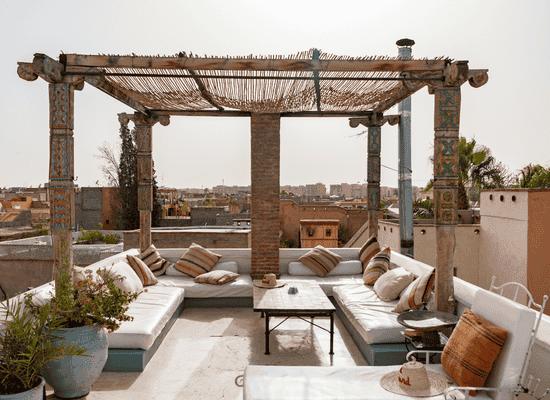
As the sun sets and the call to prayer echoes across the rooftops, the elite move upward. In 2026, the most sought-after dinner tables are those on private terraces that overlook the Koutoubia.
Imagine a table draped in hand-woven linen, lit only by silver lanterns. There is no music—only the distant hum of the Medina and the wind in the palms. This is the « Luxury of Atmosphere. » Here, you are served a Pastilla—a flaky pigeon pie dusted with cinnamon and sugar—while the storks click their beaks on the nearby ramparts. It is a sensory loop where the food, the history, and the view become a single, indistinguishable experience.
The Gardens of the Invisible – Ancient Orchards and Private Paradises
If the Medina is a labyrinth of stone, the Palmeraie and the secret gardens of the city are its lungs. However, the 2026 traveler avoids the overcrowded tourist circuits of the Majorelle. Instead, they seek the « Invisible Green »—spaces where nature has been curated into a form of living art.
I. The Agdal and the Menara: The Royal Voids
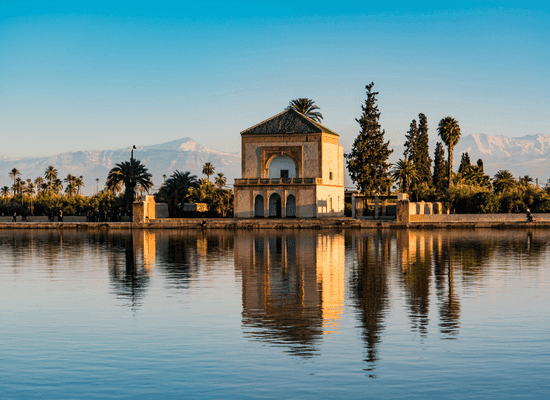
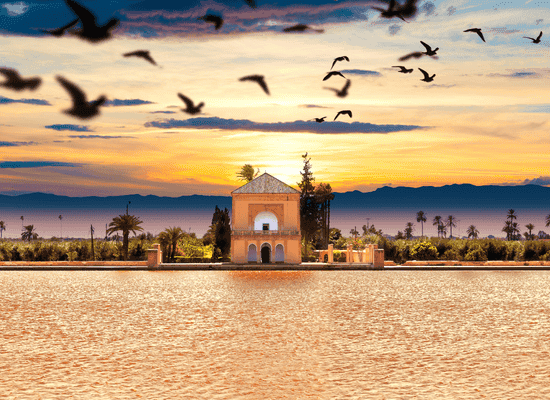
Most visitors see the Menara garden for a quick photo of the pavilion and the reflecting pool. The « Invisible » traveler, however, goes deeper into the Agdal Gardens. Spanning over 500 hectares, this UNESCO site is one of the oldest Islamic gardens in the world.
Walking through the Agdal is an exercise in scale. It is a landscape of massive water basins—so large they were once used by the Sultans’ troops to practice swimming—surrounded by thousands of olive, pomegranate, and orange trees. In 2026, the luxury here is the Silence of Space. You can walk for miles in the heart of the city and encounter no one but the gardeners tending to the ancient irrigation channels.
II. The Private Orchards of the Palmeraie
The Palmeraie, once a vast palm grove of 100,000 trees, has been transformed. While much of it is occupied by luxury villas, there are still « Hidden Pockets » of the original landscape.
- The Sensory Walk : Some of the most exclusive estates in 2026 offer private « Garden Sabbaticals. » You are invited to walk through orchards of bitter oranges (bigaradiers) and ancient olive groves that have been in the same family for four centuries.
- The Botanical Archive : These gardens are not just for show; they are genetic libraries. They grow rare varieties of roses—the Rosa Damascena—which are harvested at dawn to be distilled into the pure rose water that scents the city’s finest linens.
III. The Anima Garden: The Modern Intersection
For a shift in perspective, the 2026 traveler ventures 30 kilometers outside the city to the Anima Garden created by Andre Heller. It is a « Destination Dupe » for those who find the Majorelle too claustrophobic. It is a surrealist paradise where African art meets botanical rarity. It represents the « New Marrakech »—a city that is no longer just a museum of the past, but a laboratory for the future of landscape design.
The Sabbatical of the Soul – The Architecture of Water and Silence
To inhabit Marrakech is to eventually surrender to its humidity—not the humidity of the air, but the ritualized moisture of the Hammam. In the local consciousness, the bath is more than a place of hygiene; it is a portal of transition. It is where the « dust of the world » is scrubbed away to reveal the raw skin of the spirit.
I. The Hammam: A Descent into the Womb of Stone
The elite experience of the Hammam has moved away from the marble-clad « day spas » of the luxury hotels and returned to the subterranean soul of the Medina. The most exclusive baths are now found in private wings of ancestral Riads, where the heat is still generated by a traditional wood-fired furnace (farrane).
The ritual is a choreography of temperatures. You begin in the Barid (the cool room), a transition space of vaulted arches and flickering candlelight, before moving into the Skhoun (the hot room). Here, the walls—encased in dark, hand-polished tadelakt—sweat alongside you.
- The Black Soap Ritual : The skin is prepared with Sabon Beldi, a viscous, dark paste made from macerated olives and eucalyptus. It is left to sit until the pores yield.
- The Gommage : The Kessa (scrubbing glove) is wielded by a practitioner whose lineage of touch spans centuries. This is the « luxury of the shed skin. » As the dead cells are removed, you are physically lighter, as if the heavy history of the city has been peeled away.
- The Ghassoul Clay : The final act involves a wrap of mineral-rich clay from the Atlas Mountains, scented with rose water and seven different herbs. It is a grounding experience—literally being wrapped in the Moroccan earth.
II. The Atlas Escape: High-Altitude Solitude
When the heat of the Ocher City becomes an intrusive weight, the soul looks toward the blue serrated peaks of the High Atlas. Just sixty minutes from the Jemaa el-Fnaa lies the Ourika Valley and the higher, more secluded plateaus of Asni.
The sophisticated retreat now takes place in restored « Kasbah-style » lodges that prioritize the view over the vanity. These are places of Absolute Silence. There are no televisions, no ambient city hum—only the sound of the wind through the juniper trees and the occasional clink of a bell from a distant goat herd. This is the « Luxury of the Void. » Sitting on a terrace at 1,800 meters, wrapped in a heavy wool djellaba, watching the shadow of the mountains swallow the valley, is the ultimate reset for a mind fractured by modern complexity.
True luxury is the removal of friction. In Marrakech, a city designed as a defensive maze, friction is everywhere. The key to « Invisible Travel » is the Fixer—the local intermediary who turns « impossible » into « already done. »
I. The « Fixer » and the Art of Entry
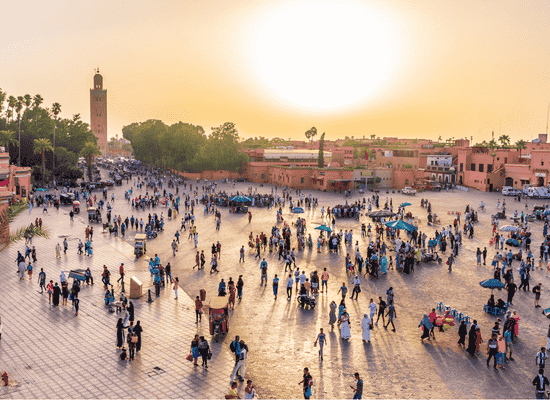
In this landscape, the most valuable currency is not the Dirham, but the maârifa (the connection). The elite traveler employs a dedicated local concierge who functions more as a cultural diplomat than a guide.
- The Unmarked Door : This fixer is the one who secures a table at a restaurant that technically doesn’t take reservations, or gains you entry to a private antique collection stored in a nondescript warehouse in the industrial zone of Sidi Ghanem.
- The Souk Buffer : Navigating the Medina with a fixer means the « hustle » evaporates. You are seen as a guest of the city, not a target of commerce.
II. The Grace of Movement: Beyond the Taxi
The days of haggling with « Petit Taxi » drivers over a broken meter are over for the discerning traveler.
- Electric Discretion : The new standard for movement within the city walls and the Palmeraie is the high-end electric shuttle or the vintage sidecar. Several boutique agencies now offer sidecar tours led by historians and architects, allowing you to zip through narrow alleys that no car could ever penetrate.
- The Private Caleche : For a slower, more romantic transition between the Medina and the lush gardens of the Hivernage, the horse-drawn carriage remains the most elegant option—provided it is a privately commissioned, well-tended carriage away from the main tourist ranks.
Luxury in Morocco is deeply tied to Respect.
- The Photography Protocol : In a culture that values the « Invisible, » pointing a camera at someone’s face is a profound intrusion. The elegant traveler asks first, or better yet, keeps the camera tucked away, choosing to « record » the city through presence rather than pixels.
- The Dressing Code : To open the doors of the most traditional noble houses, one must dress with a nod to local modesty. Linen suits, long dresses, and quality fabrics signal to the locals that you understand the « Weight of the Place. »
The Mega-FAQ – Secrets of the Inner Ocher City
This is the repository of « Invisible Data »—the specific, nuanced answers that a standard search engine cannot provide. These are the queries of the intent-driven traveler who seeks the marrow of the Marrakech experience.
I. The Deep Logistics of the Medina
II. Health, Safety, and the Desert High
The Crimson Horizon
As we reach the end of this odyssey, we realize that Marrakech is not a city you visit; it is a city you inhale. It is a place that challenges the very notion of what it means to travel. If the Nevada desert taught us about the secrets of the future, and the Thai forests taught us about the power of silence, Marrakech teaches us about the Weight of Time.
The Echo of the Ocher
We began this journey at the blue hour, watching the light fade over the Koutoubia. We have wandered through the subterranean veins of the Khettaras, sat at the feet of the Maalems, and felt the rough grace of the Atlas peaks. What remains is a realization that true luxury is not a commodity—it is a state of presence.
Marrakech is a mirror. If you approach it with hurry and entitlement, it will give you noise and frustration. But if you approach it with the « Invisible Protocol »—with respect, patience, and a desire to see what is hidden behind the windowless walls—it will reveal a world of impossible beauty.
The Final Vow of the Morocco Walker
The traveler of 2026 is no longer a consumer of sights, but a collector of echoes. As you leave the Medina, the scent of cedarwood and orange blossom clinging to your skin, you carry with you a piece of the « Crimson Echo. » You have learned that the most profound experiences are often those that leave no digital footprint.
The city will continue to evolve. The electric cars will replace the old taxis, and the fiber-optic cables will weave through the ancient plaster. But the soul of Marrakech—the nomadic spirit that found a home in the dust 1,000 years ago—will remain unreachable to the casual observer. It belongs only to those who are willing to walk, to wait, and to listen to the silence behind the ocher walls.
The red sun sets, the call to prayer rises, and the secret remains.
- MOROCCO WALKER
[…] decades, the global traveler’s map of Morocco has been anchored by the terracotta walls of Marrakech, the blue-washed steps of Chefchaouen, and the golden dunes of Merzouga. But as we move through the […]
[…] Marrakech : Vibrant imperial hub of palaces, gardens, and street […]