

The global football landscape shifted decisively under the roaring skies of the opening matches of the FIFA World Cup 2026. In a high-stakes tactical chess match, the Morocco national team lined up against the five-time world champions, Brazil. Millions of spectators leaned into their screens, expecting a relentless yellow storm. Instead, they witnessed a masterclass in calm, geometric precision delivered not by a weathered veteran, but by an 18-year-old central midfielder making his tournament debut: « Ayyoub Bouaddi ».
With the unflinching poise of a grandmaster, Bouaddi dominated the pitch, reducing elite world-class opponents to chasing shadows. Born in northern France and having risen through the ranks of French youth international squads up to the U21s, Bouaddi made a profound choice of the heart just weeks before the tournament, officially switching his allegiance to represent his parental homeland, Morocco. French sports outlets openly lamented the loss, warning that his absence could haunt their national squad for the next decade. Meanwhile, the transfer market ignited immediately, with global giants like Arsenal, Chelsea, Liverpool, and Paris Saint-Germain scrambling for his signature.
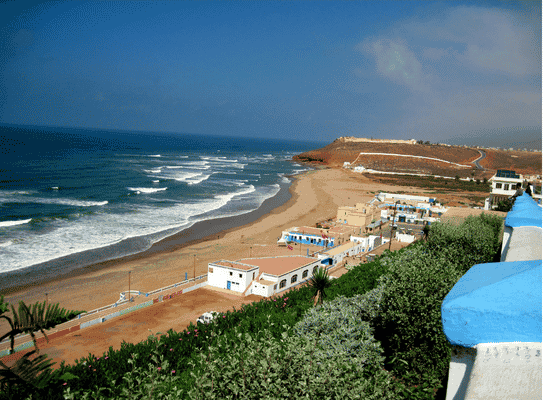
Yet, to understand where an 18-year-old mathematics student derives the spatial intelligence to dismantle elite defenses, one must look past his childhood in Creil or his training at Lille. One must journey south, far beyond the mass-tourism corridors of Agadir, to the fierce Atlantic cliffs of Sidi Ifni and the vast, shifting sands of Guelmim. This is the Southwest territory of the « Aït Baâmrane » the ancestral home of Bouaddi’s family. It is a region defined by thick sea mists, unyielding sun, and a deep-seated cultural stoicism that explains the quiet, immovable core of Morocco’s newest midfield engine.
- 1. The Legacy of the Aït Baâmrane: Pride, Resilience, and the Midfield Engine
- 2. Sidi Ifni: The Blue and White Mirage on the Red Cliffs
- 3. Guelmim: The Gates of the Sahara and the Nomad Dialect
- 4. The South Atlantic Track: Route Logistics for the Uncharted Traveler
- The Choice of the Heart and the Next Horizon
1. The Legacy of the Aït Baâmrane: Pride, Resilience, and the Midfield Engine
LOGISTIQUE MOROCCO WALKER
- Destination : Southwestern Borderlands (Sidi Ifni Province & Guelmim Gate)
- Spatial Dynamic : Marine mist corridors (Irifi) colliding with pre-Saharan rock valleys
- Cultural Landscape : Ancestral territory of the Aït Baâmrane tribal confederation
- Psychological Note : A culture of absolute silence under pressure; meticulous spatial preservation
To step into the provinces of Sidi Ifni and Guelmim is to enter a land that measures time not in news cycles or viral trends, but in centuries of fierce territorial independence. This is the domain of the Aït Baâmrane, a historic Berber tribal confederation legendary throughout North Africa for their unyielding resistance against colonial incursions and their unbreakable bond with their rugged geography.
+———————————–+———————————–+
| EUROPEAN ELITE FOOTBALL | SOUTHERN MOROCCAN ETHOS |
+———————————–+———————————–+
| * Hyper-accelerated media cycles | * Deep patience; long-form memory |
| * Erratic transfer market noise | * Rooted emotional containment |
| * Chaos of high-pressing tactics | * Spatial calculation & endurance |
+———————————–+———————————–+
When international sports journalists marvel at Bouaddi’s ability to remain utterly unbothered by multi-million dollar transfer rumors or the high-intensity press of opposing midfielders, they are analyzing an individual whose psychological anchor is deeply rooted here. The Aït Baâmrane identity is built on a specific cultural trait known locally as a quiet, protective dignity. It is a philosophy that values actions over declarations, a steady internal rhythm over outward panic.
On the pitch, Bouaddi plays football precisely the way his ancestors navigated the arid hills of the southwest. His positioning is structural, defensive, and incredibly economical. He does not waste energy on performative sprints; he calculates the geometry of the field, filling gaps and cutting passing lanes with an instinctive understanding of space. For the slow traveler, sitting in a village square in this region yields a profound revelation: the calm confidence that the global football media calls « audacious » is simply the natural state of mind inherited from the tough, serene mountains of the Moroccan South.
2. Sidi Ifni: The Blue and White Mirage on the Red Cliffs
Following the coastline south from Tiznit, the landscape begins a dramatic, cinematic transformation. The earth turns a deep, fiery crimson, and suddenly, perched precariously over the Atlantic rollers, appears Sidi Ifni.
The Art Déco Borderland
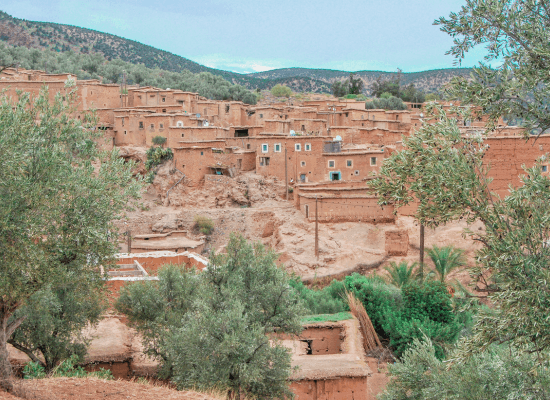
Sidi Ifni is a striking architectural anomaly. As a former Spanish colonial enclave that was handed back to Morocco only in 1969, the town looks and feels like a ghost town from a different dimension. The streets are lined with fading, white and blue Art Déco villas, geometric administrative buildings, and forgotten plazas that echo the Spanish « Movida ». It is a place caught beautifully between two worlds, where signposts still carry echoes of Iberian design, yet the language of the streets is a rich blend of Tachelhit (Berber) and Moroccan Darija.
The city’s layout is deeply vertical. Cobblestone streets plunge down toward lonely beaches, and old sea-facing balustrades look out onto an infinite blue horizon. There are no luxury resorts here, no curated tour buses. The town’s beauty lies in its elegant decay and the rhythmic, unhurried pace of its local inhabitants, who navigate their historic, wind-swept streets with a calm grace that mirrors Bouaddi’s own movements across the grass.
Legzira and the Architecture of the Atlantic
Just a short journey from the town center lies the crown jewel of the province’s raw coast: the monumental arches of « Legzira« . Here, centuries of Atlantic storms and fierce winds have carved massive, cathedral-like openings into the sheer red sandstone cliffs.
[THE RED ARCH OF LEGZIRA]
| |
[THE OCEAN FORCE] ——–> | | <——– [THE CLIFF ANCHOR]
(Unpredictable Chaos) | | (Ancestral Stability)
/ \
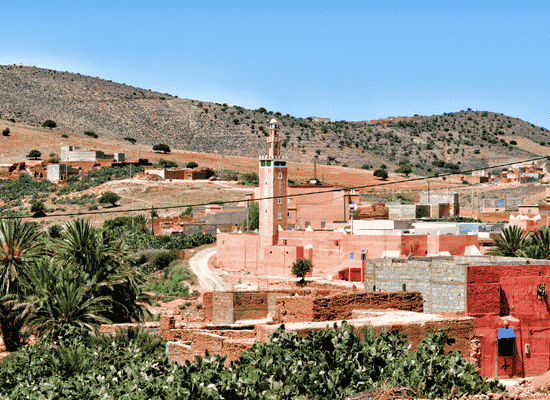
Standing beneath these colossal natural structures at low tide, with the ocean spray dampening your face, you feel the true elemental identity of the province. It is a landscape of immense, slow-cooked power. The arches represent structural resilience a masterclass in natural engineering that stands firm against the chaotic, unpredictable fury of the sea. It is an image that perfectly evokes Bouaddi’s role in the midfield: a immovable, calming structure standing tall amidst the high-velocity chaos of international football.
The Ritual of Noctourisme: The Arrival of the « Irifi »
To experience the true, mystical soul of Sidi Ifni, one must remain in the streets after twilight. As darkness settles over the ocean, the region’s signature weather phenomenon begins: the Irifi (the heavy, dense sea fog).
Within minutes, the warm desert air coming from the interior collides with the freezing Atlantic current, sending massive, silent pillows of white mist rolling up the red cliffs and into the town’s Spanish-era squares. The street lamps turn into dim, amber halos. The blue-and-white houses become silhouettes, and the entire city is wrapped in a profound, hushed silence, broken only by the rhythmic, distant boom of the ocean below. Walking through Sidi Ifni during the « Irifi » is a deeply meditative travel experience. It teaches you to appreciate visibility in tight spaces, to move forward safely when the horizon is completely obscured the exact trait Bouaddi utilizes when weaving passes through a crowded, suffocating midfield.
3. Guelmim: The Gates of the Sahara and the Nomad Dialect
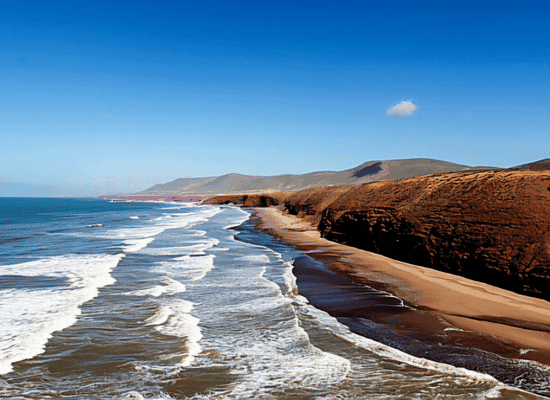
Travelling inland from the coast, the ocean breeze dies away, replaced by the dry, immense warmth of the pre-Saharan plains. The crimson clay turns to golden gravel, leading you straight to « Guelmim », historically celebrated as the ultimate « Gateway to the Desert. »
THE NOMAD TEA PROTOCOL: THREE SUCCESSIVE INFUSIONS
1. THE FIRST GLASS: « Bitter like life »
- Detail: Strong, highly concentrated gunpowder green tea leaves boiled over charcoal without sugar.
- Essence: A hard, bracing wake-up call to the senses, honoring the struggles of survival in an arid land.
2. THE SECOND GLASS: « Sweet like love »
- Detail: Infused with massive blocks of local sugar cones and freshly plucked mountain mint.
- Essence: Balanced, warm, and deeply comforting; a symbol of hospitality and communal gathering.
3. THE THIRD GLASS: « Suave like death »
- Detail: A slow, syrupy pour, heavily aromatic, often featuring wild desert herbs like wormwood (Sheeba).
- Essence: The final, lingering memory that stays with the traveler long after the fire has turned to ash.
For centuries, Guelmim was one of the most important trading hubs in North Africa, the final destination for trans-Saharan caravans traveling from Timbuktu. Today, that nomadic heritage still pulses through the city’s veins. Every Saturday, the city comes alive for the famous camel market (Souk Amhaich), where traders draped in flowing blue Saharan robes (Dara’a) gather to bargain with sharp, minimalist gestures.
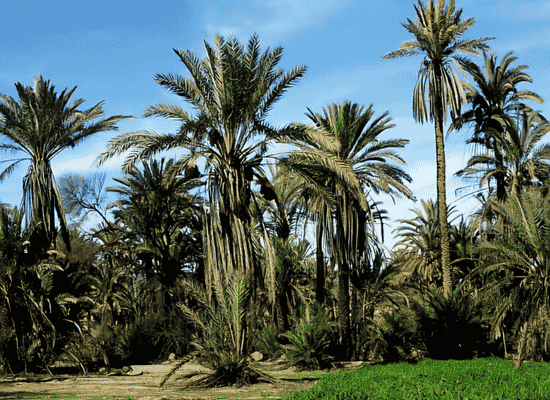
The gastronomy here reflects this minimalist, desert reality. There are no complicated sauces or delicate garnishes. Life and sustenance are boiled down to their absolute essentials: slow-roasted lamb cooked in underground clay pits, fresh dates from the Asrir oasis, and rich camel milk.
Sitting in an open-air tent on the edge of the palm groves, participating in the timeless, slow-cooked ritual of the three desert teas, you understand the value this culture places on time. Nothing is rushed. Every action requires patience, deliberation, and absolute focus. This exact discipline is what defines the Bouaddi household, where academic brilliance in mathematics is balanced seamlessly with athletic focus, proving that true excellence is a product of long-term structural cultivation rather than overnight luck.
4. The South Atlantic Track: Route Logistics for the Uncharted Traveler
For the true Walker, exploring this southwestern frontier requires stepping away from conventional transport maps and embracing the slower, unpredictable rhythms of regional overland travel.
LOGISTIQUE: SOUTHWEST COASTAL AXIS
- Primary Hub : Agadir Al-Massira Airport (Direct international connection)
- Transit Vector : Route Nationale 1 (RN1) southbound through Tiznit
- Coastal Variant : Route Régionale 104 (RR104) hugging the ocean cliffs to Sidi Ifni
- Optimal Season : Late Autumn through Early Spring (To avoid intense Saharan summer peaks)
The most authentic way to map this territory is via the network of « Grands Taxis » the shared, long-distance vehicles that serve as the vascular system of rural Morocco. Boarding a taxi at the station in Tiznit bound for Sidi Ifni is a lesson in regional geography.
[AGADIR / AL-MASSIRA GATEWAY]
│
▼ (Route Nationale 1)
[TIZNIT JUNCTION]
│
┌────────────────────────┴────────────────────────┐
▼ (Route Régionale 104) ▼ (Route Nationale 1)
[SIDI IFNI COASTAL ENCLAVE] [GUELMIM DESERT GATEWAY]
│ │
└────────────────────────┬────────────────────────┘
▼
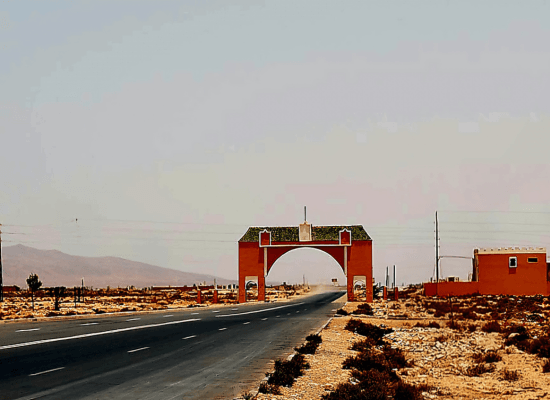
[THE SAHARAN OASIS ARCH]
The road twists through valleys thick with argan trees, where wild goats balance effortlessly on the thorny branches to eat the rich nuts. As the road approaches the coast, the driver navigates dramatic, unguarded hairpin turns carved straight into the red cliffs, with the vast expanse of the Atlantic filling the windows. The passengers often quiet fishermen or olive farmers ride in a comfortable, shared silence, watching the vast landscapes unfold with a serene patience that feels entirely unique to this corner of the world.
The Choice of the Heart and the Next Horizon
As the international sports media continues to debate the multi-million dollar future of Europe’s most coveted young midfielder, the quiet corners of Sidi Ifni and Guelmim remain blissfully unchanged. In the shade of the Art Déco arches or beneath the palms of the desert oases, the elders sip their mint tea, watching the next generation play football in the crimson dust.
Ayyoub Bouaddi’s decision to reject the tactical certainty of the French national setup to wear the star of Morocco is more than just a sports headline; it is a profound cultural statement. It proves that for the diaspora, the call of the ancestral soil is a powerful force that can completely rewrite a young life. By choosing Morocco, Bouaddi brought the geometric brilliance of his academic mind back to the very valleys that gave birth to his family’s resilience.
For the traveler who chooses to pack a bag and follow his roots down to the South Atlantic coast, the reward is an encounter with a Morocco that is wild, silent, and deeply authentic. It is a journey that teaches you that to move forward with absolute clarity on the world’s biggest stages, you must first know exactly where your foundations were poured.