
Thailand is a land of paradox. Most travelers fly into Bangkok, head south to the full-moon parties of the islands, or north to the elephant sanctuaries of Chiang Mai, following a path so well-trodden it’s visible from space. They see the « Land of Smiles » through the lens of a postcard, missing the soul of the country that lies just a few inches past the tourist curtain.
The real Thailand isn’t found in a luxury resort or a crowded tour bus. It’s hiding in plain sight. It’s in the steam rising from a noodle stall in an alleyway where no English is spoken; it’s in the silent nod of a monk in a mountain forest monastery; it’s in the dusty roads of the Isan plateau where life moves to the rhythm of the harvest, not the holiday calendar.
To find it, you have to be willing to get lost. You have to trade the comfort of the « all-inclusive » for the uncertainty of the local train. In this guide, we aren’t just looking for destinations; we are looking for a connection. We are peeling back the layers of the world’s most visited country to reveal a Thailand that is raw, spiritual, and deeply authentic.
Welcome to the Thailand you weren’t supposed to find.
- The Call of the Unknown – Why You’re Missing the Real Thailand
- The Secret North – Beyond the Chiang Mai Bubble
- Isan – The Beating Heart of Thailand
- Culinary Survival – The Street as Your Canteen
- Spiritual Immersion – Between Animism and Buddhism
- The Shadow Isles – The Deep South without the Crowds
- The Art of Local Transport – Mastering the Chaos
- The Jungle of the West – Sangkhlaburi and the Burmese Border
- Ethics and Respect – Traveling with a Conscience
- The Backpacker’s Toolkit – 2026 Gear, Budget, and Survival
The Call of the Unknown – Why You’re Missing the Real Thailand
Most travelers touch down at Suvarnabhumi Airport with a pre-packaged checklist: snap a photo at the Grand Palace, grab a Pad Thai on Khao San Road, and head straight for a full-moon party. But for the backpacker seeking soul over selfies, the Thailand seen on Instagram is often a polished mirage. The true « Land of Smiles » doesn’t reside in the all-inclusive resorts of Krabi or the neon-lit streets of Patong. It’s hiding in the red dust of Isan’s backroads, in the mist-shrouded peaks of the Burmese border, and in the quiet, wrinkled smiles of villagers who haven’t yet learned to see tourists as walking ATMs.
The Philosophy of the Slow Road
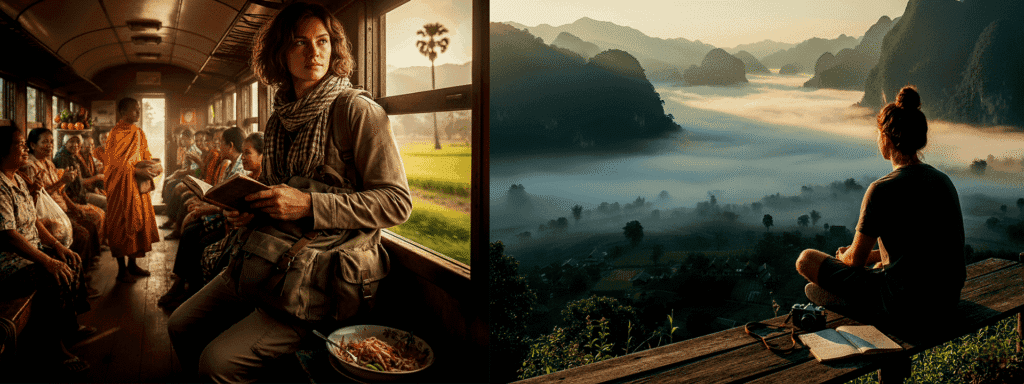
Traveling « Morocco Walker » style means trading the comfort of air-conditioned VIP buses for the rhythmic clatter of third-class trains. It’s a conscious choice to embrace the « dirt » and the « distance. » In 2026, traveling through Thailand is an act of resistance against mass-produced experiences. To find the heart of the country, you must be willing to get lost. You must accept that language is more than words—it’s a shared bowl of spicy Som Tum at a roadside shack or a nod of respect to a saffron-robed monk at dawn.
The essence of this journey is governed by three untranslatable Thai concepts that every true adventurer should carry in their pack:
- Mai Pen Rai : « It doesn’t matter » or « No worries. » It’s the art of letting go when the boat is late or the rain ruins your trek. It’s the backbone of Thai resilience.
- Sanuk : The pursuit of joy in everything. Even a hard day’s work or a grueling hike should have an element of fun.
- Nam Jai : « Water from the heart. » It’s the spontaneous generosity shown to strangers—a gift given with no expectation of return.
Breaking the « Banana Pancake Trail »
The « Banana Pancake Trail » was the legendary route defined by backpackers in the 70s and 80s. Today, much of it has become a conveyor belt of tourism. To find the « Unplugged » version of the country, we have to look at the gaps in the map.
Why head to a crowded elephant sanctuary when you can witness the ancient relationship between the Kui people and their elephants in the forgotten forests of Surin? Why wait in line for a sunset at a famous temple when you can watch the sun dip below the Mekong River in a town where you are the only foreigner for miles?
This odyssey guide isn’t about « Top 10 » lists. It’s about immersion. It’s about the sweat on your brow, the spice on your tongue, and the stories you’ll tell when the Wi-Fi is down and the stars are out. We aren’t just visiting Thailand; we are trying to understand the invisible threads that hold its 77 provinces together—from the animist spirit houses guarding the rice fields to the ultra-modern skyscrapers of Bangkok that still stop for the daily national anthem.
What to Expect from this Guide
Over the next nine chapters, we will bypass the tourist traps. We will trek through the secret valleys of the North, eat our way through the fiery kitchens of the East, and navigate the forgotten islands of the deep South. We will talk about the ethics of photography, the complexity of the « Face » culture, and the practicalities of surviving on a shoestring budget while gaining a wealth of experience.
Pack light. Leave your expectations at the gate. The road is calling, and it doesn’t have a paved path.
The Secret North – Beyond the Chiang Mai Bubble
While Chiang Mai remains the cultural heart of the North, it has become a sanctuary for digital nomads and artisanal coffee shops. To find the rugged, emerald soul of the mountains, the true backpacker must push further—west toward the Burmese border or east toward the forgotten peaks of Nan. This is where the road narrows, the air thins, and the ancient Lanna culture breathes without the filter of tourism.
1. Mae Sariang: The Quiet Frontier
Most travelers take the famous Mae Hong Son Loop, stopping in the « hippy-chic » town of Pai. If you want to escape the fire-spinners and yoga retreats, take the southern turn to Mae Sariang.
Tucked alongside the Yuam River, Mae Sariang is a town that time seemingly ignored. There are no nightclubs here; instead, you’ll find wooden shophouses and the gentle sound of temple bells. This is the gateway to the Salawin National Park, a wild frontier where the river forms the border with Myanmar.
- The Experience : Rent a small semi-automatic motorbike and ride toward the border. You’ll pass Karen tribal villages where life revolves around the seasonal rhythm of rice and corn.
- The Culture : Wake up at 6:00 AM to witness the silent alms giving. Unlike the crowded ceremonies in Luang Prabang, here it is a local, somber affair. The monks walk barefoot, and the connection between the community and the temple is palpable and raw.
2. Nan: The Forgotten Kingdom
To the east lies Nan, a province that was an independent kingdom until the late 19th century. Because of its geography, it remained isolated for centuries, preserving a unique dialect and architectural style.
- The Salt Wells of Bo Kluea : High in the mountains, ancient saltwater wells are still harvested by hand using traditional boiling methods. It’s a surreal sight—steam rising from bamboo huts against a backdrop of steep, jungle-clad mountains.
- Wat Phumin’s « Whispering Lovers » : In the provincial capital, this temple houses the most famous mural in Thailand. It depicts the « Whispering Lovers, » a man and woman in traditional attire. It’s not just art; it’s a window into the tattoos, fashion, and social norms of a vanished era.
3. The High-Altitude Weavers of the Hill Tribes
In the Secret North, textiles are the language of identity. This isn’t the mass-produced silk sold in Bangkok’s night markets. We are talking about Hmong, Lisu, and Akha weaving.
- The Craft : Deep in the hills of Doi Pha Hom Pok, women still use back-strap looms to weave hemp and cotton. The intricate embroidery tells stories of their ancestors’ migration from Tibet and Southern China.
- The Backpacker Tip : Don’t buy from a gift shop. Sit with a weaver. Even without a shared language, watching the indigo-stained fingers work the thread is a lesson in patience and cultural preservation. This is « Slow Fashion » in its truest, most ancient form.
For the adventure traveler, the journey is the destination. The North offers some of the most technical and breathtaking riding in Southeast Asia.
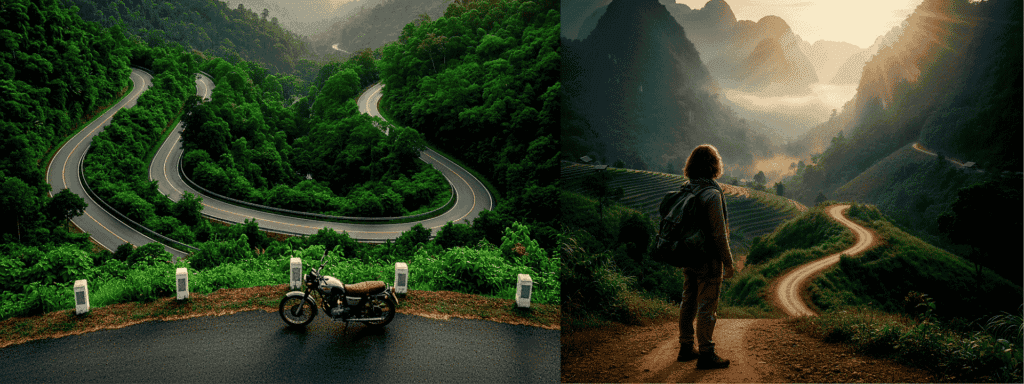
- Road 1148 : Frequently ranked among the top 10 motorcycling roads in the world, it winds through the mountains of Nan and Phayao. It’s a ribbon of asphalt draped over limestone karsts.
- The Reality Check : These roads are not for beginners. They require respect. The mist can settle in seconds, and a wandering water buffalo is a common « traffic hazard. » But as the sun sets over the « Sea of Mist » at Phu Chi Fa, and you’re standing there with a handful of locals, the 500 curves you just conquered feel like a rite of passage.
5. Staying « Roots »: The Mountain Homestay
In these regions, « hotels » are replaced by homestays.
- The Vibe : Expect a thin mattress on a bamboo floor, a mosquito net, and a cold-water bucket shower.
- The Reward : Dinner is usually whatever was harvested that afternoon—bamboo shoots, wild mushrooms, and spicy mountain chili paste. You aren’t a « guest » in the commercial sense; you are a temporary member of the family. The conversations, often fueled by a little local rice whiskey (lao khao), are where you’ll learn about the struggles of the « stateless » hill tribes and their incredible resilience.
The Secret North is a place of whispers rather than shouts. It demands that you slow down, kill your engine, and listen to the wind through the teak trees. It prepares you for the even deeper immersion that awaits in the next chapter of our journey.
Isan – The Beating Heart of Thailand
While the mountains of the North offer mystique, Isan (the Northeast) offers raw reality. Covering one-third of Thailand’s landmass but receiving only a tiny fraction of its international visitors, this is where the Thai identity is at its most resilient. It is a land of sharp contrasts: arid, sun-baked plains, electric-green rice paddies during the monsoon, and a 500-mile liquid border with Laos traced by the mighty Mekong River.
1. Isan Culture: Sticky Rice and Mor Lam
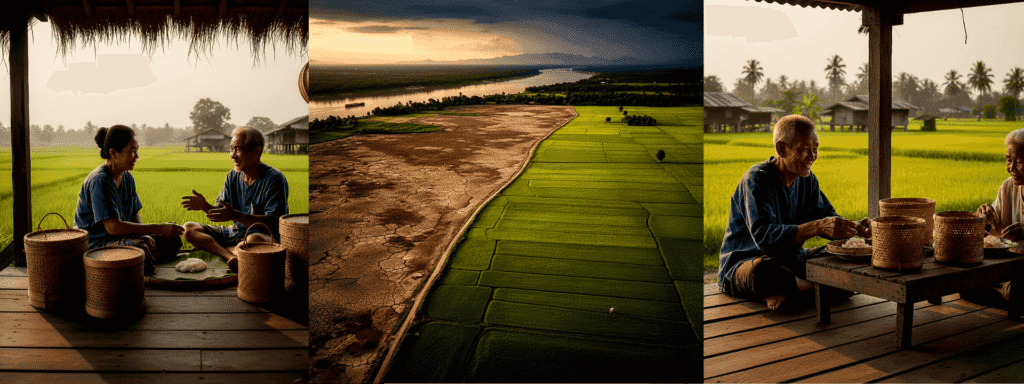
Isan is not just a geographical region; it is a culture of survival and joy. Here, the staple isn’t fragrant Jasmine rice, but Khao Niew (sticky rice), served in small hand-woven bamboo baskets.
- Mor Lam Music : Forget the polished pop of Bangkok. In the villages of Isan, the dominant sound is Mor Lam—folk music driven by the khene (a bamboo mouth organ). It is the music of storytellers, singing of unrequited love, rural poverty, and the grit of village life. Stumbling upon a village festival in Isan means being invited to dance with locals whose generosity is as spicy as their food.
- Raw Hospitality : In Isan, the concept of Nam Jai (water from the heart) is an unwritten law. Do not be surprised if a farmer invites you to share a meal on a bamboo mat. This isn’t a tourist performance; it is a way of life that hasn’t been commercialized.
2. Following the Gods: Forgotten Khmer Ruins
Long before the Thai people dominated this region, the Khmer Empire of Angkor reached its reach deep into this territory. Isan houses stone temples that rival those of Cambodia, but without the suffocating crowds.
- Phanom Rung : Perched atop an extinct volcano in Buriram province, this pink sandstone complex is a masterpiece. Walking the grand processional walkway at dawn, alone, is a spiritual experience you will never find at Angkor Wat.
- Phimai : Located at the end of the ancient Khmer Royal Road, this temple is fascinating because it blends Hindu and Buddhist iconography. It is here you truly grasp the religious fusion that still defines Thailand today.
3. The Mekong: Life Along the Mother River
Traveling Isan means following the Mekong. From Loei to Ubon Ratchathani, the river dictates the rhythm of life.
- Chiang Khan : While this wooden riverside town has become popular with Thai weekenders, it remains a sanctuary on weekdays. Rent a rusty bicycle and pedal along the river as the mist rises over the Lao mountains across the water.
- Sangkhom : For the true backpacker, this is the place to stop. It’s a village where you come to « do nothing. » Sit by the water, watch the fishermen cast their nets, and realize that time in Isan is merely a suggestion.
4. Isan Gastronomy: A Test of Courage
Isan cuisine is the most beloved food in Thailand, but the version you find here is uncompromising.
- Som Tum Pla Ra : Green papaya salad, but fermented with pungent, brined fish (pla ra). The smell is intense, the taste is deep, and it is the very soul of the region.
- Larb and Nam Tok : Meat salads saturated with dried chili, lime, and toasted ground rice for crunch.
- Grilled Insects : In the markets of Khon Kaen, crickets and bamboo worms are common protein-packed snacks. For a cultural explorer, trying these is a mark of respect for the local ingenuity in a land that was often difficult to farm.
5. Why Isan is the Ultimate Backpacker Frontier
Isan has no white-sand beaches. It has no dramatic jagged peaks like the North. So why go? Because it is the only place where you are not a « walking wallet. » You are a visitor, a guest, a curiosity. Traveling here requires patience—buses are slow, English is rare—but the reward is a profound understanding of what makes Thailand’s heart beat.
It is the land of homemade rocket festivals (Bun Bang Fai) and giant candle processions. It is Thailand unvarnished, rugged, and disarmingly kind.
Culinary Survival – The Street as Your Canteen
In the world of the adventure traveler, the street is not just a place to transit; it is the most honest restaurant in the world. In Thailand, street food isn’t a trend—it’s a social pillar. From the smoky alleys of Bangkok to the dusty roadside stalls of the deep provinces, eating on the sidewalk is where class barriers dissolve. The billionaire in his luxury car and the construction worker sit on the same plastic stools, sweating over the same bowl of spicy noodles.
1. The Anatomy of a Thai Street Stall
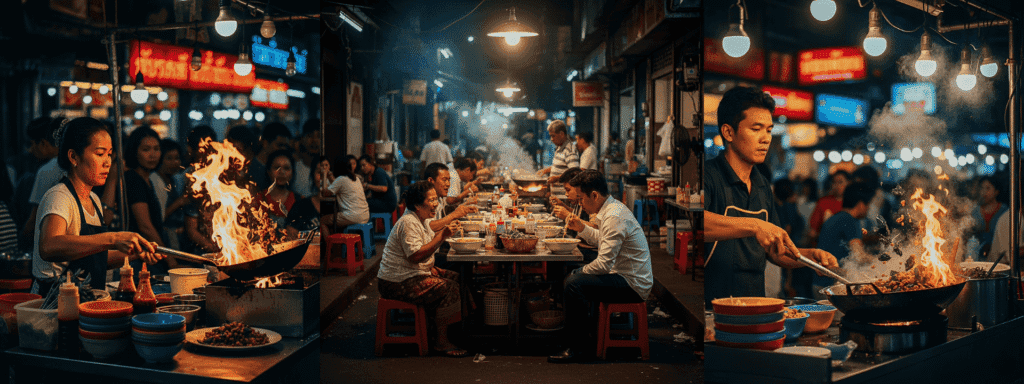
To the uninitiated, a Thai street market can look like a chaotic mess of bubbling pots and unidentified meats. But there is a hidden order to the madness.
- The Specialty Stall : Most vendors do only one thing, and they do it perfectly. One stall might only sell Hainan Chicken Rice (Khao Man Gai), while the neighbor only handles Noodle Soup (Kuay Tiew).
- The « Made-to-Order » (Ran Aharn Tam Sang) : These are the holy grails for backpackers. If you see a cart with a glass case full of fresh basil, chilies, and various meats, you’ve found a place that can cook almost anything on the spot. This is where you order your Pad Krapow (Holy Basil Stir-fry).
2. Etiquette: How to Eat Like a Local
Culture is served on a plate, but it is also found in the way you hold your spoon.
- The Fork and Spoon Rule : Thais don’t use forks to put food in their mouths. The fork is a tool used to push food onto the spoon. The spoon is the main event.
- Chopsticks are for Noodles : Unless you are eating a noodle soup or a Chinese-influenced dish, put the chopsticks down. Eating rice with chopsticks is a common tourist « faux pas. »
- Shared Dining : In Thailand, food is rarely a solo mission. Even if you are a solo traveler, the spirit of the meal is communal. Order several dishes and share (if you’re with a group), or acknowledge your neighbors.
For the backpacker, « spicy » is a rite of passage. But be warned: « Thai Spicy » is a different dimension of pain.
- Pet Nit Noi : « A little bit spicy. » (Usually 1-2 chilies).
- Pet Mak : « Very spicy. » (Proceed with caution).
- Mai Pet : « Not spicy. » (Even then, there might be residual heat in the wok).
- Pro Tip : If your mouth is on fire, don’t reach for water. Reach for more white rice or a sugary drink. The capsaicin in Thai chilies is oil-based; water just spreads the fire.
4. Survival: Avoiding the « Bangkok Belly »
One of the biggest fears of travelers is food poisoning. Ironically, street food is often safer than hotel buffets because the turnover is so high. The food is cooked at high heat right in front of you.
- Follow the Crowd : If a stall has a line of locals, the food is fresh and the quality is proven.
- Watch the Water : Most ice in Thailand is produced in factories and is safe to consume (look for the cylindrical ice with holes in the middle).
- The « Raw » Caution : Be careful with raw seafood or « dancing shrimp » in rural markets if your stomach isn’t yet acclimated.
5. Beyond Pad Thai: Dishes Every Explorer Should Know
If you’re still ordering Pad Thai after a week, you’re missing out on the soul of the country.
- Pad Krapow Moo Saap : The « real » national dish. Minced pork with holy basil and a lot of chili, topped with a crispy fried egg. It’s the ultimate fuel for a day of trekking.
- Khao Soi : A Northern specialty. A rich, coconut-based curry noodle soup topped with crispy fried noodles. It’s creamy, spicy, and deeply comforting.
- Som Tum (Papaya Salad) : As discussed in Part 3, this is the backbone of Thai flavor—salty, sweet, sour, and spicy all at once.
- Sai Oua : Northern Thai sausage filled with lemongrass, kaffir lime leaves, and galangal. It’s a flavor explosion that beats any western sausage.
6. The Night Market Culture
When the sun goes down and the heat breaks, the night markets (Talat Nat) come alive. This isn’t just about food; it’s the heartbeat of the community. In non-tourist towns, the night market is where you see the real Thailand—teenagers flirting, families strolling, and old men playing checkers. It’s an immersive sensory experience: the hiss of the wok, the smell of charcoal-grilled satay, and the vibrant colors of tropical fruits you’ve never seen before.
Eating in the street is a lesson in humility and presence. It forces you to sit in the heat, hear the traffic, and engage with the person cooking your meal. It is the bridge between being a « tourist » and being a « traveler. »
Spiritual Immersion – Between Animism and Buddhism
To walk through Thailand as an adventurer is to walk through a landscape thick with the invisible. While 95% of the population identifies as Theravada Buddhist, the spiritual reality on the ground is a fascinating, kaleidoscopic blend of ancient Hindu Brahmanism and even older indigenous Animism. For the backpacker, understanding this « spiritual cocktail » is the key to decoding why Thais behave the way they do—from the way they drive to the way they build their homes.
1. The Spirit Houses: Neighbors from the Other Side
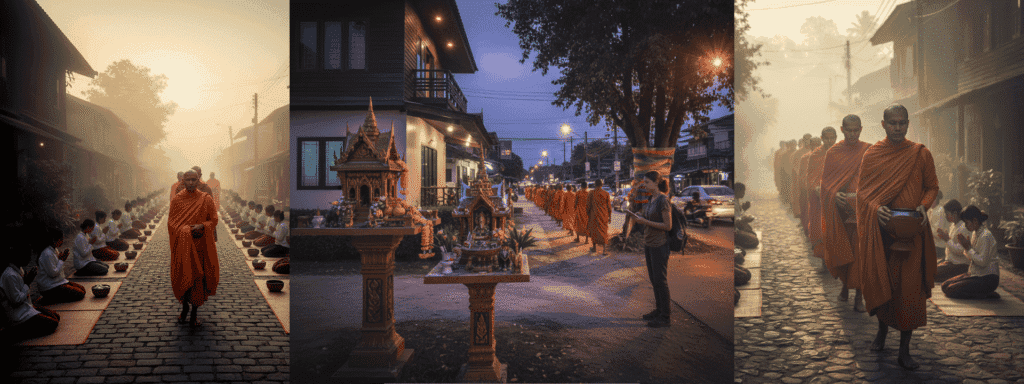
Look at any Thai building—from a humble shack in the Isan rice fields to a gleaming skyscraper in Bangkok—and you will see a small, ornate miniature temple perched on a pillar in the corner of the property. This is the San Phra Phum (Spirit House).
- The Belief : Thais believe that every plot of land is inhabited by a guardian spirit (Phra Phum). When humans build a house, they displace the spirit. To keep the peace, they must provide the spirit with its own residence.
- The Ritual : Notice the red Fanta bottles with straws, the fresh jasmine garlands, and the incense. These are daily offerings. Why red Fanta? Historically, blood sacrifices were offered; today, the red liquid symbolizes that ancient tradition in a non-violent way.
- The Lesson : This reveals the Thai desire for harmony. It is a daily reminder that we are not the sole owners of the world, but merely guests sharing space with other forces.
2. The Monkhood: A Saffron-Robed Society
The sight of a monk in bright saffron robes is the iconic image of Thailand, but the role of the monk goes far deeper than prayer.
- A Rite of Passage : It is tradition for almost every Thai male to ordain as a monk at least once in his life, usually for a few weeks or months, to earn « merit » for his parents. This means the man selling you street food or driving your motorbike taxi has likely spent time in a monastery, living a life of absolute simplicity and meditation.
- The Morning Alms (Binthabat) : At sunrise, monks walk barefoot through the streets. Locals wait with food offerings. This is not « begging »; it is a spiritual exchange. The layperson gains merit, and the monk receives the sustenance needed to continue his studies.
- Etiquette for Travelers : Never touch a monk if you are a woman (it requires a long purification ritual for him). If you are sitting near a monk, ensure your head is not higher than his.
3. Sak Yant: The Sacred Ink
You will see many Thais—and increasingly, travelers—with intricate geometric tattoos on their backs and chests. These are Sak Yant.
- More Than Art : These are not fashion statements; they are spiritual talismans. Traditionally tapped into the skin with a long bamboo needle by a monk or a Reusi (spiritual master), they are believed to offer protection, strength, or luck.
- The Rules : A Sak Yant is only powerful if the wearer follows certain Buddhist precepts (such as not lying or not killing). If you seek a Sak Yant, do not go to a tourist tattoo parlor. Seek a Samnak (shrine) where the ritual involves chanting and a blessing. It is a painful, intense, and deeply cultural experience.
4. Animism: The Ghost Culture
Thailand is a land obsessed with ghosts (Phi). From the terrifying Mae Nak (the ghost mother) to the playful spirits of the trees, the supernatural is a constant topic of conversation.
- The Banyan Tree : If you see a massive tree wrapped in colorful silk ribbons, do not touch it. It is believed to be the home of a powerful spirit. Thais will often honk their horns when passing a sacred tree or a roadside shrine to show respect.
- The Power of the Amulet : Look at the necks of Thai men. You will often see heavy gold or plastic casings holding clay amulets. Some of these are worth thousands of dollars. They are believed to make the wearer « bulletproof » or « charismatic. » This is the intersection of faith and protection in an unpredictable world.
5. Meditation: The Silent Journey
For the traveler looking to go inward, Thailand offers some of the most authentic meditation retreats (Vipassana) in the world.
- The Experience : Places like Wat Suan Mokkh in the south or various forest monasteries in the north offer 10-day silent retreats. You sleep on a wooden pillow, eat two meals a day, and wake up at 4:00 AM.
- The Why : It is the ultimate « unplugging. » In the silence, you confront the « Monkey Mind »—the constant chatter of the ego. It is the most grueling and rewarding « trek » you will ever take, and it costs nothing but your dedication.
Understanding Thai spirituality is about recognizing that for the people here, there is no wall between the sacred and the profane. The temple is a playground, a community center, and a place of worship all at once. As a backpacker, when you bow (Wai) to a Buddha image or step over a threshold instead of stepping on it, you are acknowledging a world that is much older and deeper than the one you left behind.
The Shadow Isles – The Deep South without the Crowds
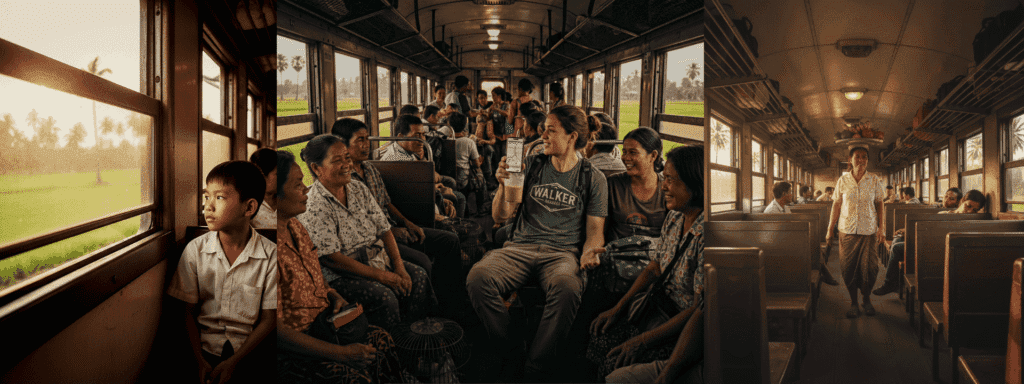
While the world flocks to the limestone cliffs of Railay or the neon-lit beaches of Koh Phi Phi, the true explorer looks further south. The Andaman coast, stretching toward the Malaysian border, holds a secret archipelago of islands where the « Full Moon Party » is replaced by the call to prayer from a mosque and the sound of the wind through the casuarina trees. This is a region of turquoise waters, nomadic sea people, and islands so wild they once served as prisons.
1. Koh Tarutao: The Pirate Prison Island
Located in the far south of the Satun province, Koh Tarutao is the largest island in the national park of the same name. Its history is as rugged as its jungle.
- The Dark Past : In the 1940s, Tarutao was used as a penal colony for political prisoners. During World War II, when food supplies from the mainland were cut off, the prisoners and guards joined forces to become pirates, raiding ships in the Malacca Strait.
- The Vibe Today : There are no resorts, no ATMs, and no 7-Elevens. You stay in basic National Park bungalows or tents. It is a place for those who want to hike through old-growth rainforest, explore « Crocodile Cave, » and cycle along abandoned roads where the macaques outnumber the people.
2. The Trang Archipelago: Koh Libong and the Dugongs
North of Tarutao lies the Trang province, home to a cluster of islands that remain remarkably « Thai. » While Koh Kradan is famous for its crystal-clear water, Koh Libong is the choice for the cultural traveler.
- The Dugong Sanctuary : Libong is one of the last places in the world where you can see the rare dugong (sea cow) in the wild. You don’t see them from a glass-bottom boat; you hire a local fisherman to take you out in a longtail boat at high tide to watch them feed on sea grass.
- Muslim Fishing Villages : The island is predominantly Muslim. Life revolves around the tides and the rubber plantations. Walking through the village of Ban Phra Muang, you’ll see dried fish hanging in the sun and elders drinking tea, offering a glimpse of a coastal life that hasn’t changed in decades.
3. Koh Phayam: The « Old School » Vibe
In the North Andaman Sea, near the border of Myanmar, lies Koh Phayam. If you ever wondered what the Thai islands felt like in the 1980s, this is it.
- No Cars, No Problems : There are no cars on Phayam—only motorbikes and bicycles on narrow concrete paths. The island is shaped like a kangaroo and is famous for its cashew nut plantations.
- The Long Beach (Aow Yai) : This isn’t your typical white-sand beach. It’s a vast, grey-sand bay with rolling waves perfect for beginner surfers—a rarity in Thailand. The bars here are built from driftwood, and the electricity often comes from solar panels and generators.
4. The Moken: Nomads of the Sea
In the waters around the Surin Islands and the southern archipelago, you may encounter the Moken, often called « Sea Gypsies. »
- A Life on Water : Traditionally, the Moken lived on wooden boats called kabang for most of the year. They are legendary divers, capable of seeing clearly underwater and holding their breath for incredible lengths of time.
- The Struggle for Identity : Today, many Moken have been forced to settle in permanent villages. As a traveler, it is crucial to visit with respect. Avoid « human zoo » tours. Instead, seek out community-based tourism initiatives that allow you to learn about their incredible knowledge of the ocean without infringing on their dignity.
5. Staying Safe and Respectful in the Deep South
The far south of Thailand (provinces like Pattani, Yala, and Narathiwat) has a complex political history. While the islands like Koh Lipe are safe and popular, the mainland provinces are under travel advisories for many.
- The Cultural Shift : As you move south, the culture shifts from Buddhist to predominantly Muslim. Respect the local norms: dress modestly when not on the beach, and be aware that alcohol is not as widely available or socially accepted as it is in the north.
- The Reward : Because fewer westerners travel here, the hospitality is often more intense. You are seen as a guest of the community, and the connections you make are often deeper and more sincere.
The southern islands are not just about tanning; they are about the relationship between man and the sea. Whether you are trekking through the prison ruins of Tarutao or watching a dugong breach the surface in Trang, you are witnessing a side of Thailand that refuses to be tamed by the tourism industry.
The Art of Local Transport – Mastering the Chaos
For the « Morocco Walker » style traveler, the journey isn’t a hurdle to get over—it is the story. In Thailand, your choice of transport is a statement of intent. You can take a domestic flight and see nothing but clouds, or you can board a third-class train and see the soul of the country. Navigating Thailand’s transport system is an exercise in « Mai Pen Rai »—it requires patience, a sense of humor, and a willingness to be part of the « organized chaos. »
1. The Third-Class Train: The Ultimate Window
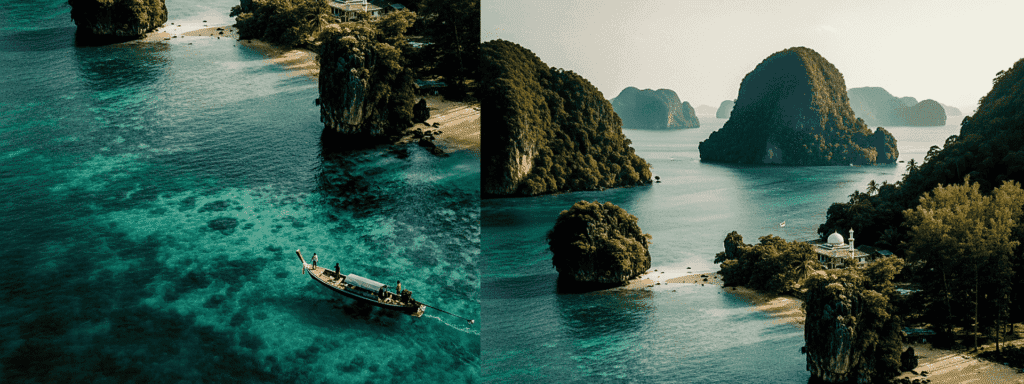
There is no better way to see Thailand than from the open window of a third-class carriage. It is the cheapest, slowest, and most rewarding way to travel.
- The Atmosphere : Forget air-conditioning. You have ceiling fans and the natural breeze. The « soundtrack » is the rhythmic clack-clack of the rails and the calls of vendors who hop on and off at every station selling grilled chicken, cold water, and bags of sliced pineapple.
- The Social Experience : You aren’t separated from the locals by a glass pane. You are sitting on a wooden or padded bench across from a grandmother going to market or a student headed home. Sharing a snack or a smile here is the best way to break the ice.
- The View : The train lines cut through the backyards of Thailand—through the middle of rice paddies, past hidden temples, and into the heart of rural villages where the road doesn’t go.
2. The Songthaew: The People’s Pickup
Outside of Bangkok, the Songthaew (literally « two rows ») is the backbone of local transit. These are pickup trucks converted into buses with two benches in the back.
- How to Use It : There are no fixed stops. You flag it down like a taxi. When you want to get off, you press the buzzer on the roof.
- The Color Code : In many cities (like Chiang Mai), the color tells you the route. Red stays in the city, while yellow, blue, and green go to the surrounding mountain districts.
- The Etiquette : It’s a communal space. Move up to make room for others, and pay the driver through the window when you hop out. It’s the ultimate « low-cost, high-immersion » transport.
3. The Motorbike: Freedom on Two Wheels
In the North or on the islands, renting a « scooter » (usually 125cc) is the backpacker’s rite of passage. It gives you the power to find that waterfall or hidden temple that isn’t on any map.
- The Reality Check : Thailand has some of the most dangerous roads in the world. This is not the place to learn how to ride. Always wear a helmet (even if locals don’t), have an international driving permit, and watch out for sand on the turns.
- The Unspoken Rules : The « Right of Way » usually belongs to whoever is bigger. If a truck is coming toward you, move. In Thailand, driving is like water—it flows around obstacles rather than stopping for them.
4. Hitching and the « Pick-up Culture »
In remote areas like the Isan or the deep North, public transport can be non-existent. This is where the Thai spirit of Nam Jai shines.
- The Thumb vs. The Hand : Thais don’t usually use the « thumb » to hitchhike. Instead, extend your arm with your palm facing down and move it slightly up and down.
- The Experience : Hitching a ride in the back of a farmer’s pickup truck is a quintessential adventure. You’ll be sitting among bags of rice or crates of fruit, feeling the wind in your hair and seeing the landscape in 360 degrees. Most Thais are incredibly helpful and will go out of their way to drop you at a main road or a bus station.
5. Night Buses and « VIP » Coaches
When you need to cover 800 kilometers in a night, the sleeper bus is your best friend.
- The Government Bus (BKS) : These are the most reliable. Avoid the private « backpacker buses » sold on Khao San Road—they are famous for petty theft and breakdowns. Go to the official terminal and buy a ticket for a 999 Government Bus.
- The Cold Factor : Thai buses are famous for « Arctic-level » air conditioning. Even if it’s 35°C outside, it’s 15°C inside. Always keep a hoodie or a sarong in your daypack.
6. The Longtail Boat: The Spirit of the Water
In the South or on the canals of Bangkok, the longtail boat (Ruea Hang Yao) is the iconic mode of transport. Driven by a massive car engine on a long pole, it is loud, spray-filled, and incredibly fun.
- Supporting Locals : Hiring a local fisherman for a day to take you to « no-name » beaches is much better for the local economy than taking a massive tourist catamaran. You get to decide when to stop and how long to stay.
Mastering Thai transport is about embracing the delay. If the bus is late, it’s an opportunity to have another iced coffee. If the train stops in the middle of a field, it’s a chance to look at the buffalo. When you stop worrying about the arrival time, the traveling becomes the best part of your trip.
The Jungle of the West – Sangkhlaburi and the Burmese Border
While many travelers stop their westward journey at the famous « Bridge over the River Kwai » in Kanchanaburi, the true adventurer keeps going. Three hundred kilometers further, where the road begins to twist like a dying snake through the Tenasserim Hills, lies Sangkhlaburi. This is a place where Thailand ends and a complex, misty frontier begins. It is a land of refugees, rebels, and a profound cultural fusion between Thai, Mon, and Burmese peoples.
1. The Mon Bridge: A Testament to Faith
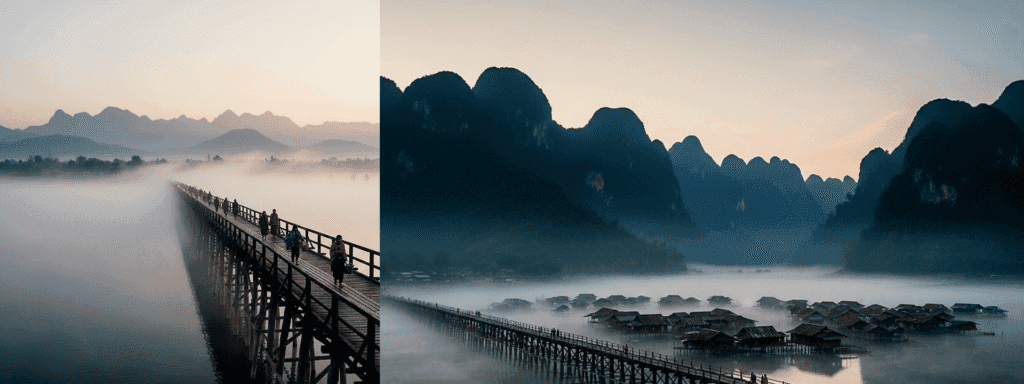
The icon of Sangkhlaburi is the Saphan Mon, the longest wooden bridge in Thailand. Built by the Mon community under the leadership of a revered monk, Luang Phor Uttama, it spans the Song Kalia River, connecting the Thai side of town to the Mon village of Wang Kha.
- The Morning Ritual : Every morning at dawn, the bridge becomes a stage for a silent, beautiful alms-giving ceremony. Mon women, often with thanaka (a yellow cosmetic paste) swirled on their cheeks, carry offerings on their heads with incredible grace.
- The Symbolism : The bridge isn’t just a transport link; it is a symbol of the resilience of the Mon people, an ethnic group from Myanmar who found sanctuary here. Walking across it at 6:00 AM as the mist rolls off the water is one of the most cinematic experiences in all of Southeast Asia.
2. The Sunken Temple: Remnants of the Past
In the 1980s, the construction of the Khao Laem Dam flooded the original town. Today, you can hire a local boatman to take you out onto the lake to see the Sunken Temple (Wat Sam Prasop).
- The Experience : Depending on the season, the temple is either partially submerged or standing on dry, cracked earth. Exploring the bell tower and the skeletal remains of the main hall as the water laps at the bricks is a haunting reminder of the cost of progress and the impermanence of things—a core Buddhist concept.
3. The Three Pagodas Pass: The Edge of the World
An hour’s drive from Sangkhlaburi is the Three Pagodas Pass, the historic gateway into Myanmar. This mountain pass has seen centuries of armies, from ancient Siamese-Burmese wars to the tragic construction of the « Death Railway » by Allied POWs in WWII.
- The Border Vibe : Today, it’s a quiet, slightly dusty border post. You can stand at the small, white pagodas and look across into Myanmar. It feels like the « edge of the world »—a place where the influence of the central government fades and the mountain laws take over.
- The Market : The border market here is a fascinating place to find Burmese jade, handmade cigars (cheroots), and traditional Mon textiles that you won’t find in the malls of Bangkok.
4. Cultural Immersion: Thanaka and Mon Food
Living in Sangkhlaburi is different from the rest of Thailand. The influence of Myanmar is everywhere.
- Thanaka Culture : You will see children and women with white or yellow patterns on their faces. This is thanaka, made from ground bark. It serves as sun protection, a skin conditioner, and a cultural badge of honor.
- The Food : Don’t leave without trying Burmese Curry or Mon-style noodles. The flavors are earthier, using more turmeric and ginger than traditional Thai cuisine. Look for the small shops near the bridge where people gather for breakfast.
5. Jungle Trekking and the « Green Desert »
The jungle surrounding Sangkhlaburi is part of the Thung Yai Naresuan Wildlife Sanctuary, a UNESCO World Heritage site. This is one of the most pristine forest systems in Southeast Asia.
- The Trek : This isn’t « jungle-lite. » Trekking here involves hacking through dense bamboo, crossing streams, and seeing wildlife like hornbills and, if you’re incredibly lucky (or unlucky), signs of wild tigers or elephants.
- Ethical Travel : Always hire a local Mon or Karen guide. They know the spirits of the forest and the hidden paths. It ensures your money goes directly to the community that protects this wilderness.
6. Why Sangkhlaburi Matters for the Backpacker
Sangkhlaburi is a lesson in empathy. Many of the people living here are « stateless »—they have no Thai ID and cannot travel freely. Despite this, the sense of community is overwhelming. For the traveler, it’s a place to check your privilege at the door. You come here to learn about the complexities of border politics, the strength of faith, and the beauty of a life lived at the end of the road.
It is a place where you stop being a tourist and start being a witness. The quietude of the lake, the creak of the wooden bridge, and the scent of Burmese incense stay with you long after you’ve returned to the chaos of the city.
Ethics and Respect – Traveling with a Conscience
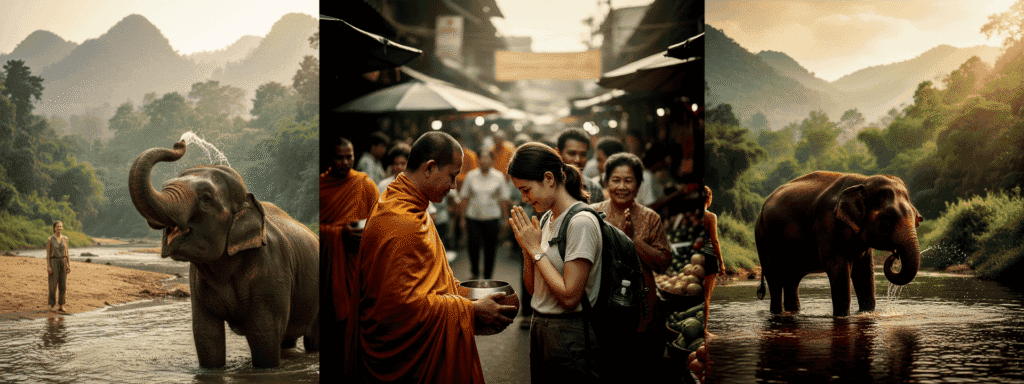
In a world of « instant travel, » being a backpacker is a privilege that comes with a responsibility. In Thailand, your actions carry weight. Because the Thai people are famously polite and conflict-averse (Greng Jai), they may not always tell you when you are being disrespectful. To truly walk the path of an explorer, you must understand the subtle social codes that keep the « Land of Smiles » in harmony.
1. The Concept of « Face » (Raksa Na)
The most important social currency in Thailand isn’t the Baht; it’s Face. « Saving face » means avoiding public embarrassment for yourself and, more importantly, for others.
- Never Lose Your Cool : Shouting, getting aggressive, or crying in a dispute won’t get you a discount or a solution—it will only make you look like you’ve lost control. If you encounter a problem, stay calm, smile, and negotiate quietly. A person who loses their temper loses their « face » and the respect of everyone watching.
- The « Mistake » Exit : If someone makes a mistake (like a wrong food order), don’t point it out bluntly. Say, « Maybe I didn’t explain clearly, » or « Perhaps there was a misunderstanding. » This allows the other person to fix the error without feeling shamed.
2. The Body Hierarchy: Heads and Feet
In Thai culture, the body is a spiritual map. The head is the most sacred part (the seat of the soul), and the feet are the lowest and « dirtiest. »
- Hands Off the Head : Never touch someone’s head, not even playfully ruffling a child’s hair. It is a major boundary violation.
- The Foot Faux Pas : Never point your feet at a person, a Buddha image, or the King’s portrait (this includes stepping on a rolling coin, as it has the King’s face on it). When sitting on the floor in a temple, tuck your feet behind you—never point them toward the altar.
- Step Over, Not On : When entering a temple or a traditional home, you will notice a raised wooden threshold. Step over it. Thais believe the guardian spirit of the house lives in the threshold; stepping on it is like stepping on the spirit’s head.
3. The « Elephant in the Room »: Ethical Wildlife
For decades, riding an elephant was the « must-do » backpacker activity. Today, we know better.
- The « No-Ride » Rule : If a sanctuary offers riding, shows, or uses chains and bullhooks, walk away. The process of « breaking » an elephant (Phajaan) to be ridden is incredibly cruel.
- True Sanctuaries : Look for « observation-only » parks where elephants can just be elephants. Ethical spots like Elephant Nature Park (Chiang Mai) or Boon Lott’s (Sukhothai) focus on rescue and rehabilitation. If you can wash them or ride them, it’s usually for the tourist’s ego, not the animal’s welfare.
4. Lèse-Majesté: Respecting the Monarchy
The Thai Royal Family is deeply revered. It is not just a cultural preference; it is the law.
- Watch Your Words : Avoid any negative comments, jokes, or even « political analysis » of the monarchy in public or on social media. The lèse-majesté laws are some of the strictest in the world and apply to foreigners too.
- The Anthem : If you are in a train station or a park at 8:00 AM or 6:00 PM, the National Anthem will play. Stand still. Everyone will stop what they are doing for those two minutes. Join them.
5. Dress Code: Beyond the Beach
While Thailand is hot, it is also conservative.
- Temple Etiquette : Always cover your shoulders and knees. Carrying a lightweight sarong in your backpack is the ultimate pro-move—you can wrap it around your waist or shoulders whenever you visit a sacred site.
- Daily Life : Walking through a local market shirtless or in a bikini top is considered rude and « low class. » Save the swimwear for the beach. By dressing modestly, you signal that you respect the local community, and you’ll often find that locals are much more open and helpful in return.
6. The « Wai »: More than a Hello
The Wai (pressing your palms together near your face) is a beautiful gesture, but it’s not a « high-five. »
- The Rule of Seniority : As a traveler, you generally don’t need to initiate a Wai to people younger than you or people in service roles (like waitstaff), though a polite nod and a smile go a long way. However, always return a Wai if given one. If you meet an elder or a monk, a deep Wai is a sign of high respect.
Traveling ethically in Thailand is about being a « ghost »—leaving a positive impression but no permanent scar. When you trade your « tourist rights » for « cultural respect, » the country opens up to you in ways you never imagined.
The Backpacker’s Toolkit – 2026 Gear, Budget, and Survival
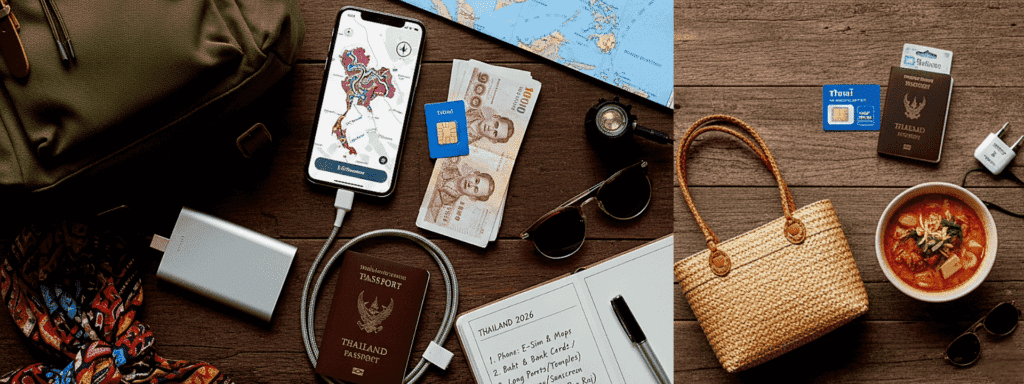
You’ve traced the map from the misty mountains of the North to the secret coves of the South. Now, let’s talk reality. To survive and thrive in Thailand in 2026, you need to balance old-school traveler wisdom with new-age digital tools. Here is your final checklist for the road.
1. The 2026 Budget: Managing Your Baht
While Thailand remains one of the most affordable destinations globally, prices have shifted. In 2026, the Thai Baht fluctuates around 32–36 THB per USD.
- The Daily Breakdown : For a « Morocco Walker » style traveler (hostels, street food, public transport), budget approximately 1,750–2,000 THB ($50–$60 USD) per day.
- The Island Tax : Expect to spend 20-30% more when you’re on the islands due to the cost of importing goods and the higher price of ferries.
- Pro Tip : Use a Wise or Revolut card to avoid terrible bank exchange rates, but always keep cash for rural markets and small stalls.
2. Digital Survival: Apps You Need
Your smartphone is your 2026 Swiss Army Knife. Download these before you land:
- Grab / Bolt : Essential for ride-hailing (including motorbike taxis) and food delivery when you’re too tired to scout the streets.
- 12Go Asia : The gold standard for booking trains, ferries, and buses across the country.
- Google Translate : Use the camera feature to translate menus in Isan or temple signs in Nan.
- ViaBus : If you’re brave enough to tackle Bangkok’s local bus system, this app shows you real-time GPS locations of the buses.
- Airalo or Saily (eSIM) : Don’t wait in line at the airport. Download an eSIM and get 5G data the second your plane touches the tarmac.
3. The Off-Piste Packing List
The golden rule of backpacking Thailand: If you think you need it, you probably don’t.
- The « Arctic » Layers : You’ll spend 90% of your time in shorts, but Thai buses and trains use air conditioning like a weapon. Always have one lightweight hoodie or a large sarong.
- Footwear : One pair of rugged sandals (like Chacos or Tevas) for everything, and one pair of lightweight trail runners if you plan on jungle trekking.
- Dry Bag : A 10L waterproof bag is essential for island hopping and protecting your tech during a sudden monsoon downpour.
- Power Bank : 20,000mAh is the sweet spot. Long bus rides and remote mountain villages aren’t always generous with outlets.
4. Logistics: Visas and Entry
As of 2026, entry requirements have become more digitized.
- The Arrival Card : Ensure you’ve registered for the Thailand Digital Arrival Card (TDAC) QR code before you fly.
- Proof of Funds : Technically, immigration can ask to see proof of 10,000 THB in cash or bank statements. It’s a random check, but it happens—be prepared.
- The Extension : Most tourist entries (60 days) can be extended for another 30 days at any local immigration office for 1,900 THB. It’s a rite of passage involving a lot of paperwork and a few hours of waiting, but it’s how you turn a trip into a journey.
5. Final Words: The Road is Yours
Thailand is a country that gives back exactly what you put into it. If you approach it with a « tourist » mindset, you will see the traps. If you approach it with the heart of a « walker »—humble, curious, and patient—the country will reveal its secrets to you.
Don’t be afraid of the wrong bus, the spicy soup, or the language barrier. In those moments of « useful frustration, » the real adventure happens.
Safe travels, and remember: The best stories are found where the pavement ends.
- MOROCCO WALKER
Ping : Phú Quốc Ultimate Immersion 2026