
The city does not announce itself; it exhales. I arrive not as a conqueror but as a patient listener, my footsteps tuned to the rhythm of a place that prefers whispers to proclamations. To arrive in Krung Thep (Bangkok) is to realize that maps are merely suggestions and that the soul of this metropolis refuses to be captured by a postcard.
I do not walk through the city; it flows through me—a rhythmic pulse of ancient teak and shimmering fiber optics. This is a sanctuary of contradictions where the « City of Angels » hides its wings behind a veil of neon and incense, waiting for those who know how to look beneath the surface of the Chao Phraya (River of Kings). I will refuse the postcard; I will insist on the seam. I am here to witness the invisible architecture of a titan that breathes through its canals and thinks through its silicon.
The Walker’s Pulse
- Route/Défi : Navigating the city’s hidden arteries—forgotten Khlongs (canals) and the shadowed thresholds of neighborhood temples—without a digital compass.
- Intensité : High-voltage sensory overload balanced by the sudden, profound silence of a hidden courtyard.
- L’Essence : The delicate friction between the saffron robe and the glass skyscraper; a palimpsest of rituals.
- Emotion : A visceral sense of belonging to a chaos that is perfectly orchestrated.
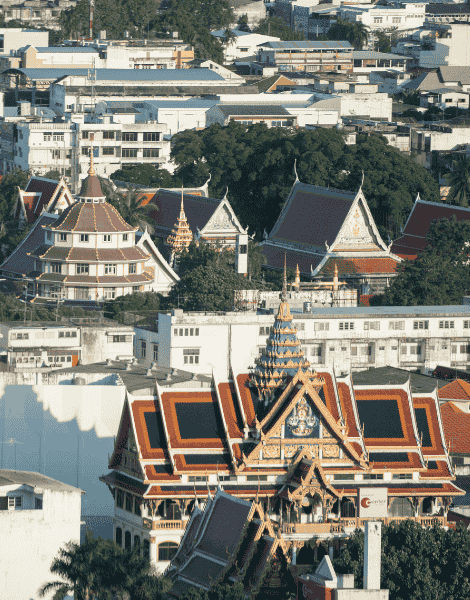
- Secret : The « Ghost Tower’s » shadow holds more history than the gilded monuments; the most revealing moments happen where the tourist trail thins.
The Liquid Threshold
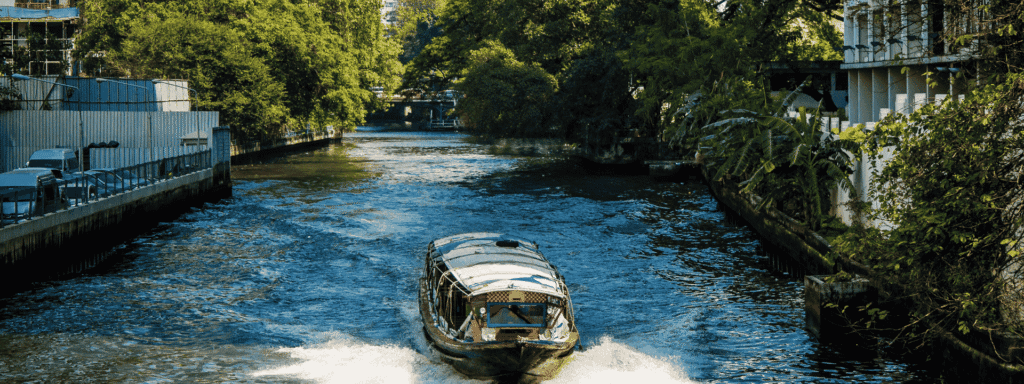
The water of the Khlongs (canals) does not reflect the sky; it swallows it, turning the azure above into a murky, emerald mystery. I stand at the edge of a rotting wooden pier in Thonburi, the vibrations of a long-tail boat’s engine rattling my marrow before the vessel even comes into view. This is the true nervous system of the city, a web of veins that ignored the asphalt revolution of the 20th century. While the world stares at the Grand Palace, the real power resides here, in the damp corners where orchid roots grip the mossy bricks of forgotten villas.
The boatman doesn’t speak; he communicates through the tension in his steering pole, a silent choreography developed over generations. We slide past stilt houses where laundry hangs like colorful banners of surrender. There is a specific kind of silence here—a density of sound where the splashing of a monitor lizard carries the weight of a thunderclap.
This is sustainable travel in its most primal form: moving with the current, not against it. My fingers brush against a submerged shrine, the cold ceramic tiles a sudden jolt against the tropical heat. I carry the river with me, the dampness clinging to my linen shirt like a second skin.
As we drift deeper into the labyrinth, the « Angle Mort » of the city reveals itself. Here, the « Invisible » is a way of life. I witness an elderly woman on a porch, her eyes milky with age but her hands precise as she cleans a plastic solar-powered lantern—a small, blue spark of Modernity Infused against the blackened wood of her ancestral home. The air smells of wet earth, jasmine garlands, and the faint, metallic tang of the outboard motor.
We pass under a low bridge where the concrete is etched with the names of forgotten kings. Above us, I can hear the muffled roar of the city’s modern traffic, but down here, time is viscous. A young girl sits on a floating tire, her eyes fixed on a high-end tablet encased in a waterproof sleeve. She is watching a tutorial on traditional dance, the digital glow reflecting in the ancient, silt-heavy water.
This is the bridge between eras—a seamless transition where the river remains the foundation for the cloud. As the boat moors near a crumbling temple wall that no guidebook mentions, a single petal of a frangipani flower falls into my palm, its fragrance a sharp, sweet contrast to the metallic tang of the engine.
Saffron Shivers
That sweetness lingers, a phantom scent that guides me away from the water and toward the awakening limestone of a neighborhood shrine. The sun is a pale disc struggling through the haze, but the light is already caught by the Kasaya (monk’s robes) of a lone figure moving with a gravity that slows the world.
The ritual of Tak Bat (morning alms) is often treated as a tourist spectacle in the brochures, but here, in the grey-blue light of dawn, it is a lesson in the Sacred Code. I watch from the shadows of a banyan tree, its roots strangling the pavement in a slow-motion heist.
The exchange is silent. A woman offers a small parcel of rice; the monk offers his presence. It is a profound economy of merit, a local secret that functions on the invisible currency of faith. To be a Morocco Walker is to understand that respect is a costume you never take off. I keep my head lower than the monk’s, my camera stays in my bag; the memory is more vital than the megapixels.
Modernity bleeds into this ancient scene with a quiet elegance. The monk pauses at a street corner, checking a sleek smartphone tucked into his waistband—the screen’s sapphire glow a sharp contrast against the burnt orange of his robe. He is checking the weather, or perhaps a digital sutra, but the gesture is so natural it feels as if the technology itself has been baptized in incense. This is the « Modernity Infused » reality: the digital and the divine don’t clash; they coexist in a state of mutual respect.
As I follow at a distance, the « History Brutale » of the neighborhood reveals itself. The walls are pockmarked with the history of floods, yet the residents have used high-tech water-resistant polymers to seal their doorsteps. They don’t fight the water; they acknowledge it. The monk turns a corner, the hem of his robe brushing against a high-speed fiber optic cable snaking up a telegraph pole—a vibrant orange spark against the black wire. The spark seems to ignite the air, as the first true heat of the day begins to shimmer off the road, drawing me toward the metallic pulse of the upper world…
The Concrete Canopy
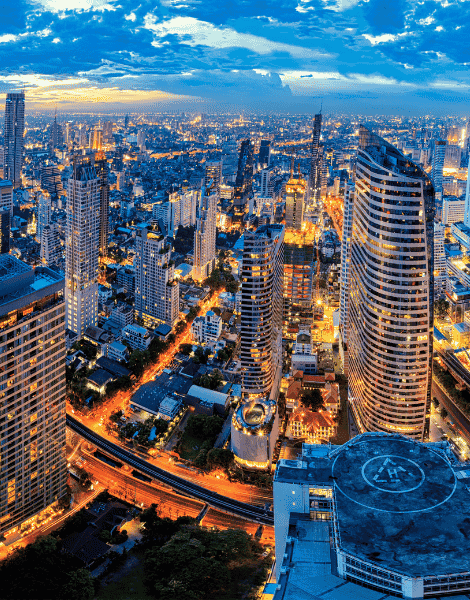
The asphalt vanishes, replaced by a vertical ascent into the ozone. The sticky, ground-level fever of Krung Threp retreats before the boreal breath of the Rod Fai Fa (Skytrain). Here, the sky is carved by blades of steel and pre-stressed concrete that serpentine between glass monoliths like cybernetic dragons. This is not mere transport; it is a clinical extraction. The world below, with its exhaled coriander and diesel, becomes a silent mosaic—a distant memory observed from a pressurized glass capsule.
Inside the carriage, a cathedral-like silence prevails, governed by a modern Sacred Code. It is broken only by the crystalline chime announcing Siam. Humanity here is tethered by invisible silver threads; the OLED screens of the latest smartphones cast sapphire flickers across stoic faces.
There is no jostling, only an undulating, synchronized grace. Outside the reinforced windows, the architecture narrates a History Brutale of relentless growth: colossal malls, glass cathedrals of commerce, straddle wooden shrines two centuries old. Ancient banyan roots grip the concrete pillars of the aerial tracks—a millennial struggle for territory where nature refuses to capitulate to fiber optics.
The perspective shifts radically. From this artificial canopy, the city’s hidden scalp is revealed: secret hydroponic gardens where Thai basil glows under violet UV lights, and infinity pools that seem to spill their turquoise contents into the void. The city never stops; it stacks. Stepping onto the platform at Sukhumvit, the vibration of the rail hums in the marrow of my heels—a low-frequency drone that aligns with the buzzing of an invisible hive, pulling the body toward the shadow of an alley where metal yields to fiber…
The Architect of Shadows
The hum of the rails fades, eclipsed by the sharp, rhythmic clacking of wooden looms. The path leads deep into Ban Khua, a geographic Angle Mort wedged between glass towers and the dark waters of the Saen Saeb canal. Here, the air changes texture; it grows heavy with the dust of raw silk and the scent of vegetable dyes. Sun-bleached teak walls lean inward, creating a temporal tunnel where time is no longer measured by processors, but by the passage of a shuttle between warp threads.
A tension of raw silk occupies the entirety of an atelier open to the alley. The hands at work here possess a memory that defies any algorithm. They do not merely weave; they trap the light. The silk of Krung Thep holds a specific, irregular grain—a soul that a machine can never simulate. This is the realm of the Invisible: ancestral motifs that appear in no fashion catalog, telling the story of a people who learned to transform an insect’s cocoon into royal armor.
The ethics of Sustainable Travel resonate in every inch of fabric. Every meter is an act of resistance. Modernity enters in subtle, jagged pulses: a digital tablet rests on a teak workbench, displaying global sales analytics for a luxury boutique in Paris, while beside it, a vat of indigo dye ferments according to a three-hundred-year-old recipe. This is Modernity Infused at its purest—the digital tool serving the ancestral gesture.
The narrative silence of the workshop is broken only by the whir of an oscillating fan dispersing the cloying scent of mulberry leaves. Upon leaving this sanctuary of shadows, a trace of crimson dye remains etched into the whorls of my fingertips—an organic signature that follows me toward the acrid, electric scent of the falling night…
The Alchemist’s Mortar
The crimson of the silk transmutes into the searing orange of a charcoal brazier. Night does not fall on Krung Thep; it ignites. The side streets—the Soi—become a laboratory of fire and ice. There is no search for a restaurant here, only a search for a sound: the heavy, hollow thud of a wooden pestle against a stone mortar.
The street alchemist does not cook; he performs a ritual of aggression and balance. Prik (chilies) are bruised with a calculated violence, releasing a capsaïcine cloud that stings the eyes and accelerates the pulse. The resulting Som Tum (green papaya salad) is a physical strike—a precarious equilibrium of lime-acid, fermented fish salt, and palm sugar.
This is a gastronomy of the immediate, stripped of all presentation. « Beauty » is banished in favor of the raw truth of the palate. Meals are taken standing up, amidst the roar of Tuk-tuks whose multi-colored neon underglow illuminates plastic plates like stage lights.
The Sacred Code of the city reveals itself in the shared sweat of the table. Corporate executives in silk suits stand shoulder-to-shoulder with construction laborers, unified by the pursuit of the perfect sting. No words are wasted. Modernity invites itself via QR codes taped to dented metal tables; the street fare is settled with a facial scan on a high-end smartphone.
The aroma of honey-grilled pork intermingles with the ozone of luxury air conditioners venting their heat into the street. This heat becomes a physical weight, a pressure that forces the eyes upward toward the summits, where the air finally promises to thin…
The Vertical Jungle
The weight of the street heat dissolves, not into air conditioning, but into the ancient, leafy embrace of Bang Krachao. To reach this place is to cross a liquid border where the city’s roar is strangled by the sheer density of the fern and the palm. This is the « Green Lung, » a fortress of emerald silence where the ground is not pavement, but a labyrinth of elevated concrete walkways snaking through a tidal wilderness.
The air here is thick, tasting of crushed chlorophyll and damp silt. It is a world of vertical layers: the dark, sucking mud of the mangroves below, and the chaotic canopy of mango and durian trees above. There are no sirens here, only the rhythmic, territorial call of the kingfisher and the rustle of the monitor lizard sliding into the brackish water. The architecture is a study in survival; wooden houses on stilts lean precariously over the mud, their timbers silvered by decades of humidity.
This is the Sacred Code of the wilderness—a coexistence with the swamp that predates the skyscraper. Every turn in the narrow path reveals a secret: a hidden clearing where wild orchids cling to the bark of a tamarind tree, or a small, hand-carved pier where the river provides the only transport. The silence is narrative, telling a story of a city that was once entirely like this—aquatic, green, and governed by the tides rather than the clock.
Neon Ancestry (The Shadow Shrine)
The « Neon » is left behind at the mouth of a nameless alley in Chinatown, where the only light comes from the flickering red glow of paper lanterns and the smoldering tips of giant incense coils. This is the Angle Mort of faith, a hidden shrine dedicated to the goddess of the sea, tucked behind a warehouse of rusting iron.
The scent of sandalwood is a physical barrier, thick enough to coat the throat. Inside, the walls are blackened by a century of smoke, creating a charcoal canvas for the gilded carvings of dragons that seem to writhe in the dim light. There is no digital hum here, only the dry, percussive sound of Chiam-chi (fortune sticks) being shaken in wooden cylinders—a wooden heartbeat echoing against the stone floor.
The History Brutale is etched into the faces of the statues, their gold leaf peeling like sunburnt skin to reveal the dark wood beneath. This is the soul of the diaspora, a place where the rituals of the sea were transplanted into the heart of the urban sprawl.
To stand here is to feel the weight of a thousand prayers for safe passage and prosperous trade. The floor is cold underfoot, a sharp contrast to the warmth of the candle flames. As a single drop of wax hits the floor, the sound carries through the silence, leading the way toward a doorway draped in heavy, dust-laden silk.
The Silk Thread’s Ghost
Beyond the shrine lies a courtyard that the sun has forgotten. It belongs to the « Invisible » masters of the needle, a dying enclave of embroiderers who work by the shifting light of the moon and the oil lamp. Here, the « Silk Thread’s Ghost » is the memory of a craftsmanship so fine it was once reserved for the robes of the celestial court.
The sound of the needle piercing the taut silk is like a soft intake of breath. The women sit in a circle, their spines curved by decades of devotion to the stitch. They do not use patterns; the designs—lotus flowers, celestial nagas, and geometric stars—are pulled directly from a shared ancestral memory. This is the Traditions Vivantes in its most fragile form, a craft that cannot be hurried or scaled.
The silk is not the shimmering, commercial variety found in malls; it is raw, heavy, and smells of the earth and the worm. Each piece takes months to complete, a testament to a philosophy of time that refuses the modern rush. To touch the fabric is to feel the labor of a lifetime.
The silence in this courtyard is heavy with the knowledge that when these hands stop, the thread may break forever. A soft breeze stirs the hanging fabrics, their shadows dancing on the cracked tiles like ghosts of a forgotten empire, guiding the senses toward the cool, pre-dawn mist of the water’s edge.
The Silent Market
The mist of the pre-dawn hours acts as a shroud, erasing the horizon and turning the world into a monochromatic dream. The path leads to the edge of the Talat Noi, where the damp stone of the riverbank exhales the scent of iron and ancient mud. This is the Angle Mort of commerce, a market that exists in the stillness before the first cockcrow, where the trade is conducted in a language of nods and soft whispers.
Mountains of Dok Mali (jasmine) petals rise from the shadows, their fragrance so concentrated it feels like a physical weight against the chest. There is no neon to guide the way, only the pale, ghostly glow of oil lamps reflecting in the puddles of melted ice.
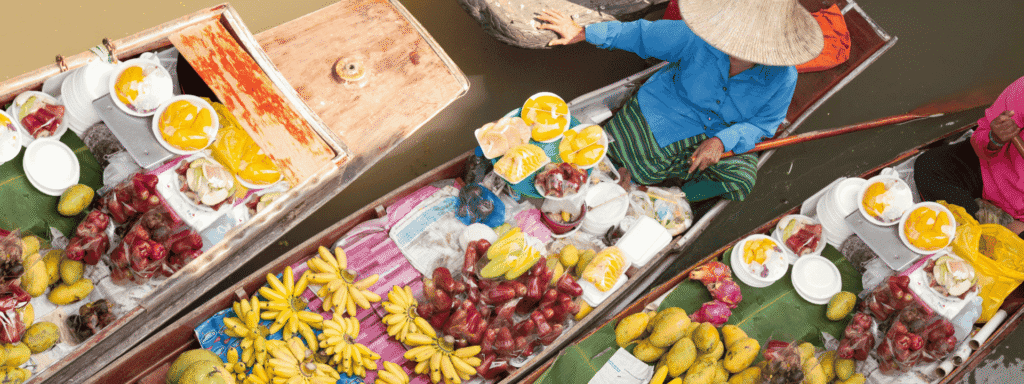
The ground is a mosaic of scales and petals—remnants of the river’s bounty and the earth’s fertility. Here, the Sacred Code of the provider is absolute; the finest catch and the most fragrant blooms are set aside for the temple offerings before a single coin is exchanged for profit.
The sound of the market is a low-frequency hum: the rhythmic scraping of scales, the splash of river water into wooden basins, and the distant, haunting toll of a bell from a hidden monastery. The History Brutale of the city’s survival is written in the calloused palms of the porters who carry baskets of galangal and lemongrass on their shoulders, their silhouettes moving through the fog like shadows of the ancestors.
It is a place of labor and devotion, where the city feeds its soul before it feeds its stomach. As the first hint of grey light begins to peel back the darkness, the scent of the jasmine gives way to the metallic, tidal breath of the open water.
The Eternal Current
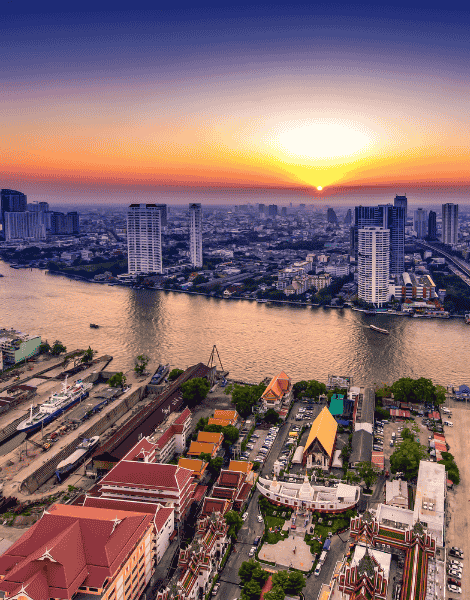
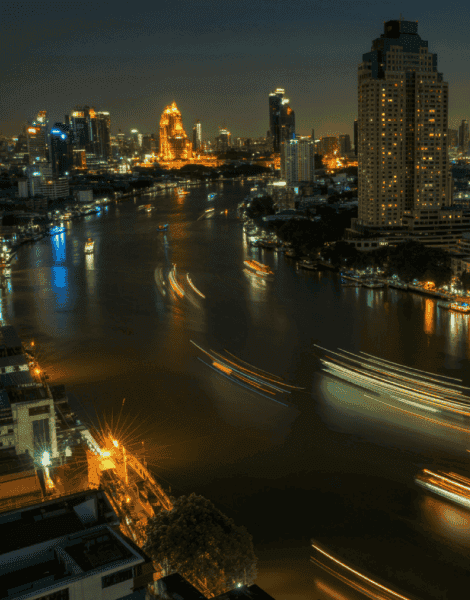
The final threshold is a crumbling pier of black teak, vibrating with the pulse of the Chao Phraya. The river is not a body of water; it is a moving archive, a liquid road that has witnessed the rise and fall of kings without ever changing its pace. The current is strong here, a dark, swirling force that tugs at the wooden pilings with a prehistoric hunger.
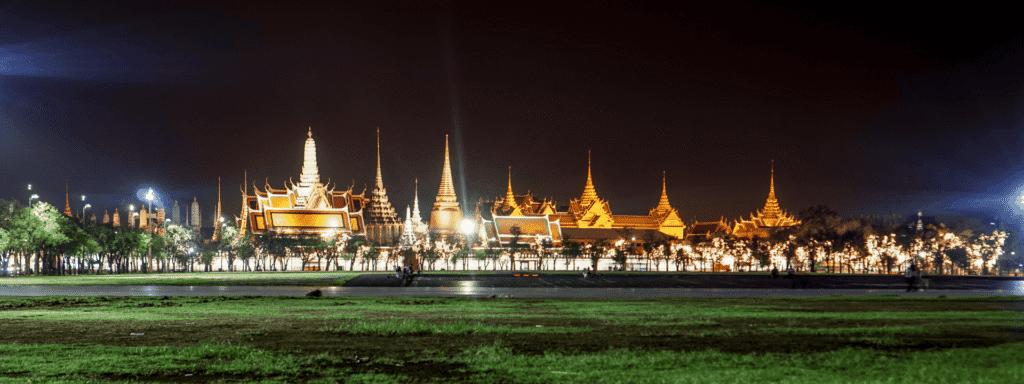
Looking out across the expanse, the « Invisible » geography becomes clear. The river is the center of the universe, the source from which every ruelle and every shrine draws its life. Small, wooden Ruea Hang Yao (long-tail boats) bob on the tide, their prows draped in colorful silks to appease the water spirits. This is the Eternal Current, a reminder that despite the concrete and the ambition of the land, the water remains the ultimate master of Krung Thep.
The silence of the dawn is a narrative in itself—a pause between the breath of the past and the exhale of the future. The city does not end at its borders; it dissolves into the river, carrying the prayers, the silk threads, and the scents of the market toward the sea.
To stand here at the edge of the world is to feel the heartbeat of a titan that is both ancient and immortal. The journey does not conclude; it merely flows back into the source, leaving behind a trail of incense smoke and the memory of a city that sleeps with one eye open to the stars.
« นกไม่มีขน คนไม่มีความรู้ บินไม่สูง »
(A bird without feathers, a man without knowledge; neither can fly high.)
- MOROCCO WALKER