
We leave behind the mystical mists of the Thai mountains to rediscover the coppery warmth of the Moroccan Great South. If Taroudant was an urban stopover, the Moussem of Tan-Tan is a nomadic explosion—a mirage coming to life in the heart of the desert.
Here is the chronicle of this legendary gathering, where the sand stands as the ultimate witness to a culture that refuses to fade away.
-
The Moussem of Tan-Tan: The Great Diwan of the Blue Men
- The Arrival: An Ephemeral City of Cloth
- The Fantasia: A Dance of Fire and Powder
- The Guedra: The Rhythm of the Earth
- The Desert Economy: The Camel Parliament
- The Indigo Veil : The People of the Cloud
- The Poetry of the Sands : The « Ghoum »
- The Sacred Geometry of the Tents
- The Modern Nomad – Tradition in the 21st Century
The Moussem of Tan-Tan: The Great Diwan of the Blue Men
There is a place, on the far edges of the Sahara, where the wind does not merely sculpt the dunes: it carries songs, the scent of searing mint tea, and the shrill whinny of high-blooded stallions. For the modern explorer, the map usually ends where the sand begins. But once a year, the desert awakens. Welcome to the Moussem of Tan-Tan in Morocco.
For decades, this gathering was forbidden, forgotten, and relegated to the nostalgic shadows of tribal memory. But in 2004, under the aegis Morocco and of UNESCO, this « Proclaimed Masterpiece of the Oral and Intangible Heritage of Humanity » reclaimed its birthright. To stand here is to witness a living miracle: a mirage that refuses to vanish, a city of cloth that rises from the dust to celebrate a culture that refuses to die.
The Arrival: An Ephemeral City of Cloth
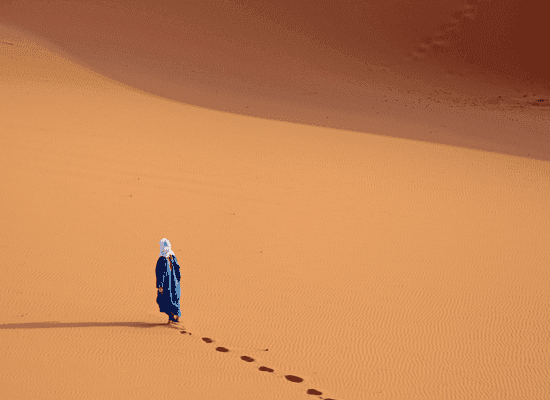
You do not arrive at the Moussem by following a GPS; you follow the dust clouds of distant caravans and the rhythmic thrum of drums echoing off the hamada (stone desert). Imagine a parched, desolate plain—the M’seyred—suddenly smothered by hundreds of khaymas, the traditional tents woven from camel or goat hair.
The Moussem is not a festival curated for cameras or a staged performance for tourists; it is a family reunion on a continental scale. More than thirty nomadic tribes from the Moroccan Sahara, as well as from Mauritania, Mali, and Niger, converge upon this exact point. The air vibrates with an electric tension. Here, you begin to grasp the quiet dignity of the Sahrawi people: the men draped in their voluminous indigo-blue derras, faces partially masked by the litham (veil), and the women, sovereign in their melhfas—vibrant silken wraps that flutter like prayer flags in the relentless trade winds.
The Fantasia: A Dance of Fire and Powder
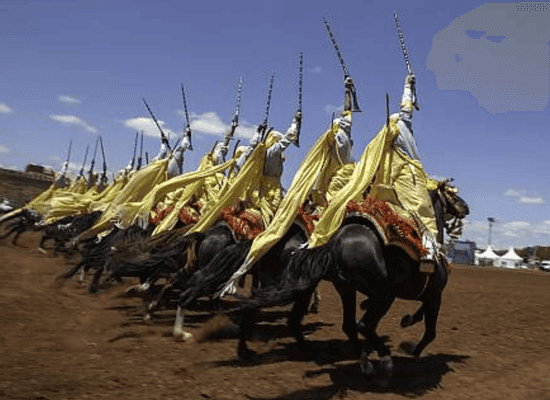
The heartbeat of the event is the Tbourida. It is a spectacle of raw power and absolute discipline. At a sudden signal, a line of horsemen—the « Sereba »—charges at a full gallop, forming a tidal wave of muscle, silk, and dust. Their long-barreled muskets, encrusted with silver and bone, point toward the heavens.
At the commander’s cry, a single, deafening blast shatters the air in perfect unison. This is not merely a display of equestrian skill; it is an act of faith, a celebration of the visceral bond between the rider and his mount. The acrid smell of burnt gunpowder mingles with the sweat of the horses and the kicked-up sand, creating a primitive intensity that vibrates in your very marrow. It is the sound of history refusing to be silenced.
The Guedra: The Rhythm of the Earth
As night falls and the implacable sun dips below the horizon, the Moussem wears a different, more mystical face. The orange glow of campfires replaces the daylight, and the air cools. This is the hour of the Guedra.
A woman kneels at the center of a circle of men who beat a hypnotic, heartbeat-like rhythm on a clay drum covered in animal hide. Her hands—often the only visible part of her body—begin a mesmerizing dance. They mimic the flight of a bird, the strike of a serpent, the unfolding of a desert flower. It is a gentle trance, a silent language recounting the story of survival in the vastness. You aren’t merely watching a just simple dance; you are witnessing a show that lasts until the first light of dawn, connecting the soul of the nomad to the spirit of the earth.
The Desert Economy: The Camel Parliament
One cannot speak of Tan-Tan without mentioning the ancient laws of commerce. Historically, the Moussem was the « Port of the Desert, » the place where salt was bartered for gold, and fine textiles for livestock. To this day, the camel negotiations are a masterpiece of human theater.
Breeders eye one another, feeling the humps and discussing lineages for hours over endless glasses of tea. Time has no grip on these transactions. Every word is weighted; every silence is an argument. Here, you understand the sacred value of a man’s word in a world where survival once depended entirely on tribal solidarity and the strength of a handshake.
The Indigo Veil : The People of the Cloud
To witness the Moussem is to encounter the « Sahraouis. » They are the masters of the void, people who see paths where we see only dunes. Their clothing is their identity. The deep indigo of the derra (the voluminous male robe) once stained the skin of the nomadic warriors, earning them the nickname « Blue Men. »
Walking between the tents, you are invited in—not by a host, but by a culture. To refuse a tea is to refuse a soul. The tea ceremony here is a three-act play: the first glass is « bitter like life, » the second « sweet like love, » and the third « soft like death. » Sitting on the carpets, listening to the elders recount genealogies that span a thousand years, you realize that the Moussem is a living library of the Sahara.
The Poetry of the Sands : The « Ghoum »
While the Fantasia represents the thunder, the poetry represents the soul. During the Moussem, the Ghoum (poetry contests) are as vital as the horse races. Hassanya, the local Arabic dialect, is a language of nuance and metaphor.
Poets compete to praise their lineage, the beauty of a camel, or the vastness of the night sky. Even if you don’t understand the words, the cadence of the voices, rising and falling with the crackle of the fire, tells a story of longing and resilience. This is the « oral masterpiece » the UNESCO sought to protect—a culture where memory is the only paper.
The Sacred Geometry of the Tents
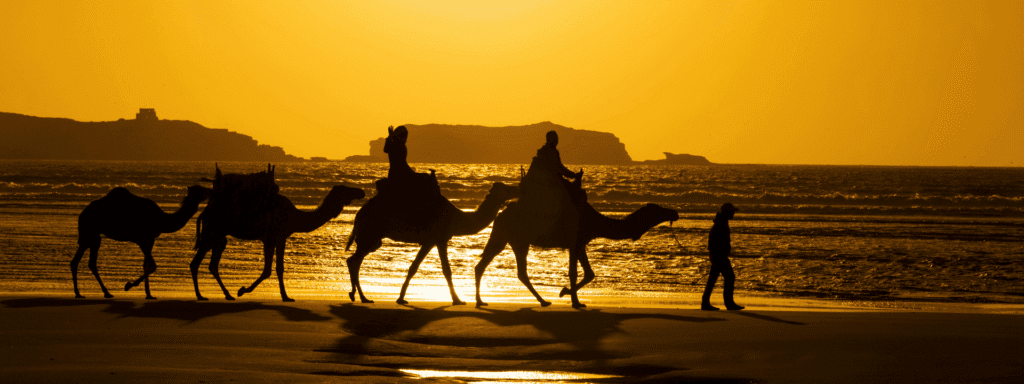
Every khayma is a masterpiece of nomadic engineering. The way the poles are set, the orientation against the wind, the inner partitions separating the public from the private—it is a lesson in minimalism.
I spent a night under one of these tents. The wind outside was a roar, but inside, the heavy fabric created a sanctuary of absolute stillness. There is a profound humility in living in a house you can pack onto the back of a camel in an hour. It reminds the traveler that we are all just passing through.
The Modern Nomad – Tradition in the 21st Century
The Moussem is also a place of friction and fusion. You see young men in indigo robes checking their smartphones, or GPS devices mounted on camel saddles. But rather than diluting the tradition, it seems to strengthen it. The technology is a tool, but the desert remains the master. The Moussem of Tan-Tan is proof that a culture can embrace the future without cutting its roots.
The Soul’s Oasis
If you go to Tan-Tan, go with an open heart. You will be dusty, you will be sun-scorched, and you will be overwhelmed by the noise and the light. But you will return with something rare: the feeling of having touched the very pulse of humanity.
The tents are being raised. The tea is brewing.
- MOROCCO WALKER