
« If God had a palette for the sky, he spilled it over the Rif Mountains, and the locals simply decided to keep it. »
We leave the golden dust of the Moroccan Sahara and the ochre ramparts of the south behind. Our compass now points toward the north, where the peaks of the Atlas soften into the rugged, emerald-green ridges of the Rif. As the road twists, a mirage begins to crystallize against the limestone cliffs of Jebel El-Kelaa. It isn’t a mirage, though. It is a dream rendered in cobalt, cyan, and periwinkle.
Welcome to Chefchaouen. Beyond the postcards and the filtered feeds lies a city that breathes in shades of azure—a place where every alleyway feels like a dive into a deep, cool ocean.
- The Overture: The Ritual of the Indigo
- The Anatomy of Indigo: A Sensory Mapping of the Medina
- The Rifian High: The Embrace of the Peaks
- The Alchemy of the Kitchen: A Feast from the High Lands
- The Art of the Loom: The Soul of the Rif Winter
- The Night Watch: When the Blue Turns to Silver
- The Dialogue of the Soul – Questions from the Blue (Q&A)
- The Art of Wandering: Logistics and Rifian Wisdom
- Blue as a State of Mind
The Overture: The Ritual of the Indigo
For the soul that wanders, Chefchaouen is more than a destination; it is a frequency. It is a vibration of peace. Why is it blue? Ask ten locals, and you’ll get ten different poems. Some say it was the Jewish refugees in the 1930s who painted it to mirror the heavens; others claim it’s a natural mosquito repellent; the elders will tell you it keeps the houses cool under the African sun.
The truth is that the blue is a living ritual. It is repainted by hand, year after year, by the women of the medina. It is a collective act of love, a masterpiece of maintenance that ensures the city never fades into the gray of the modern world.
The Anatomy of Indigo: A Sensory Mapping of the Medina
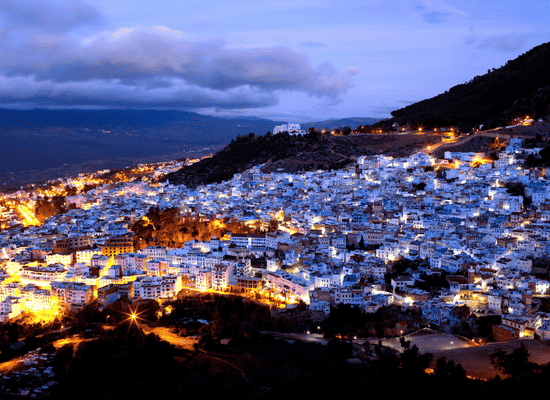
To walk through the medina of Chefchaouen is to lose your sense of gravity. There are no right angles here; only curves, slopes, and stairs that seem to lead directly into the clouds.
1. The Psychology of the Blue Palette
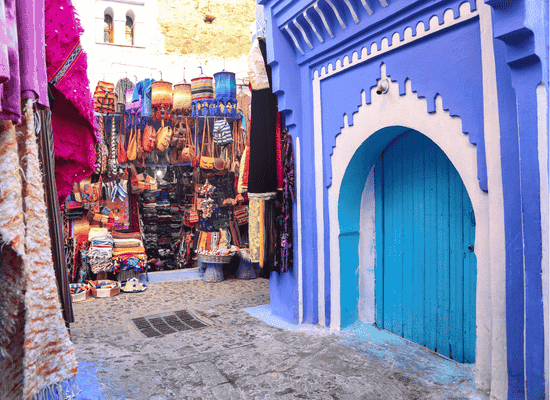
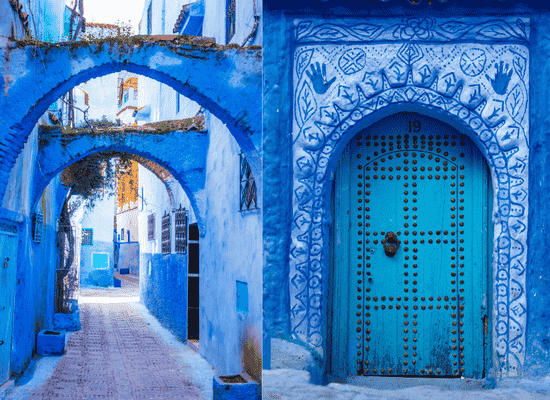
As you enter through Bab el-Ain, you notice that the blue isn’t uniform. The lower parts of the walls are often a deep, saturated indigo—grounded and heavy. As your eyes travel upward, the color thins into a pale, ethereal sky-blue. This creates a psychological « lifting » effect. You don’t just walk through the city; you float within it. The stone beneath your feet is polished by centuries of footsteps, reflecting the sky back at you in a shimmering, cerulean dance.
2. The Sound of Water: Ras El-Maa
Move past the crowds. Follow the sound of the water further up, where the local women still gather to wash wool rugs at the Ras El-Maa laundry spring. The sound of the rushing water against the limestone is the city’s original soundtrack. Here, the experience isn’t about looking at the water; it’s about sitting on a cold rock, feeling the spray on your face, and realizing that this water is why the city exists. Without this spring, the blue would have turned to dust centuries ago. It is the lifeblood that feeds the gardens and cools the air of the winding streets.
In the Andalusian Quarter, look for the doors that aren’t painted blue. There are ancient, dark wood doors, weathered by five centuries of history. These belong to the families who fled Spain during the Reconquista. They brought their keys with them, hoping to return. They never did. These doors are the « ghosts » of the city, anchoring the blue fantasy in a very real, very human history of displacement, hope, and resilience.
The Rifian High: The Embrace of the Peaks
To truly understand Chefchaouen, you must eventually turn your back on the blue and look toward the gray and green of the mountains. The city is nicknamed « The Horns » (Chaouen) because of the two peaks that frame it like a protective crown.
1. The Ascent to the Spanish Mosque
The path that leads out of the eastern gate and up toward the white mosque on the hill is a rite of passage. But don’t just go for the sunset like everyone else. Go at dawn. Watch the first light of the sun hit the limestone peaks of the Rif, turning them into pillars of gold while the city below remains draped in its blue shadow. It is a moment of profound silence, where the only sound is the distant call to prayer rising from the valley like a column of incense.
2. The Wisdom of the Trails
The mountains surrounding Chefchaouen are a labyrinth of goat paths and ancient cedar forests. This is the land of the Jbala people, the mountain Berbers. Their connection to the earth is fierce and proud. As you hike toward the Akchour waterfalls or the God’s Bridge, you encounter a different Morocco. Here, the houses are made of stone, and the hospitality is as rugged and warm as a wool blanket. You’ll find shepherds who navigate these vertical landscapes with a grace that humbles any modern hiker.
3. The Flora of the Heights
The Rif is an ecological treasure. Between the rocks, you’ll find wild oleander, aromatic thyme, and rosemary that scents the air so strongly it feels like a tonic. In the spring, the mountainside is a riot of wildflowers, providing a stark, beautiful contrast to the monochromatic blue of the town below. Exploring these trails isn’t just exercise; it’s a recalibration of the senses.
The Alchemy of the Kitchen: A Feast from the High Lands
In the heart of the Rif, the kitchen is a sanctuary of fire and earth. While the cities of the plains boast complex spice blends and honeyed meats, the gastronomy of Chefchaouen is a tribute to the mountain—rugged, honest, and profoundly nourishing. Here, the flavors are defined by the altitude and the seasons.
1. The White Gold of the Rif: J’ben
The most iconic taste of the region is undoubtedly its goat cheese, known as J’ben. As you walk through the markets, you will see mountain women, draped in their traditional striped mendozas and wide-brimmed straw hats, selling small rounds of cheese wrapped in hand-woven palm leaves.
This is not the processed cheese of the supermarket. It is creamy, slightly tart, and carries the subtle aroma of the wild herbs the goats graze upon in the limestone crags. To eat J’ben for breakfast, drizzled with local olive oil and served with a side of black olives and hot, crusty bread, is to taste the very essence of the Rifian hills.
2. Bisara: The Peasant’s Elixir
On a misty morning when the clouds descend into the blue alleys, there is only one remedy: Bisara. This thick, velvety soup made from dried fava beans is the fuel of the working man. It is served in simple clay bowls, topped with a generous swirl of golden olive oil, a dusting of cumin, and a pinch of chili.
The locals don’t use spoons; they use pieces of warm khobz (bread) to scoop up the soup. It is a humble dish, yet it possesses a richness that warms the bones. In the small, hole-in-the-wall eateries near the Kasbah, the steam from the massive Bisara pots creates a communal fog where travelers and locals sit side-by-side in a shared, silent appreciation of heat and salt.
3. The Secret of the Black Olive and the Wild Honey
The olive oil of the North is legendary—darker, heavier, and more « peppery » than its southern counterparts. It is the lifeblood of every meal. Accompanying it is the wild mountain honey, harvested from hives tucked into the cedar forests. This honey is dark, almost like molasses, with a medicinal depth that speaks of thyme and lavender. When these two elements—the bitter oil and the sweet honey—meet on a piece of traditional semolina bread, they create a perfect equilibrium of the mountain’s bounty.
The Art of the Loom: The Soul of the Rif Winter
Chefchaouen is a city of weavers. Long before the tourists arrived with their cameras, the city was a hub for wool production. Because the winters in the Rif can be biting and damp, the textile tradition here evolved toward utility and warmth.
1. The Jelaba of the North
Unlike the light, silk-blended jellabas of Casablanca or Marrakech, the jellaba of Chefchaouen is a heavy, woolen armor. Often left in its natural shades of cream, brown, or grey, it features a distinctive pointed hood that gives the men of the town an almost druid-like appearance as they move through the blue mist. To touch this wool is to feel the coarseness of the mountain sheep and the skill of the hand-looms that have been clattering in the medina for centuries.
2. The Mendil: A Stripe of Identity
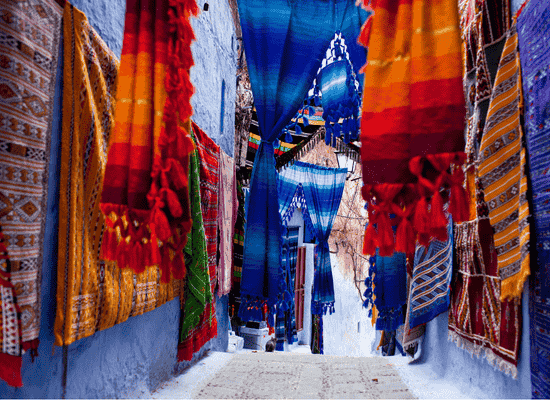
The Mendil is the iconic striped cloth, usually red and white, worn by the women of the Rif as a wrap-around skirt. It is more than a garment; it is a cultural flag. Each stripe, each fold, speaks of a specific tribal identity. Seeing these flashes of red and white against the monochromatic blue walls is one of the most striking visual experiences the city offers—a reminder that while the walls are blue, the people are a vibrant tapestry of Berber history.
3. The Rhythm of the Workshop
Behind many of the blue doors, if you listen closely, you can hear the rhythmic « thwack-clack » of the wooden looms. These workshops are often small, dimly lit spaces where the master weaver works with a speed that defies the eye. They don’t use patterns; the geometry is held in their heads, passed down through generations of muscle memory. Here, the art isn’t for a gallery; it’s to keep a family warm when the snow falls on the « Horns » of the mountain.
The Night Watch: When the Blue Turns to Silver
There is a moment, long after the day-trippers have returned to the coast and the shop shutters have rattled closed, when Chefchaouen reveals its true face.
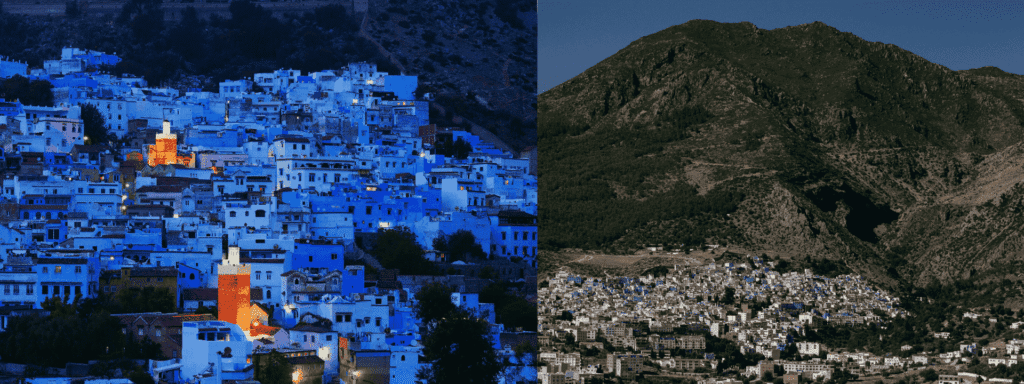
1. The Blue Hour
As the sun dips below the horizon, the city enters the « Blue Hour. » This is when the artificial lights begin to flicker on, and the blue walls take on a luminescent, almost metallic quality. The shadows aren’t black; they are a deep, bruised violet. The air cools, and the scent of woodsmoke from the communal bakeries begins to drift through the streets.
2. The Solitude of the Stairs
Walking the medina at 2 AM is a spiritual experience. The labyrinth becomes a cathedral of silence. Without the colorful rugs and trinkets hanging from the walls, you see the bones of the city—the ancient masonry, the worn steps, the way the houses lean into one another for support. The blue feels more intimate, less like a decoration and more like a protective skin.
3. The Midnight Call
If you stay awake long enough, you might hear the distant, lonely call of a night watchman or the soft padding of a street cat—the true owners of the night. At this hour, the « Blue Pearl » is no longer a tourist destination. It is an ancient mountain refuge, a place of safety and prayer, suspended between the jagged peaks and the starlit sky.
The Dialogue of the Soul – Questions from the Blue (Q&A)
In the quiet corners of the indigo alleys, certain questions naturally arise. These are not the answers of a guidebook, but the reflections of the road.
The Art of Wandering: Logistics and Rifian Wisdom
Navigating the northern mountains requires a different rhythm than the coastal plains. Here is how to harmonize with the local flow.
1. The Ridge Road: Transport
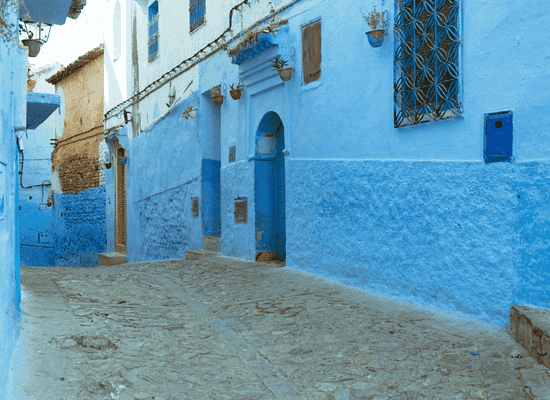
- The Journey : The most authentic way to arrive is via the CTM bus. The routes from Tangier, Tetouan, or Fes offer dizzying panoramas of the Rif mountains.
- The Grand Taxi : For a more visceral experience, share a « Grand Taxi » (usually a vintage Mercedes) at the local station. This is where the best conversations begin, tucked between sharp mountain turns.
- On the Ground : Your legs are your only engine. Pack shoes with excellent grip; the centuries-polished stones can be treacherous, especially after a light mist turns the blue walls into shimmering mirrors.
2. Tools for the Modern Nomad
- Mapping : Download Maps.me or an offline version of Google Maps. Signals can weaken deep within the narrow veins of the Medina, but GPS remains reliable enough to orient your soul.
- Communication : While Arabic, Spanish and French are the keys to the city, Google Translate with a downloaded offline pack is a bridge-builder. A few words in Darija (the local dialect) will transform you from a spectator into a guest.
3. Insider Secrets
- The Light : For those capturing the city, the « magic » isn’t at noon. It is found at dawn, when the blue is cold and silent, or just after a rainfall when the colors saturate to an almost supernatural degree.
- Etiquette : Always ask before photographing someone. A simple « Samahti? » (Do you permit?) accompanied by a hand over the heart opens more doors than any lens ever could.
Blue as a State of Mind
Chefchaouen is not a destination to be checked off a list; it is a city to be steeped in. It teaches us that beauty can be a daily act of resistance, that color can heal the weary mind, and that the silence of the mountains is the ultimate antidote to the noise of the modern world.
As you leave, you carry a bit of blue dust on your boots and a new clarity in your thoughts. One never truly returns the same from a journey into the heart of the Rif. Chefchaouen remains there, suspended from its horns of rock, imperturbable—a reminder that the essential is often found in the simplicity of a shared tea and the endless horizon of an azure sky.
- MOROCCO WALKER