

The blinding stadium lights of the World Cup, the thunderous roars of eighty thousand souls, and the slick, manicured grass of modern football’s grandest stages represent the pinnacle of global athletic achievement. Yet, to truly understand the relentless engine, the blistering verticality, and the unyielding resilience of Achraf Hakimi, one must look far away from the glitz of Paris or Madrid. One must travel inland, away from the coastal tourist hubs, to the sun-baked ocre earth of Ksar El-Kébir.
This is not a traditional travel destination. You will not find it in glossy mainstream brochures, nor will you see it swarming with casual holidaymakers. Ksar El-Kébir is an anchor. It is a geographic crucible of dust, history, and deep-seated familial devotion. For Achraf Hakimi, this northern Moroccan city is where his bloodline meets the soil. It is the hometown of his mother, Saïda Mouh a woman whose early life in this regional hub shaped the values of sacrifice that she later packed into a single suitcase bound for Spain.
To explore Ksar El-Kébir through the lens of Morocco Walker is to practice pure slow travel. It means peeling back the layers of a town built on the banks of the ancient Loukkos River, understanding the profound quiet of its historical quarters, and discovering how an overlooked city in the Gharb plain can give birth to the spirit of a national hero.
- 1. The Map of Return: From Getafe to the Stade Municipal
- 2. The Invisible Soul of Ksar El-Kébir: Architecture, Ruines, and Mauresque Noctourisme
- 3. The Taste of Beginnings: A Gastronomic Map of the Inner Streets
- 4. Beyond the Walls: The Wild Basin of the Loukkos
- The Eternal Return and the Manifesto of the Walker
1. The Map of Return: From Getafe to the Stade Municipal
LOGISTIQUE MOROCCO WALKER
- Destination : Ksar El-Kébir (Municipal District & Old Quarters)
- Focal Point : Stade Municipal Achraf Hakimi
- Spatial Dynamic : Informal street football spaces vs. Structured athletic infrastructure
- Atmosphere : High energy, localized youth pride, deep community integration
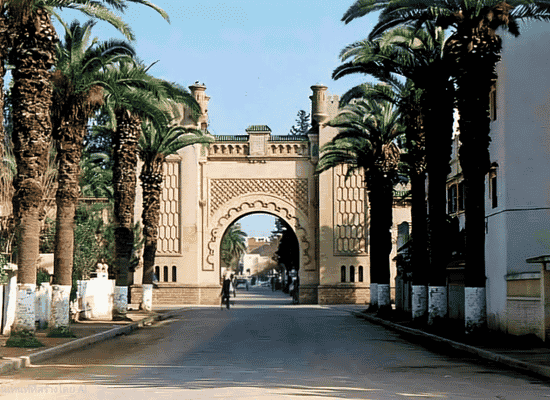
To understand the contemporary heartbeat of Ksar El-Kébir, one must begin where the dust meets the leather: the local football pitches. In January 2023, shortly after the historic semi-final run of the Atlas Lions in Qatar, Achraf Hakimi returned to his mother’s hometown. He didn’t come for a fleeting public relations appearance; he came to reconnect with an urban fabric that had cheered his every stride from across the Mediterranean. The culmination of this homecoming was the official inauguration of the town’s stadium, renamed the Stade Municipal Achraf Hakimi.
+———————————–+———————————–+
| STRUCTURAL ATHLETIC INFRASTRUCTURE| INFORMAL URBAN SPACES (STREET FT) |
+———————————–+———————————–+
| * Stade Municipal Achraf Hakimi | * Dusty alleyways of the Medina |
| * Synthetic turf, security gating | * Empty brick-walled lots |
| * Institutional youth training | * Spontaneous twilight matches |
| * Symbol of diaspora investment | * Engine of raw, adaptive talent |
+———————————–+———————————–+
Walking past the stadium on an afternoon when the North African sun begins its slow amber descent, you witness a profound social phenomenon. The arena is more than concrete and synthetic turf; it is a monument of possibility for the youth of the Gharb region. In the surrounding neighborhoods, the urban space itself mimics the game. Children utilize every available surface empty plots between concrete residences, narrow alleyways, and clay-packed clearings to recreate the runs of their hometown idol.
This informal athletic culture is embedded in the city’s layout. Unlike the highly structured football academies of Western Europe, the talent that germinates in Ksar El-Kébir relies on spatial adaptability. The uneven terrain teaches balance; the tight walls of the old quarters teach quick, short passing synchronization. Hakimi’s signature style his ability to explode into tight spaces and read chaotic transitions is structurally reflective of this very environment. For the slow traveler, spending an hour sitting on a stone step, watching the local youth spin a worn ball through the dust of a neighborhood square, offers a clearer view into the soul of Moroccan football than any modern stadium seat ever could.
2. The Invisible Soul of Ksar El-Kébir: Architecture, Ruines, and Mauresque Noctourisme
While modern sports headlines bind the city to the future, the architecture of Ksar El-Kébir tethers it to an epic, often forgotten past. It is a historical paradox: the city is significantly older than its coastal neighbor, Larache, yet it remains blissfully invisible to the mainstream tourism grid. Founded before the Islamic conquest and fortified heavily under the Almohad and Mérinide dynasties, Ksar El-Kébir was structurally designed as a « ksar » a fortified palace-city meant to guard the fertile basins of the northern plains.
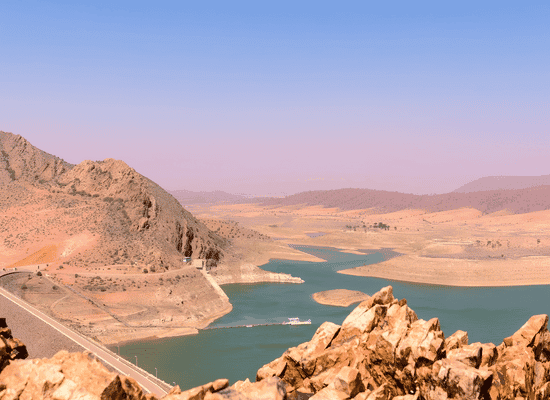
The Spatial Geography of the Medina
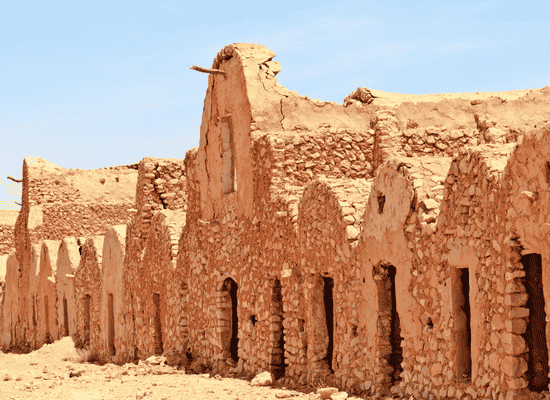
Stepping into the ancient Medina of Ksar El-Kébir is an exercise in historical immersion. The walls, built from heavy bricks and local river stone, bear the marks of centuries of geopolitical shifts. Here, the layout is a labyrinth of shade. The narrow street widths are deliberate medieval design choices, engineered to block the punishing midday summer heat and create natural wind tunnels.
As you wander deeper, the architectural language changes, revealing a complex hybrid identity. You will spot heavy, iron-clamped wooden doors that echo Andalusian craftsmanship, sitting directly across from geometric arches that hint at the Spanish Protectorate era. This is a borderland city, a place that has quietly absorbed the aesthetic movements of both the Iberian Peninsula and the Moroccan interior.
The Ghosts of Oued Al-Makhazin
One cannot understand the quiet pride of the local residents without acknowledging the historical weight of the soil they walk upon. Just outside the city limits lies the plains of Oued Al-Makhazin, the site of the legendary « Bataille des Trois Rois » (Battle of the Three Kings) in 1578. It was here that Morocco altered the course of global history, defending its sovereignty against a massive Portuguese invasion in a clash that saw three monarchs perish on the battlefield.
This historical event is not relegated to textbooks; it lives in the collective consciousness of the town. There is a specific stoicism in the local character a quiet, unyielding sense of independence. When you look at the tactical discipline and fierce defensive pride of the Moroccan national team, you are witnessing an cultural lineage that has defended this specific valley for nearly half a millennium.
The Ritual of Noctourisme
To experience Ksar El-Kébir at its most evocative, one must embrace the philosophy of noctourisme the art of exploring a city after the sun dips below the horizon. During the heat of the day, the Medina can feel intensely private, almost somnolent. But as twilight bleeds into a deep Moroccan blue, the city sheds its reserved exterior.
Field Note for the Slow Traveler: Do not look for neon signs or curated evening experiences. The nightlife of Ksar El-Kébir belongs to its people. It begins with the low hum of vintage modified mobylettes echoing through the outer ring roads, followed by the sudden, vibrant illumination of small, bulb-lit market stalls along the ancient ramparts. The air fills with the sharp, clean scent of bruised spearmint leaves and the warm, earthy aroma of roasting chickpeas. This is the hour when the city breathes collectively, transforming the historic public squares into open air living rooms where generations meet to discuss community life, weather, and invariably, football.
3. The Taste of Beginnings: A Gastronomic Map of the Inner Streets
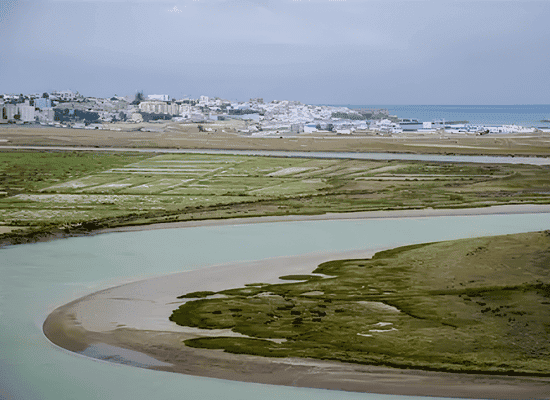
The culinary identity of Ksar El-Kébir is deeply agrarian, shaped entirely by its proximity to the rich alluvial soils of the Loukkos river basin. In a globalized world where food is heavily standardized, this city offers an authentic, farm-to-table reality where every ingredient is hyper-seasonal and sourced from the immediate landscape. This is the honest, unpretentious food language that diaspora families return to when they cross the straits to seek the tastes of home.
THE STREET-FOOD PROTOCOL: THREE UNMARKED ESSENTIALS
1. THE LOUKKOS SARDINE STALLS (Near the old fish market gates)
- Detail: Fresh sardines brought up daily from Larache, heavily marinated in a classic northern chermoula (garlic, coriander, cumin, fresh lemon, and paprika).
- Experience: Fried in massive iron cauldrons right in front of you, served inside a torn piece of crusty, wood-fired khobz. No pretense, pure maritime crunch in the heart of the valley.
2. THE CAFE SOUK BISSON (The Elders’ Corner)
- Detail: A tiny, no-name cafe identifiable only by its low wooden stools and the massive copper teapot steaming over charcoal.
- Experience: Order the signature northern-style mint tea, heavily packed with wild « Sheeba » (absinthe leaves) during cooler months or rich mountain mint. It is bitter, sweet, and structurally designed for long, observational afternoons.
3. THE STREET-SIDE BISSARA HOLES (Medina Arteries)
- Detail: Deep bowls of dried fava bean soup, slow-simmered for twelve hours until completely smooth.
- Experience: Topped generously with cold-pressed green olive oil from the surrounding hills, a heavy dusting of cumin, and crushed chili flakes. It is the fuel of the working-class Gharb region.
The gastronomic geography of the city is defined by its weekly souks, where local farmers bring produce that has never seen a plastic wrapper or a cold-storage warehouse. The citrus fruits are intensely fragrant, the tomatoes taste of sun and soil, and the olive oils carry a distinct, peppery kick unique to the northern hills.
When you sit at a simple wooden table in the market, watching an old artisan meticulously assemble a tagine using vegetables harvested just three miles away that morning, you begin to understand the grounded nature of this region. It is an environment that rejects extravagance in favor of deep, nourishing quality. This sensory memory is precisely what anchors binationaux athletes to their heritage; it is a visceral reminder of a simpler, fiercely authentic way of living that contrast sharply with the hyper-managed, corporate world of elite European sports.
4. Beyond the Walls: The Wild Basin of the Loukkos
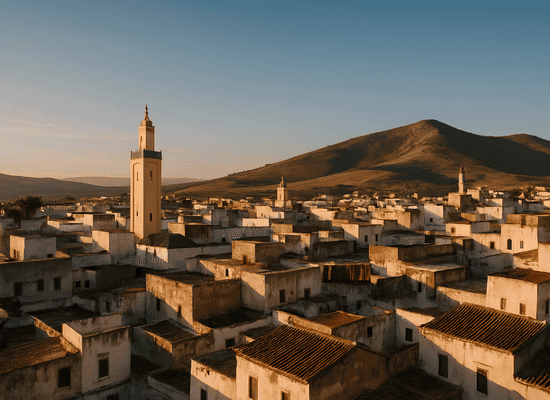
To fully appreciate the isolation and raw beauty of this territory, the traveler must venture outside the city walls and follow the curves of the Loukkos River. The basin is a vast, emerald tapestry of agricultural engineering and wild wetlands, acting as the lifeblood for the entire region. It is a landscape defined by water and sky, where massive flocks of migratory birds stop on their journeys between Africa and Europe, mirroring the human migrations that define the local families.
LOGISTIQUE: CROSSING THE BASIN
- Transit Mode : Regional Grand Taxi (Six-passenger Mercedes) or Local Train Network
- Route : Tanger-Melloussa Hub —> Ksar El-Kébir Rural Lines —> Larache Coast Extension
- Terrain Check : Low-lying clay basins, river dikes, seasonal wetlands
- Tactical Gear : Sturdy leather boots, high-UV protection, offline mapping tools
For a true Walker, the journey to Ksar El-Kébir is an integral part of the narrative. The city is exceptionally well-connected via the national ONCF rail network, making it an easy stop on the axis between Tangier and Rabat. However, to see the hidden elements of the basin, one must rely on the legendary network of « Grands Taxis ».
[TANGER / RABAT CORRIDOR]
│
▼ (ONCF Mainline Train)
[KSAR EL-KÉBIR HUB]
│
┌────────────────────────┴────────────────────────┐
▼ (Blue Petite Taxis) ▼ (Old Mercedes Grand Taxis)
[Medina & Urban Arteries] [Loukkos Basin & Rural Tracks]
│
▼
[Historical Battlefields]
Boarding an old, cream-colored Mercedes taxi at the edge of the city limits is a lesson in shared human space. You sit shoulder-to-shoulder with local farmers carrying bundles of fresh herbs, teachers commuting to rural schoolhouses, and workers returning from the coastal ports. The conversation flows fluidly between Moroccan Arabic (Darija) and occasional fragments of Spanish, a linguistic reminder of the region’s complex colonial history.
As the taxi navigates the narrow asphalt roads running along the river dikes, the landscape unfolds in grand, sweeping brushstrokes. To your left, the vast fields of sugarcane and rice shimmer under the North African sun. To your right, the ruins of ancient Roman outposts lay half-buried under wildflowers and wild grass. This is a land that has seen empires march past, from Rome to Lisbon, yet it has remained stubbornly itself: a fertile, resilient valley that continues to feed the nation and cultivate individuals capable of defying the odds on the global stage.
The Eternal Return and the Manifesto of the Walker
As the night deepens over Ksar El-Kébir, the distant sound of a television broadcast echoes from a brightly lit corner cafe inside the Medina. A crowd of men, young and old, lean forward in unison, their faces illuminated by the screen, watching a re-run of an international match. Every time the number 2 jersey flashes across the screen, a palpable wave of quiet pride ripples through the room. They don’t just see a world-class fullback executing a tactical transition; they see a son of their soil. They see the name of their forgotten town carried proudly into the glittering arenas of the West.
The story of Achraf Hakimi and Ksar El-Kébir is a profound reminder of why we travel. It challenges the modern obsession with hyper-curated, Instagram-friendly tourist traps. It proves that the most valuable travel experiences are found in the places that hold the roots of human stories the places of quiet work, historic standoffs, and deep familial ties.
To travel to Ksar El-Kébir as a Walker is to honor the invisible lines that connect our global present to our local pasts. It is an invitation to step off the train, leave the crowded beaches behind, and walk through the dusty, historic streets of a city that taught a global icon how to run without ever forgetting where he started.