

Losing the Script to Find the Story
They say that in the field of communication, everything is about the narrative. We script the message, we control the branding, and we manage the optics. But a month in the Philippines taught me that the best stories are the ones you don’t write the ones that happen to you when you’re standing drenched under a tropical downpour, 16,000 kilometers from home, wondering where on earth you’ve just landed.
I left for the Philippines on a whim. no itinerary, no spreadsheets, and thankfully no 25kg suitcases. I traded the prestige aesthetic for a 15kg hiking bag and a one way ticket to Manila. What followed was a 30 day odyssey that shattered every preconceived notion I had about luxury, poverty, and human kindness.
This is not a travel guide for the tourist who wants a scheduled bus. This is for the traveler who wants to feel the heartbeat of a nation. This is a journey through the invisible of the archipelago the moments between the maps, the smiles behind the uniforms, and the absolute, terrifying beauty of the unknown.
The Chaos of the First Breath
Stepping out of Ninoy Aquino International Airport (NAIA) at midnight is like walking into a warm, wet blanket that smells of salt, diesel, and anticipation. After a grueling 20 hour journey, your brain is a fog, and Manila does not offer a gentle landing.
My first lesson? The Airport is not a building; it’s a geography. In Europe, a terminal is a gate away. In Manila, Terminal 1 and Terminal 2 are separate universes. If you land in the wrong one, you aren’t just walking to the next hall; you are negotiating a taxi ride through a city that never sleeps just to find your connection. I stood there, watching the kaleidoscope of lights, the roar of the tricycles, and the sea of people, and for a split second, the traveler in me panicked. “What am I doing here? I should just take my things and go home.”
But then, I saw the first smile. A hand on the heart gesture from a local worker. In that moment, the chaos became a rhythm.
The Makati Contradiction
I had booked my first three nights in Makati, known as the Chic heart of Manila. It’s the district of glass skyscrapers, expatriates, and high end branding. But because I hadn’t planned the specifics, my hotel sat on the razor thin edge where the Modern Europe aesthetic of the center fades into the raw, authentic Philippines.
Walking those peripheral streets at 1:00 AM might sound daunting, but the fear evaporated within minutes. I found myself in a local « Sari sari » (convenience store) just to buy water and snacks. I saw my first Jeepney a flamboyant, roaring icon of Filipino resilience. It wasn’t clean or minimalist, but it was vibrantly alive.
Beyond the Neon: Finding Manila’s Secret Soul
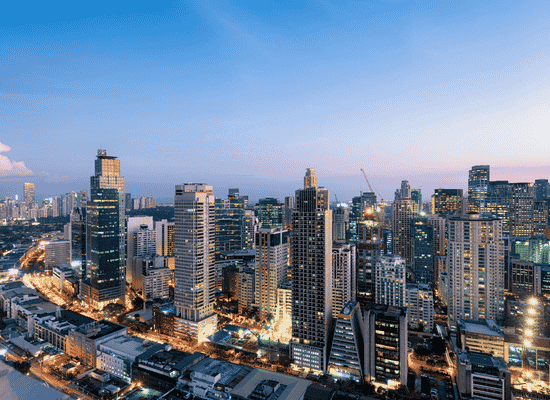
Most people use Manila as a waiting room for the islands. They stay in the malls and miss the ghosts of the city. But if you push past the skyscrapers of Makati, you find the real Manila.
I remember wandering into Escolta Street in Binondo. It feels like a fever dream of the 1920s art deco buildings crumbling gracefully next to modern street food stalls. It’s the oldest Chinatown in the world, but if you look closer, you’ll find The First United Building, where local artists and coffee roasters have reclaimed the space. It’s not on the glossy brochures, but it’s where the city’s creative heart beats.
For a moment of absolute peace that no one tells you about, I found the Paco Park. It used to be a Spanish cemetery, a circular fort hidden in the middle of the city. At dusk, the stone walls glow orange, and the noise of the traffic disappears. It’s a pocket of silence in a city of ten million screams. And if you crave the high end but want it hidden, look for the Salcedo Weekend Market. It’s where the locals meet not for souvenirs, but for organic heirloom rice and gourmet Filipino dishes that you won’t find in any restaurant.
The Logistics of Freedom (Pack Light)
If there is one piece of advice I can give you for the Philippines, it is this: Abandon the suitcase. My decision to carry only a 15kg backpack was the single most important decision of the trip. Why? Because the Philippines is a land of Internal Transfers.
- The Terminal Trap: Domestic flights often depart from entirely different airports than international ones. You will find yourself running, sweating, and jumping into taxis.
- The Weight Limit: Most local airlines (like AirSwift or Cebu Pacific) have a strict 15kg limit. If you show up with a 25kg suitcase, you aren’t just paying extra; you are slowing down your soul.
The Search for the « Invisible » Ferry
The next morning, the instinct kicked in. I didn’t want the flight to El Nido that everyone else took. I wanted the sea. I wanted the ferry.
I spent an entire day in a tropical downpour short, raincoat, and wet as a drowned hen searching for a way out of Manila by water. I ended up in a massive, desolate industrial port, standing among cargo containers and heavy machinery, asking confused sailors where the passenger boats were. It was a fail, but a beautiful one.
Before leaving the city, I made one last stop at Intramuros, the walled city. But I didn’t stay on the main path. I followed a small alley near Fort Santiago and found a tiny workshop where men were restoring old Spanish carriages. They didn’t want money; they wanted to show me their craft. That’s when I realized: Manila isn’t a place you see; it’s a place you listen to.
- Hidden Gem: Quiapo Market is intense but visit the Golden Mosque nearby for a stunning architectural contrast.
- Pro Tip: Use the « Grab » app for all city movements. It’s the safest and most transparent way to navigate the Makati Binondo Intramuros triangle.
- The Mall Strategy: If you need a break from the heat, Greenbelt in Makati is a park mall hybrid where the gardens are more impressive than the shops.
The Emerald Road
The Hangar of New Beginnings
Landing in Puerto Princesa felt like shedding the last skin of my city life. Forget the polished terminals of international hubs; here, the airport was a big hangar raw, functional, and humming with a different kind of energy. The air was thicker here, smelling of wet earth and salt.
Panic flared for a moment when my pre-arranged shuttle was nowhere to be found. In the heat of the terminal exit, the plan dissolved. But the Philippines has a way of catching you when you fall. After a bit of negotiation, I found myself in a white van a shared transport that would become my home for the next six hours of winding roads.
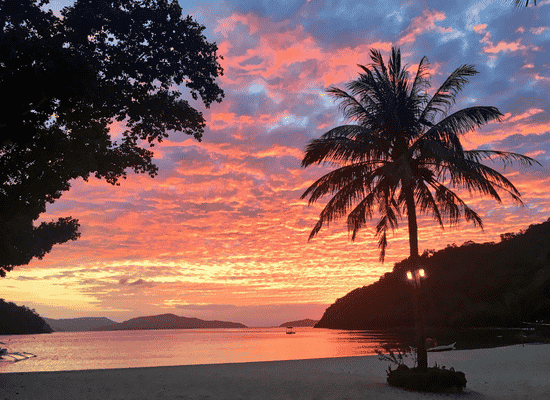
If you want to see the soul of Palawan, you don’t look for it in a brochure; you look for it through the window of a van bouncing over potholes. I have never seen a green so electric. The road to El Nido is a ribbon through a jungle that seems to breathe. Even under the pouring tropical rain, the landscape was magnificent.
We stopped at roadside shacks tiny wooden huts tucked into the trees that served the most incredible snacks and coffee. No signs, no TripAdvisor stickers. Just a rest for the weary traveler in the middle of nowhere.
By the time we reached the outskirts of El Nido, it was pitch black. I walked into the darkness, guided by a local child and a friendly dog. The only sounds were the crunch of my boots on the path and a deafening, rhythmic croaking the giant bullfrogs of Palawan. When I finally reached the hut, I found a warm, wooden sanctuary. I fell asleep to the sound of waves hitting the shore, wondering what the light would reveal.
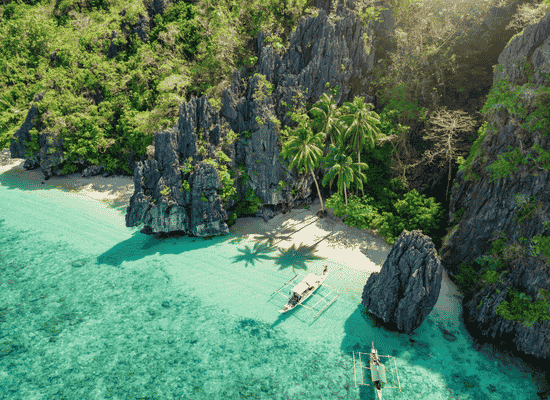
I woke up exactly at sunrise. I pushed open the wooden door of my cabin and froze. The ocean was barely three meters from my doorstep. The water was a mirror reflecting the first gold of the sun. To my left and right, massive limestone cliffs rose like prehistoric guardians out of the mist. I sat on the tiny terrace with the owner’s young son, watching the islands bloom in the distance.
Beyond the Script: Breaking the A, B, and C Loop
Every traveler in El Nido is handed the same menu: Tour A, B, C, or D. They are beautiful, yes, but they are the script. To find the invisible, you have to deviate. Here are two alternative circuits that will lead you to the heart of the archipelago without the crowds.
The Eastern Spirit Circuit: Sibaltan and the Forgotten Coast
While everyone heads west to the lagoons, the true traveler heads east to Sibaltan. This is a journey into the Culture.
- Rent a motorbike or hire a local guide to take you to this quiet fishing village. Here, the water isn’t framed by cliffs but by endless horizons.
- Visit the Pangko Maritime Museum, a tiny, locally run hut dedicated to the traditional boat making history of the Cuyonon people.
- You won’t find 50 boats anchored in a circle. You’ll find empty beaches like Duli Beach, where the sand is white, the jungle meets the sea, and the only footprints are your own. It is the raw, unpolished version of paradise.
The Linapacan Expedition: The World’s Clearest Water
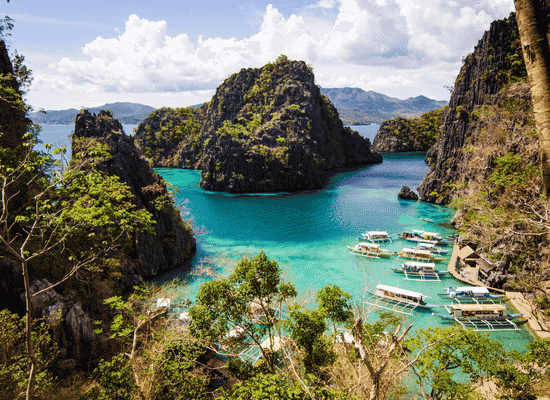
If you have the courage to skip a night of resort comfort, look for a local captain willing to take you toward Linapacan, situated between El Nido and Coron.
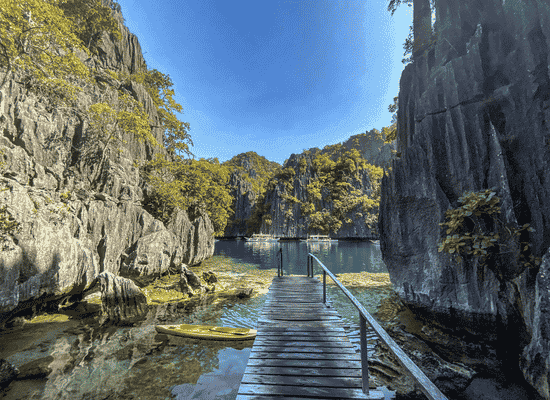
- This isn’t a 4-hour tour; it’s an expedition. You are looking for islands like Gintu or Maosonon. These are invisible dots on the map where the water is so transparent it feels like the boat is floating in mid air.
- Stopping at a remote island « Barangay » (village) for lunch isn’t a tourist activity; it’s a cultural exchange. You’ll eat whatever was caught that morning likely grilled snapper or squid served with ginger and calamansi.
- While Tour A tourists are fighting for a selfie spot in the Big Lagoon, you will be snorkeling in reefs that have never seen a commercial tour boat. This is where the silence is so loud it stays with you forever.
- Eco-Note: Sibaltan is a hub for community based tourism. Support the local « Kuyonon » cooperatives for authentic weaving and cooking workshops.
- Travel Logic: If visiting Linapacan, ensure your boat is a « Bangka » with proper outriggers, as the crossing can be choppy. This is « Slow Travel » at its most extreme no 4G, no distractions.
The Scent of Salt and Starlight
Leaving El Nido for Coron is a rite of passage. I bypassed the speedboats for the ferry a slower, more rhythmic crossing. As we docked in Coron, the air changed; it felt older, more rugged. At the port, I was met by a sight that would be intimidating anywhere else: Filipino soldiers with their guard dogs patrolling the entrance.
But this is the Philippines. Instead of a cold interrogation, I was met with wide, genuine smiles. We ended up chatting, laughing, and even taking photos together. Their dogs, fierce but disciplined, were a symbol of the island: protective yet welcoming. Again, my 15kg backpack was my hero. While other travelers struggled, dragging heavy suitcases across the vibrating metal ramps of the ferry, I simply walked off, light and free, ready for the next mystery.
The « Coron Town » Mirage
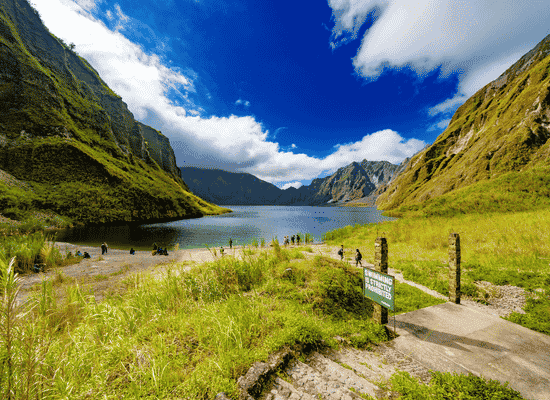
Coron Town itself is different from El Nido. It’s less tropical postcard and more authentic port. It feels mineral, dusty, and honest. I stayed at a smaller affiliate of the Sunlight group a clean, classic building but the service was already on another level. The staff didn’t just provide a room; they provided a sanctuary.
However, the real Coron isn’t in the streets; it’s hidden in the shadows of the surrounding limestone. While everyone talks about the famous Kayangan Lake, I went looking for the Silence.
The Culion Leper Colony (The Island of No Return)
A short boat ride from Coron lies Culion. For decades, it was the largest leper colony in the world, an island invisible to the rest of society. Today, it is a stunningly preserved historical site with a haunting beauty.
- Walking through the old Spanish church and the museum is a journey into human resilience. The streets are quiet, the architecture is colonial, and the views of the surrounding bay are unparalleled.
- It offers a depth of soul that a beach party can never provide. It’s a place of reflection, far away from the Instagram-trap crowds of the main lagoons.
The Black Island (Isla Mabait)
Locally known as Malajon Island, this place feels like a set from a dark fantasy novel. A massive black limestone monolith rising from a white sand beach.
- While the Ultimate Tour bypasses this for the coral gardens, making the trip here rewards you with a massive cathedral-like cave right on the beach, containing a natural pool of cool, fresh water.
- There are very few inhabitants here. If you arrive early, you might find a lone fisherman mending nets in the shadow of the giant black cliffs.
The Symphony of the Night: Fireflies and stardust
The most profound moment of my life happened after the sun went down. We took a small boat out onto a silent river, moving away from the lights of the town until the darkness was absolute.
Watch the trees, the captain whispered. He gave a sharp, melodic whistle. Suddenly, as if the forest was waking up, thousands of Fireflies began to pulse in unison. They weren’t just flickering; they were communicating. The trees looked like they were decorated with breathing diamonds.
Then, the captain pointed to the water. « Now, touch the sea. »
I dipped my hand into the dark water, and it exploded in a neon-blue glow. Bioluminescent Plankton. Every movement of my fingers created a trail of cold, liquid light. I looked up: the sky was so thick with stars and the Milky Way that there was no black left in the sky. I looked down: my hands were glowing. I looked at the trees: they were blinking. I was suspended in a universe of light, in a place so invisible it felt like a dream.
- Bioluminescence Logic: The best time for the firefly and plankton tour is during a « New Moon. » The darker the night, the more intense the glow.
- Navigation Tip: When in Coron, don’t just book a boat; book a Captain. The older fishermen know the Secret Lagoons (like Hidden Lagoon) that don’t appear on the standard Tour B map.
- Sustainability: Coron is a pioneer in protecting its Ancestral Waters. Always respect the rules set by the Tagbanua tribes, the indigenous guardians of the lakes.
The Switch to the Island Private
After days of adventure, it was time to retreat. We took a speedboat, slicing through the waves for nearly an hour, toward a dot on the map: a private island resort. As I stepped onto the wooden pier of the « Sunlight Eco Tourism Resort », the world shifted again. I was moving from the « cabane » life to a kingdom on stilts. Little did I know, a typhoon was coming, and I was about to become a prisoner of paradise.
The Kingdom on Stilts
The Island of Culion, the Glass Floor, and the Eye of the Storm
Leaving the dust of Coron Town behind, we boarded a sleek speedboat. For forty-five minutes, we sliced through the turquoise veins of the Sulu Sea, heading toward a silhouette on the horizon: Culion. Here, the « Sunlight Eco Tourism Resort » rises out of the water like a dream.
Stepping onto the long wooden pier was a sensory reset. After weeks of just enough showers and the roar of tricycles, the silence here was a physical weight. I was no longer an explorer fighting the elements; I was a guest of the ocean. My villa sat on stilts over the reef, with a glass panel in the floor that allowed me to watch the ballet of the fish while I sipped my morning coffee.
Then, the sky turned a bruised purple. The wind began to whistle through the thatch, and the news came in: a Typhoon was sweeping through the region. All boats were grounded. No one could leave.
For nearly a week, the resort already quiet because it was the low season became my private kingdom. I was trapped in five star luxury. While the storm raged outside, I spent my days walking the perimeter of the island. It takes exactly one hour to circle this world on foot. I walked through the rain, feeling the power of the Pacific, knowing that just a bridge away was another tiny island where the resort’s restaurant sat in total isolation. Crossing that bridge in the middle of a storm felt like walking between worlds.
Invisible Geographies: The Secrets of the Calamianes
While the storm kept me anchored, it allowed me to listen to the staff the true keepers of the island’s secrets. They told me of places that no speedboat tour would ever suggest.
The Maltatayoc Sandbar
Located far from the usual snorkeling spots, this is a « phantom » island.
- It is a curved spine of blindingly white sand that only appears at low tide. There are no trees, no huts, no people. Just you, the sand, and the birds.
- Because it is so exposed, most tours avoid it. But if you catch it at the right hour, you feel as though you are standing on the very edge of the earth.
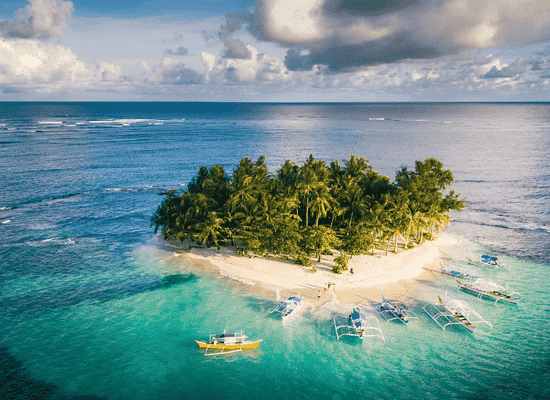
Pass Island: The True « Slow » Anchor
While the resort offered every comfort, the staff spoke of Pass Island as the soul of the region.
- A tiny dot of land with a few coconut trees and a single volleyball net. It is the definition of « minimalist beauty. »
- Most tourists visit for 30 minutes as part of a Reefs and Wrecks tour. But the secret is to stay. There are basic huts there where you can watch the sunset in a silence so deep you can hear the crabs scuttling on the sand.
The Shift: From Stillness to the Great South
When the typhoon finally passed and the no-sail order was lifted, I felt a heavy ache in my chest. Leaving the staff, who had treated me like royalty during the storm bringing me coffee in my villa and sharing stories of their own families was harder than I expected.
I returned to Coron to catch a flight that would take me away from the limestone cliffs of Palawan toward the rolling hills of Cebu and Bohol. It was time to trade the silence of the private island for the roar of the Great South.
- Eco-Luxury Logic: Sunlight Eco Tourism Resort uses a sophisticated solar and water filtration system crucial for the eco-conscious traveler.
- Typhoon Season Tip: June to October is the risk window. If you are trapped, stay at a resort with its own power and water supply (like Sunlight) to ensure safety and comfort.
- The « Buzzed » Airport: Busuanga Airport (USU) is tiny. Check-in is fast, but the Terminal Fee must often be paid in cash (Pesos). Always keep 200-500 PHP in your pocket.
The Flight of Contrasts
Taking the small plane from Busuanga (Coron) to Cebu was a lesson in scale. From the air, the Philippines looks like a handful of emeralds thrown onto a blue velvet cloth. My 15kg backpack was once again my passport to a quick transit. As I landed in the urban sprawl of Cebu City, the humidity hit me again but this time, it carried the scent of a different adventure.
I wasn’t looking for the city. I was looking for the Tarsiers, the Chocolate Hills, and a mountain peak that would test my courage in ways I never imagined.
The Giant and the Tarsier
The Southern Pulse: Cebu to Bohol
Arriving in the south felt like entering a different country. The air in Cebu was busier, more commercial, but it was merely a gateway. I quickly moved toward Bohol, an island that feels like a geological playground.

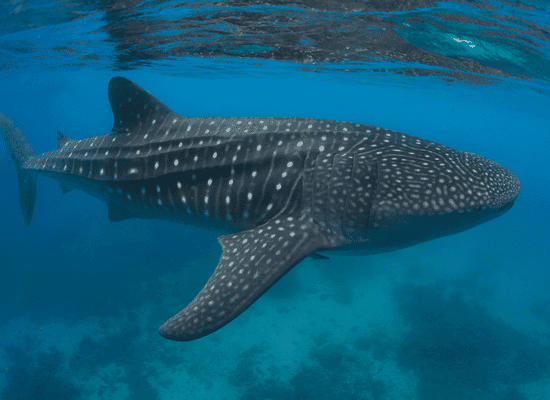
Here, the invisible isn’t hidden by distance, but by size. My first stop was the Tarsier Sanctuary. I had seen photos, but nothing prepares you for the reality of the world’s smallest primate. They are globular, no bigger than a human fist, with eyes that seem to hold the secrets of the universe. They are incredibly sensitive so much so that silence is mandatory. Standing there, watching this tiny creature rotate its head 180 degrees to look at me, made the 10 meter whale shark I had encountered just days before seem less daunting. It was a lesson in the power of the small.
The Safari in the Sun
Following the advice of a local doctor I met over dinner a woman whose generosity was as vast as the ocean I headed toward a Safari experience that felt like a glitch in the matrix. Under a blistering, African level heat, I found myself in a landscape that looked like the Kenyan savannah. No rain, just golden grass and a sun that felt personal. It was a stark reminder that the Philippines is not just one thing; it is a thousand different climates in one.
Everyone knows the 1,200 symmetrical brown mounds of the Chocolate Hills, but to see them through the « Morocco Walker » lens, you have to find the edges.
The Alicia Panoramic Park (The « Invisible » Hills)
While the crowds gather at the main viewing deck in Carmen, the true beauty lies in the Alicia region.
- These hills are grassy, sharp, and ridge like. Hiking here at dawn feels like walking on the spine of a sleeping dragon.
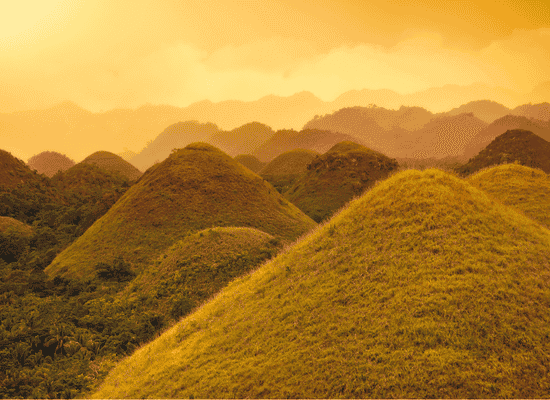
- You won’t find tour buses. You’ll find local hikers and a view that stretches all the way to the sea. It is the raw version of the Chocolate Hills.
The Can-Umantad Falls
In the remote town of Candijay, I found the tallest waterfall in Bohol, hidden behind layers of rice terraces that rival those of the north.
- The water drops 60 meters into a pool of pure turquoise.
- The local farmers here still use traditional irrigation. Watching them work while the mist of the falls cools the air is a moment of pure, unscripted peace.
The Zipline of Fire: A Double Descent
Then came the moment that tested my very soul. I found myself at the foot of a mountain, the ground turned into a swamp of mud from a recent, unseen rain. My tricycle driver a man of incredible grace parked his moto in the middle of nowhere, left his keys, and guided me up the mountain, the mud reaching our knees.
At the summit, I faced my phobia: a Zipline that connected one island to another. Two separate descents across the abyss.
I was terrified. I was strapped in like a sardine by a guide who looked even more worried than I was. He kept repeating « Safe, Ma’am, safe! » not for me, but for himself. I had a choice: walk back down through the mud or fly.
I closed my eyes. I thought of the things I had regretted not doing in the past. And I jumped.
The rush of wind was a scream of freedom. When I opened my eyes mid air, I wasn’t just flying; I was suspended between two emerald worlds. The descent took me from one peak to a small island, and then a second zip to a final beach. When I landed, caked in mud, shaking with adrenaline, I ran to the nearest beach shack restaurant.
I sat there, feet in the sand, and ordered the best grilled fish of my life. The price of that meal wasn’t in Pesos; it was in the fear I had just conquered.
- Tarsier Ethics: Only visit the Philippine Tarsier Foundation in Corella. Avoid roadside displays which are stressful and harmful to these suicidal primates.
- The Zipline Logic: The Loboc Ecotourism Adventure Park offers the most scenic zip, but for the island-to-island experience, you must venture to the peripheral adventure zones near the coast.
- Climate Note: Bohol can be significantly hotter and drier than Palawan. Hydration and salt-tabs are essential for the Safari regions.
The Budget Reality
A quick note for the traveler’s ledger: despite being less exclusive than the private resorts of Coron, the Cebu and Bohol region felt significantly more expensive. From transport to excursions, the Great South has a price tag that reflects its popularity. But for the Tarsier’s gaze and the flight across the islands? It was worth every cent.
The Stairway to Heaven
The Vertical Ascent
Leaving the tropical heat of the coast, I headed north into the Cordillera mountains. The air here doesn’t just cool down; it thins and sharpens, carrying the scent of pine needles and woodsmoke. The journey is a grueling 9 hour zigzag up the Halsema Highway, a road that clings to the cliffs like a vine.
As we climbed, the palm trees disappeared, replaced by mossy forests and mist. This is the land of the Igorot people the « mountain people » who have guarded these peaks for millennia. There are no speedboats here; the only way to move is on foot or perched atop a colorful Jeepney, breathing in the crisp mountain air.
The Green Amphitheater of Batad
Nothing prepares you for the first sight of the Batad Rice Terraces. While the main town of Banaue is impressive, Batad is the Invisible Jewel.
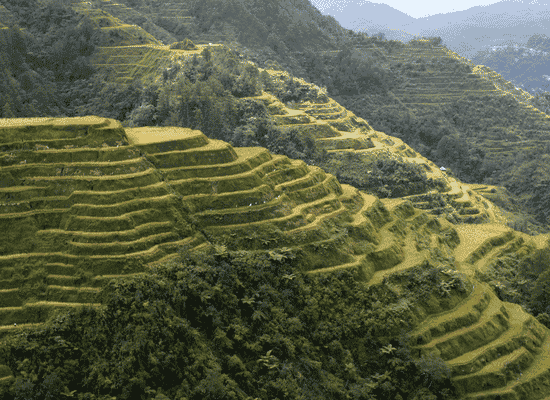
- To get here, you have to hike. There are no roads. You descend into a massive, amphitheater-like valley where the stone-walled terraces rise like giant stairs toward the sky.
- The 2,000-Year Rhythm: These terraces were carved by hand two millennia ago. Watching the locals move across the narrow stone edges with heavy baskets of rice is like watching a ballet of survival.
- I stayed in a simple homestay where the shower was a bucket of cold spring water and the heater was a shared meal of Tinawon (heirloom red rice) by a fire. It was raw, it was cold, and it was perfect.
While the terraces are the stars, the North hides deeper, more mysterious secrets for those willing to walk a little further.
The Echo Valley of Sagada
Higher still lies Sagada, a town wrapped in permanent mist.
- The Hanging Coffins: This is one of the most profound traditions in the world. Instead of burying their dead, the locals hang the coffins from the limestone cliffs to bring the souls closer to heaven.
- Standing at the bottom of Echo Valley, looking up at these ancient wooden boxes suspended hundreds of feet in the air, you feel a deep sense of respect for a culture that refuses to be modernized by outsiders.
The Blue Soil of Sagada (Kaman-utek)
While everyone goes to the caves, few find the Blue Soil Hills.
- It is exactly what it sounds like a small range of hills where the earth is a surreal, pale turquoise blue due to high copper sulfate content.
- The path is unmarked and slippery. Walking through the towering pine trees to suddenly find a blue landscape feels like you’ve stumbled onto another planet.
The Lesson of the Mountain
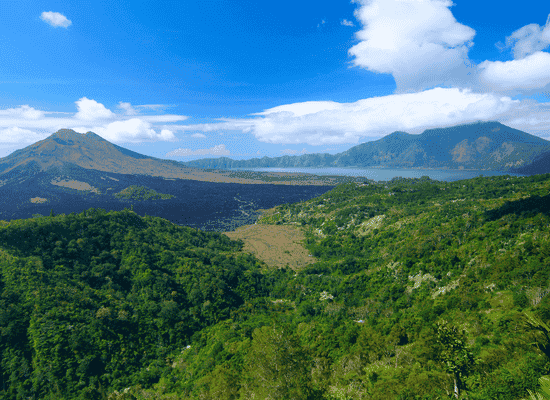
In the North, I learned that luxury isn’t a 5 star resort; it’s the warmth of a hand woven blanket after a day of hiking in the rain. I met an old weaver in a village near Bontoc who told me that every pattern in her cloth was a map of her ancestors’ journeys.
I remember sitting on a ridge, watching the clouds pour over the rice terraces like a slow motion waterfall. There was no 4G, no Cebu budget stress, just the sound of the wind. The North demands effort it makes you earn every view but it rewards you with a perspective that makes the world feel vast and sacred again.
- Logistics: The night bus from Manila to Banaue (Coda Lines or Ohayami) is the standard. It is freezing bring a heavy jacket inside the bus.
- Trekking Logic: Never hike Batad without a local guide. Not because you’ll get lost, but because the guide is your cultural bridge to the community.
- The Invisible Law: In Sagada, the reverse-hospitality rule applies: respect the silence. It is a sacred town, not a party destination.
The Long Road Back
With my 15kg backpack now smelling of pine and woodsmoke, I began the long descent back toward the lowlands. I was headed for Manila for my final days, but I was carrying the silence of the mountains with me. I had seen the giants of the sea and the tiny primates of the south, but the stone stairs of the north had taught me about the endurance of the human spirit.
The Circle Closes in Makati
The Great Contrast
Returning to Manila after a month in the wild is a sensory shock. I landed in the city with my 15kg backpack now weathered, salt stained, and smelling of mountain pine and headed straight for the heart of Makati. This is the Philippines’ Wall Street, a forest of glass towers and air conditioned luxury.
I walked into the lobby of a high end business hotel, a place where the air smells of expensive cologne and the silence is curated. I stood there in my shorts, sandals, and a worn out t-shirt, my skin bronzed and peeling from the sun. I felt like a glitch in their matrix. In any other global capital, I would have been met with a cold stare. But here?
The receptionist placed her hand on her heart, gave me a radiant smile, and before I knew it, she had upgraded me to a luxury suite. They didn’t see a sale traveler; they saw a guest. I spent my first hour in that room just staring at the shower a marble sanctuary that felt like a cathedral after weeks of bucket washes and cold mountain streams.
The Small Gentleman of the Rain

On my penultimate day, I sat in a tricycle during a sudden downpour, heading toward the city center. We stopped to pick up a passenger: a boy, no older than five, in his school uniform.
I was mesmerized. Despite the torrential rain and the muddy streets, his uniform was perfect. Not a single crease, not a speck of dust. He sat there like a miniature gentleman, checking his little watch with a serious face. When he reached his stop, he paid the driver with a precise grace and stepped out into the rain, a tiny icon of the dignity that defines this nation.
The Final Test: The Missing Bag
On my very last afternoon, the « Morocco Walker » almost lost it all. I was in a crowded fast food joint in a Makati mall, rushing through a final meal of fried chicken and rice before my flight. I was distracted, thinking of my 20 hour journey home.
I left. I walked through the mall, looking for last minute gifts, when I reached for my wallet. « Nothing. » My heart stopped. My bag was gone. Inside were my passport, my phone, my credit cards my entire life. I was a ghost in a foreign land.
I ran back, pushing through the crowds, my breath hitching. I reached the table where I had eaten. « Empty. » I felt the world tilt. Then, a woman sitting nearby looked up. « Are you looking for a bag, Ma’am? » she asked softly. « I gave it to the manager for safety. »
The manager met me with the bag held behind his back. He didn’t just hand it over; he asked me to describe the contents, to verify my identity with a gentle professionalism. When he finally handed it to me, I realized I hadn’t just recovered my passport; I had received a final confirmation of the Filipino spirit. In a city of millions, my life was guarded by strangers.
The Last « Nescafe » and the Tears
Hours later, I sat in the international terminal of NAIA. I bought a simple canned Nescafe the same one I had drank on boat decks and in mountain huts. As I watched the planes take off, the reality hit me. I began to cry.
I wasn’t crying because I was tired, or because I had almost lost my bag. I was crying because I was leaving a place that had taught me how to be human again. I had seen the largest fish and the smallest primates; I had flown across islands and climbed 2,000 year old stairs. But the most invisible thing I found in the Philippines was the capacity of the human heart to stay open, no matter the weather.
The Morocco Walker’s Legacy: Final Advice
- The Shell Lesson: I tried to bring home pieces of the ocean magnificent, unique shells I had bought on the beach. At the airport, I saw the sign: Species Protection. I went to the customs officers and showed them my treasures. They were kind, but they took them. « It’s for the ocean, Ma’am, » they said. It was my final lesson in responsible travel: some things are too beautiful to own; they must stay where they belong.
- The Slow Diet: Never say no to Galing-Galing (rice cakes) or fish marinated in vinegar and ginger. The food is the bridge to the people.
- The Spirit: If you travel to the Philippines, don’t bring a plan. Bring a smile, a 15kg bag, and the willingness to let the islands write your story for you.
- The Makati Safety: Makati is one of the safest urban districts in Asia, but the Hand on Heart culture is nationwide.
- Eco-Compliance: The Philippines is strictly enforcing the CITES treaty. Do not take sand, shells, or coral. It carries heavy fines or detention.
- The Pasalubong Tradition: Always leave space in your bag for small gifts. The act of giving is the social currency of the archipelago.
The Morocco Walker’s Compass
Logistics, Sacred Traditions, and the Unmapped Horizon
The Philippines is not a destination you simply visit; it is a system you must learn to navigate. To find the invisible treasures, you need more than a GPS; you need an understanding of the local pulse. Here is the distilled wisdom from a month of wandering.
I. The Logistics of the Archipelago
The Tri-Media Transit: To move through the Philippines, you must master the three levels of transport.
- Air: Stick to AirSwift for Palawan they own their own docks and terminals, making the transition seamless. For everything else, Cebu Pacific is the workhorse. Note: Always keep 200 – 500 PHP in cash for Terminal Fees in smaller airports.
- Sea: The Fast Ferry (OceanJet) between Cebu and Bohol is efficient, but for the soul of the journey, look for a Bangka (traditional outrigger). It’s slower, but it allows you to see the flying fish and the shifting blues of the reef.
- Land: In the city, use Grab. In the islands, the Tricycle is king. Negotiate the price before you sit down, and don’t be afraid to share the ride it’s where the best conversations happen.
- Connectivity: Buy a local eSim (Globe or Smart). Even in the most remote villages, you’ll be surprised by the 5G signal, though in places like Sibaltan or Batad, the best connection is the one you have with the person sitting across from you.
II. Traditions & The Etiquette
To be a « Morocco Walker » is to respect the invisible boundaries of a culture.
- The Mano Po Spirit: You will see children taking the hand of an elder and pressing it to their forehead. This is « Mano Po », a sign of ultimate respect. As a traveler, a slight bow and a genuine « Salamat Po » (Thank you) will open doors that money cannot.
- The Modesty of the North: In the Cordillera mountains, the culture is conservative. When visiting the Rice Terraces or the Hanging Coffins, dress modestly. It’s a sacred landscape, not a photo set.
- The Sunday Solemnity: As I witnessed in the villages, Sunday is for God and Family. If you are traveling on a Sunday, expect slower service and crowded churches. Wear your best clean clothes if you enter a cathedral it’s noticed and appreciated.
- The « No Waste » Honor: If a local family invites you for fish and rice, finish your plate. To leave food behind is often seen as a slight to the hard work it took to harvest it from the sea or the mountain.
III. The « Next » Map: 4 Places You Haven’t Heard Of
If my journey left you craving more, here are the coordinates for your next adventure:
- 1. Siquijor (The Island of Fire): Known for its healers and witchcraft, this island has a mystical energy. Visit the Old Enchanted Balete Tree and dive into the Cambugahay Falls. It’s quieter than Bohol and deeply spiritual.
- 2. Batanes (The New Zealand of the North): At the very tip of the Philippines, closer to Taiwan than Manila. It’s a land of stone houses, rolling green hills, and a « Honesty Café » where there are no staff you just take what you need and leave the money.
- 3. Camiguin (The Island Born of Fire): It has more volcanoes per square kilometer than any other island on earth. Explore the Sunken Cemetery underwater and the white sandbar of Mantigue Island.
- 4. Siargao (Beyond the Surf): Everyone goes to Cloud 9 to surf, but the invisible side is Sugba Lagoon. Rent a paddleboard and disappear into a maze of mangroves and turquoise waters where the only sound is the drip of your paddle.
IV. Final Wisdom: The « Eco » Mandate
The Philippines is beautiful because it is fragile.
- Sunscreen: Use only reef safe brands. The chemicals in standard sunscreen are invisible killers for the coral you came to see.
- Plastic: The country is fighting a war against single use plastic. Carry a reusable bottle; most hostels and resorts (especially the Sunlight group) have refill stations.
- The Shell Rule: As I learned at the airport, the ocean’s treasures belong to the ocean. Take photos, take memories, but leave the shells.
- Digital Nomad Note: Siargao and Makati have the best co-working spaces.
- Health Logic: Drink only bottled or filtered water. Even in luxury resorts, the mineral content in local water can be a shock to a traveler’s system.
- Safety: The Hand on Heart gesture is your universal pass. If you feel lost or overwhelmed, look for someone in a uniform or a shop owner, place your hand on your heart, and ask for help.
»And you? Have you ever had a moment where losing everything a path, a bag, a plan allowed you to finally find what you were looking for?